
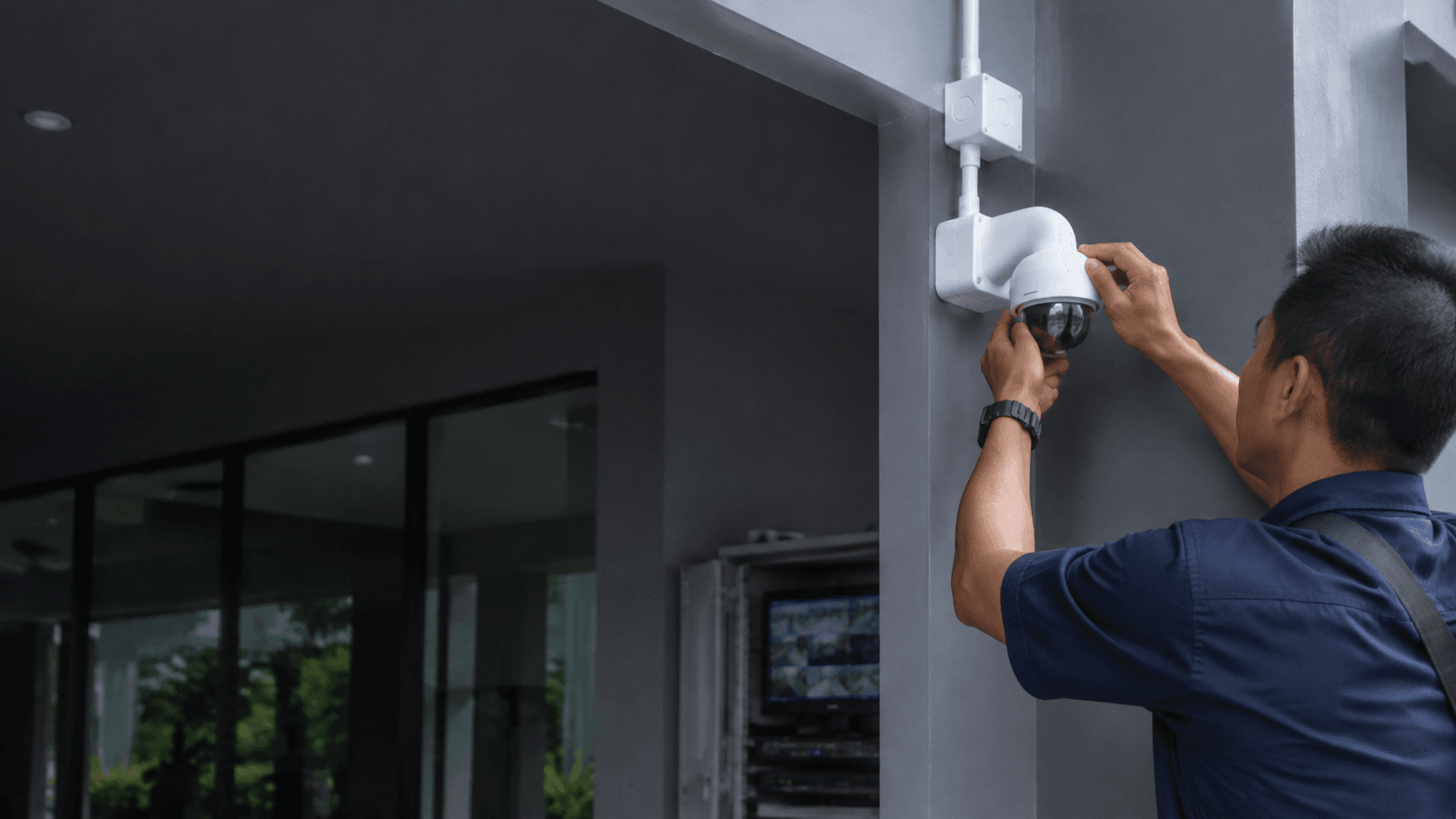
The two names sit at opposite ends of the same market. Toolstation is a trade counter and online retailer; Eyonic is an installation contractor. A buyer comparing them is usually deciding between carrying a box home and paying someone to design, mount and hand over a working system.
- Confirm what the property actually needs watched — entrances, tills, loading bays, corridors or perimeter.
- Check the real lighting at each position, including after dark, before fixing camera placement.
- Decide between self-install retail hardware and a planned installation with survey and handover.
- Match recording, storage and remote viewing to how the footage will be used.
- Agree the handover. who tests the system, who trains the users, and what happens after.
Toolstation Cctv. What the Retail Range Actually Contains
Toolstation sells CCTV through category pages rather than a single product line. The observed range splits into outdoor CCTV cameras, indoor security cameras and dummy CCTV cameras, with IP cameras and smart cameras sitting in separate categories.
Brands named across those pages include TP-Link Tapo, Swann Security, Yale, Blink, Eufy, Ring and Google Nest. Resolution options run from 1080p through 2K to 4K, and power options include battery, mains, 12V and plug-in. Weatherproof ratings such as IP65, IP66 and IP67 appear on outdoor models.
That structure matters because it tells a buyer what kind of purchase this is. The range is broad, the specifications are published on each listing, and the buyer is expected to match the product to the job. Nothing in the category structure suggests design work, cable routing or commissioning.
Dummy Cameras and Deterrence
A dummy CCTV camera can act as a deterrent against unwanted intruders, and Toolstation lists them as a distinct category alongside working cameras. The trade-off is straightforward: a dummy unit costs less and needs no power or recording, but it produces no footage, so it cannot support an investigation or an insurance claim. It suits a site where the visible presence of a camera is the whole objective.
Wireless Kits and Their Limits
Battery and Wi-Fi cameras avoid cable runs, which makes them practical for rented property, temporary sites and awkward corners. The constraints are real. batteries need charging or replacing, Wi-Fi signal has to reach the camera position, and continuous recording drains power far faster than motion-triggered clips. A wireless kit is a good fit for a small number of viewpoints; it is a poor fit for a site that needs many cameras recording without interruption.
Choosing the Right Toolstation Cctv Setup for a Property
The decision usually comes down to three questions: how many viewpoints, how long footage must be kept, and who will maintain the system.
A single entrance or a small shop counter can be covered by one or two cameras with local storage or a cloud plan. A house with a driveway, a side gate and a rear door needs overlapping coverage, which pushes toward a multi-camera kit with a recorder. A commercial site with staff areas, visitor movement and multiple access points needs a planned layout, because camera positions that look adequate on a floor plan often fail once lighting, glare and obstruction are considered.
Eyonic's own guidance on ColorVu-style cameras is to check actual lighting conditions before confirming placement. That advice applies equally to retail hardware: a camera rated for low light still performs differently under a sodium street lamp, an unlit yard or a doorway facing a bright wall.
Where Retail Hardware Fits Well
Retail hardware suits a buyer who is comfortable mounting a camera, running or avoiding cable, configuring an app and managing storage. It also suits small premises where one or two viewpoints cover the risk, and situations where the property cannot be modified.
Where Installation Fits Better
Installation suits multi-camera sites, buildings where cabling must be tidy and concealed, and organisations that need documented handover. Eyonic's CCTV installation process runs through site survey, system proposal, installation and handover, which is the sequence a commercial buyer needs when the system has to keep working after the installer leaves.
Practical Considerations for Buyers
Several constraints decide whether a retail purchase or an installed system is the better route.
Coverage versus count. Two well-placed cameras often beat four badly placed ones. Overlap at entry points matters more than total camera count.
Night performance. Infrared range figures describe ideal conditions. Reflective surfaces, rain and headlights change results, so the position matters as much as the specification.
Storage and retention. Local recording capacity determines how far back footage reaches. A busy site overwrites old clips quickly unless storage is sized for the retention period required.
Remote viewing. App access depends on the recorder or camera staying online, the network remaining stable, and the user account being set up correctly at handover.
Maintenance. Lenses need cleaning, batteries need replacing, and firmware needs updating. A system nobody maintains stops being useful quietly.
What a Planned Installation Includes
Eyonic's service scope covers camera placement, NVR setup and remote viewing, delivered for homes, offices, shops and industrial sites. The Kuching Immigration Office project focused on arrival flow, staff areas, visitor movement and dependable daily operation — the kind of brief where camera positions are chosen around how a building is actually used rather than around a product list.
For a smaller commercial office, the KTA Sarawak Sdn Bhd project addressed staff movement, visitor handling, tidy cabling and clearer daily site control. Both examples point to the same principle: the layout follows the operation.
Budget Expectations
Eyonic's published package pricing starts at RM 1,599 for a Hikvision CCTV package covering camera supply and setup, basic recording configuration and mobile viewing handover. The same figure applies to a Hikvision alarm system package and an autogate package.
Larger commercial work sits well above that. The Kuching Immigration Office project carried an approximate budget of RM 12,000 to RM 28,000, and the KTA Sarawak Sdn Bhd project an approximate budget of RM 8,000 to RM 18,000. Those ranges reflect multi-camera commercial scope rather than a single-camera domestic job.
Making an Informed Choice About
The useful question is not which name is better but which route matches the property. Retail hardware gives control, lower upfront cost and immediate availability. A planned installation gives a surveyed layout, tidy cabling, configured recording and a handover that leaves someone able to use the system.
For a single camera over a doorway, retail is usually enough. For a shop with a till, a stockroom and a rear entrance, or an office with staff and visitor areas, the layout work is where most of the value sits — and that work is not part of a product listing.
Eyonic Sdn Bhd operates as a security system supplier in Sarawak, Malaysia, specialising in CCTV and ELV systems, with founder Eric Yong working in the industry for more than ten years. The company's scope extends beyond cameras to alarm systems, autogate, keyphone intercom and Starlink internet installation, which matters when a site needs several systems to work together rather than one standalone device.
Share the location, property type and required system with Eyonic on WhatsApp at +60 11-5111 7959 for the next practical step.