
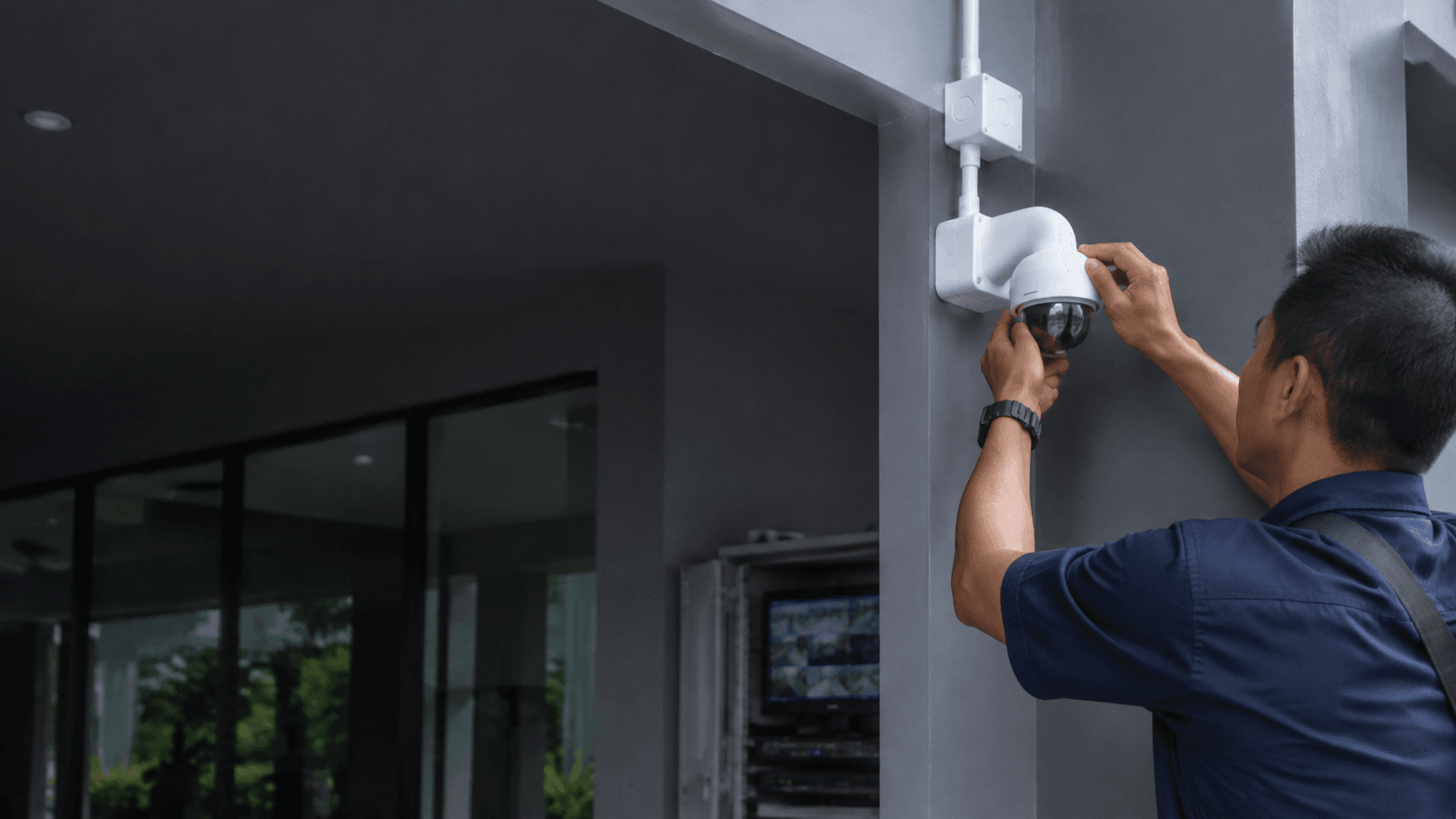
The exact-match term poe kamera is the German and Malay spelling of the same idea, and readers in Malaysia search it when they want a wired camera that draws power from the network rather than from a wall socket. The practical appeal is simple. one cable per camera instead of two, and no electrician needed at the far end of a long run.
Eyonic Sdn Bhd plans, supplies and installs CCTV and ELV systems in Sarawak for homes, offices, shops and industrial sites, and the company's installation process runs from site survey through to handover. That sequence matters more than the hardware label, because a PoE Kamera only performs as well as the cabling route and mounting position chosen for it.
Poe Kamera: What Matters Before You Choose
Power over Ethernet works by injecting direct-current power onto the same twisted-pair conductors that already carry the network signal. The camera separates the two internally, so it needs no local adapter, no plug point and no separate low-voltage cable pulled alongside the data run.
That single-cable design changes the physical planning. A camera can sit under an eave, on a gate pillar or at the far corner of a warehouse where no socket exists, provided the cable route reaches it. The trade-off is that the route itself becomes the constraint: once the cable is pulled and terminated, moving the camera means re-running cable, not just shifting a bracket.
Because power and data share one path, the network side of the system also carries the recording and viewing load. A recorder or switch feeds the cameras, receives their video streams, and stores or forwards the footage. Remote viewing then depends on that same network being reachable from a phone or office workstation.
Why the cable route decides the design
Every PoE Kamera position is really a cabling decision. The installer has to find a path from the recorder or switch to the mounting point that avoids sharp bends, water ingress and long exposed spans, while keeping the run within the limits of the equipment being used.
This is where a site survey earns its place. Walking the property reveals which walls are accessible, where existing conduits can be reused, and which corners have no practical route at all. A position that looks ideal on a floor plan can turn out to be unreachable without drilling through a structural element or running cable across a finished ceiling.
What to check before confirming camera placement
Placement is confirmed on site, not on a catalogue page. Three checks decide whether a position will actually deliver usable footage: what the camera will see, what light will be available at that spot, and whether the cable can reach it cleanly.
- Site survey. Eyonic surveys the property to assess entry points, coverage gaps, cable routes and existing infrastructure before any hardware is proposed.
- System proposal. The survey findings become a proposal covering camera positions, recording and remote viewing, matched to the property type.
- Installation. Cabling, mounting and configuration are carried out, with camera placement and NVR setup handled as part of the same job.
- Handover. The system is tested and explained, including how to view footage remotely.
Eyonic recommends checking actual lighting conditions before confirming placement for ColorVu-style cameras, because a position that looks well lit during a daytime visit can behave very differently after dark. The same logic applies to any camera expected to produce usable images at night: the light present at the mounting point, not the light present at the gate, is what the sensor will work with.
Lighting, angle and obstruction
A camera pointed at a bright doorway from a dark corridor will expose for one and lose the other. A camera mounted too low will catch passing traffic and heads rather than faces. A camera behind a pillar or under a deep awning may be protected from rain but also shaded from the light it needs.
These are physical constraints, not settings. No amount of configuration recovers detail that the lens never captured, which is why placement is confirmed against the real scene rather than assumed from a plan.
Where a wired setup fits in Malaysian properties
A wired PoE Kamera suits properties where cable can be routed and where the camera positions are stable. That covers a broad range of Malaysian buildings, but the fit varies by property type.
Terrace houses and semi-detached homes usually have accessible eaves and gate pillars, and the cable route can often follow existing conduits. Shops and offices benefit because the recorder can sit in a back room or utility area while cameras cover the entrance, counter and stock area. Industrial sites and warehouses tend to have the strongest case of all, because long runs, high mounting points and the absence of convenient power sockets make single-cable cameras genuinely practical.
The weaker fit is a rented property where drilling and permanent cabling are restricted, or a building where the only viable camera position has no route back to the recorder. In those cases the constraint is the building, not the technology.
What a wired system does not solve
PoE does not remove the need for a recorder or storage, and it does not make a camera immune to weather, lightning or power interruption. It also does not guarantee a clear image if the position is wrong.
Where a property has no practical cable route, or where the camera must move frequently, a wired system may be the wrong choice regardless of how well the hardware performs. Recognising that early saves the cost of installing something that cannot be repositioned later.
Planning installation and handover
The gap between a good PoE Kamera system and a disappointing one is usually the planning stage. Hardware selection matters, but camera positions, cable routes and recording configuration decide whether the finished system is actually useful.
Eyonic's work for the Kuching Immigration Office focused on arrival flow, staff areas, visitor movement and dependable daily operation, which illustrates how a public-facing building shapes its own coverage priorities. A similar project for KTA Sarawak Sdn Bhd addressed staff movement, visitor handling, tidy cabling and clearer daily site control for an engineering consultancy office in Kuching.
Both cases point to the same principle: the system is designed around how the building is used, not around a standard camera count. Tidy cabling is part of that, because exposed or poorly routed cable is both a maintenance risk and a sign that the installation was not planned.
What handover should cover
Handover is where the system becomes usable. It should include confirmation that each camera is recording, that footage can be retrieved, and that remote viewing works on the devices the owner actually uses.
It should also cover the practical limits: what the cameras will and will not capture clearly, how to check that recording is still running, and who to contact if a camera drops offline. A system that nobody can operate confidently tends to be treated as unreliable even when it is working correctly.
questions before you commit
Most hesitation around a PoE Kamera comes down to fit rather than features. The useful questions are about the building, the cable route and what happens after installation.
Does a PoE camera need a power point at the camera
No. Power arrives over the same network cable that carries video, so no socket is required at the mounting position. The power source sits at the recorder or switch end of the run.
Can a PoE camera work without internet
Recording and local viewing can continue on the local network without an internet connection. Remote viewing from outside the property does depend on the network being reachable, so internet availability affects off-site access rather than recording itself.
Is PoE better than a wireless camera
Wired cameras avoid the wireless problems that cause most dropouts: weak signal at the camera position, interference and bandwidth contention. The trade-off is that a wired camera cannot be moved without re-running cable, so the position must be right the first time.
What should be ready before an installer visits
A clear idea of what needs to be watched, which areas matter most, and whether the property has existing conduits or cabling that can be reused. Access to ceilings, utility areas and the intended recorder location helps the survey move faster.
For readers in Sarawak weighing up a wired camera system, the practical next step is to share the location, property type and required system with Eyonic on WhatsApp at +60 11-5111 7959, so the survey and proposal can be matched to the actual building rather than to a generic package.