
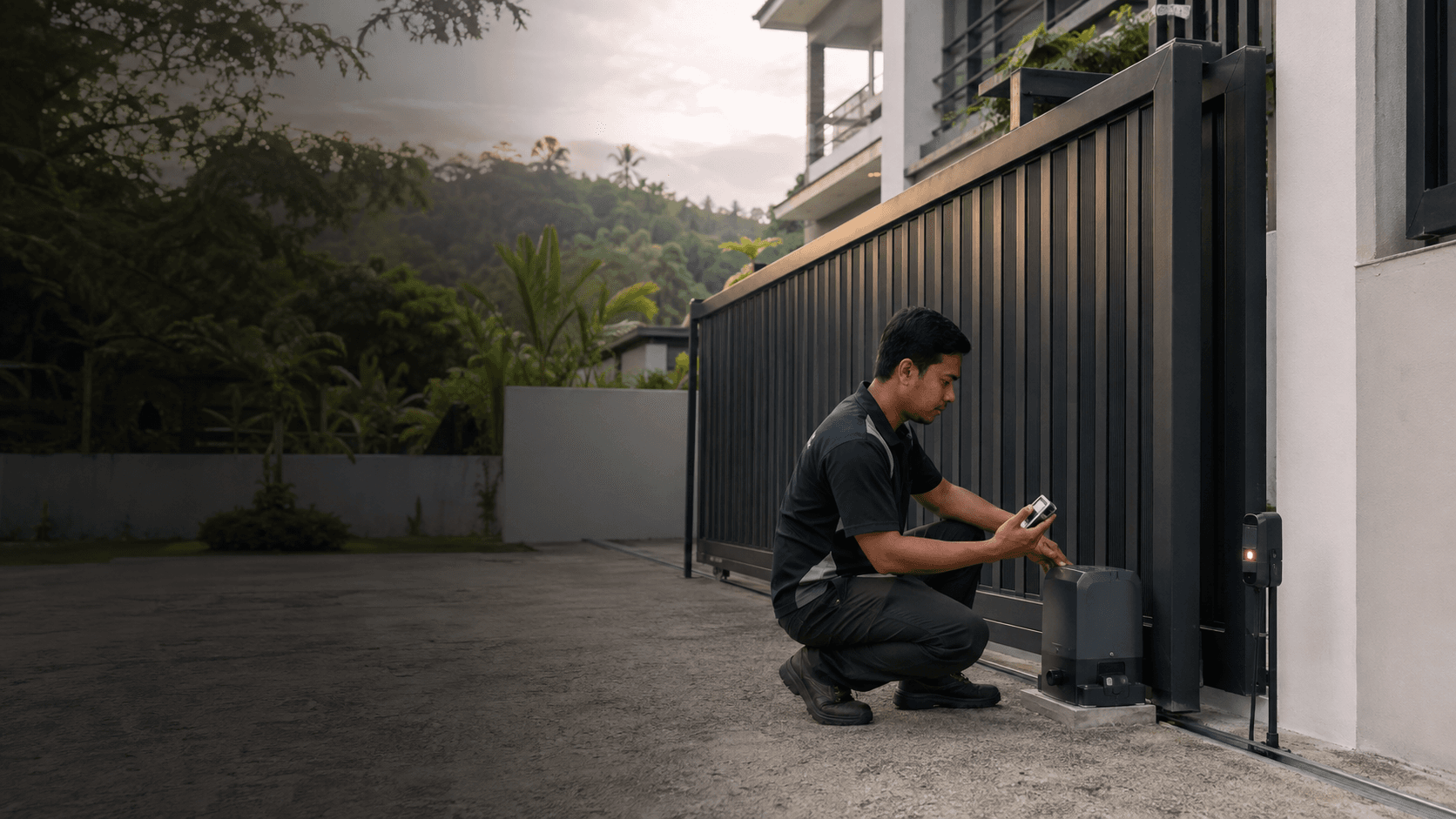
Electric Gate Photocell Installation Basics
Electric gate photocell installation begins with understanding the gate type, the control panel, and the physical layout of the driveway. Swing gates and sliding gates place different demands on sensor positioning, and the control panel determines how many photocell sets the system can accept. A site survey that checks the gate mechanism, cable route, and beam path prevents the most common installation failures.
Eyonic's CCTV installation process follows a sequence of site survey, system proposal, installation, and handover, and the same discipline applies to electric gate photocell installation. Checking the actual conditions before confirming placement matters because sunlight, reflective surfaces, and ground level all affect beam reliability.
Choosing the Right Electric Gate Photocell Installation
Photocells for automatic gates come in two main configurations. Point-to-point systems use a separate transmitter and receiver mounted on opposite sides of the driveway, while reflective systems combine both functions in one unit that bounces the beam off a reflector. The choice between them affects wiring distance, alignment difficulty, and vulnerability to vandalism.
For swing gates, two or three sets of photocells are often required because the gate leaves sweep through a wide arc. Sliding gates typically need one set across the opening plus additional protection at the leading edge. The control panel manual specifies the terminal connections and whether the photocells use normally open or normally closed contacts.
The GTR169 Electric Lock Manual Rev 1 Reflective Photocell represents one documented approach to reflective sensing. Reflective photocells simplify electric gate photocell installation because both the emitter and receiver sit in a single housing, but they demand a clean reflector surface and precise angular alignment.
Point-to-Point Versus Reflective Photocells
Point-to-point photocells handle longer distances and tolerate more environmental interference because the receiver only needs to detect the transmitter's beam. Reflective units work well where running cable across the driveway is impractical, but the reflector must stay clean and the mounting surface must not shift with temperature changes.
What Is Electric Gate Photocell Installation?
Electric gate photocell installation is the process of mounting safety sensors, running their cables to the control panel, and configuring the panel so beam interruption triggers the correct safety response. The photocells act as an obstacle detection layer that complements, rather than replaces, other safety devices such as safety edges and torque limiting.
The infrared beam operates continuously while the gate is active. When a vehicle, pedestrian, or object breaks the beam, the receiver signals the control panel, which stops a closing gate and often reverses it to the open position. This mechanism protects people and vehicles from being trapped or struck by the moving gate leaf.
European safety standards EN 12453 and EN 12445 address the force limits and safety device requirements for automatic gates, and many manufacturers reference these standards in their installation guidance. Compliance typically requires photocells plus additional protection measures rather than photocells alone.
Practical Considerations for Electric Gate Photocell Installation
Mounting height directly affects detection reliability. Photocells mounted too high miss small children and pets, while units mounted at ground level suffer from mud splash, leaf buildup, and accidental damage from vehicles. Most guidance recommends positioning the beam between 400 mm and 600 mm above ground level, though the exact height depends on the gate type and the risk assessment.
Alignment is the most common field problem. Both the transmitter and receiver must share the same horizontal and vertical plane, and the mounting posts must remain rigid. A gate that vibrates during operation can knock the units out of alignment over time, so installers often use adjustable brackets and check the beam after the gate completes several cycles.
Wiring runs from the photocells back to the control panel terminals. The EasyGates CB1 manual documents a simplified wiring diagram for installing one set of photocells, showing the connection points for the transmitter and receiver elements. Following the specific control panel diagram matters because terminal functions vary between manufacturers and models.
Sunlight interference can cause false triggering or missed detections. Direct low-angle sunlight can overwhelm the receiver, while some photocell designs use modulated infrared signals to distinguish the beam from ambient light. Checking the actual lighting conditions before confirming placement is a practice Eyonic applies to camera installations, and the same principle applies to photocell positioning.
Installation Sequence
- Confirm the gate type, control panel model, and required number of photocell sets from the manufacturer documentation.
- Survey the driveway to select mounting positions that keep the beam clear of vehicles, pedestrians, and moving gate parts.
- Mount the transmitter and receiver (or reflective unit and reflector) on rigid posts or walls at the recommended height.
- Run the signal cable from each photocell to the control panel, protecting it from pinching and moisture.
- Connect the wires to the terminals specified in the control panel manual and configure any DIP switches or programming options.
- Test the beam by breaking it while the gate closes, then verify the gate stops and reverses correctly.
Testing should cover the full gate travel cycle, not just a single closing motion. The photocells must respond consistently when the gate is opening, closing, and stationary, and the control panel must prioritize the safety input over normal operating commands.
Common Installation Mistakes
One frequent error is mounting photocells where the gate leaf itself blocks the beam during normal operation, causing the gate to stop unexpectedly. Another is running the photocell cable alongside high-voltage motor cables without separation, which can introduce electrical interference that causes erratic behavior.
Vandalism and accidental damage affect exposed photocell units. Some installations use protective housings or recessed mounting to reduce the risk, while others position the units where vehicles cannot strike them during normal entry and exit. The trade-off between protection and accessibility requires site-specific judgment.
Making an Informed Choice About
Electric gate photocell installation is a safety-critical task that benefits from professional assessment of the gate mechanism, control panel compatibility, and site conditions. The cost of the photocells themselves is modest compared with the cost of correcting a poor installation or addressing a safety incident after the fact.
Eyonic Sdn Bhd operates in Sarawak, Malaysia, supplying and installing security and ELV systems for homes, offices, shops, and industrial sites. The company's project work includes the Kuching Immigration Office, where practical support focused on arrival flow, staff areas, visitor movement, and dependable daily operation, and KTA Sarawak Sdn Bhd, an engineering consultancy site needing tidy cabling and clearer daily site control.
Eric Yong, founder of Eyonic Security Systems, has more than 10 years of industry experience in technical installation of digital security solutions for commercial businesses in Sarawak. That background covers the practical wiring and configuration skills that electric gate photocell installation requires.
Share the location, property type, and required system with Eyonic on WhatsApp at +60 11-5111 7959 for the next practical step. A site survey can confirm whether the existing gate control panel supports additional photocells or whether an upgrade is needed before installation proceeds.