
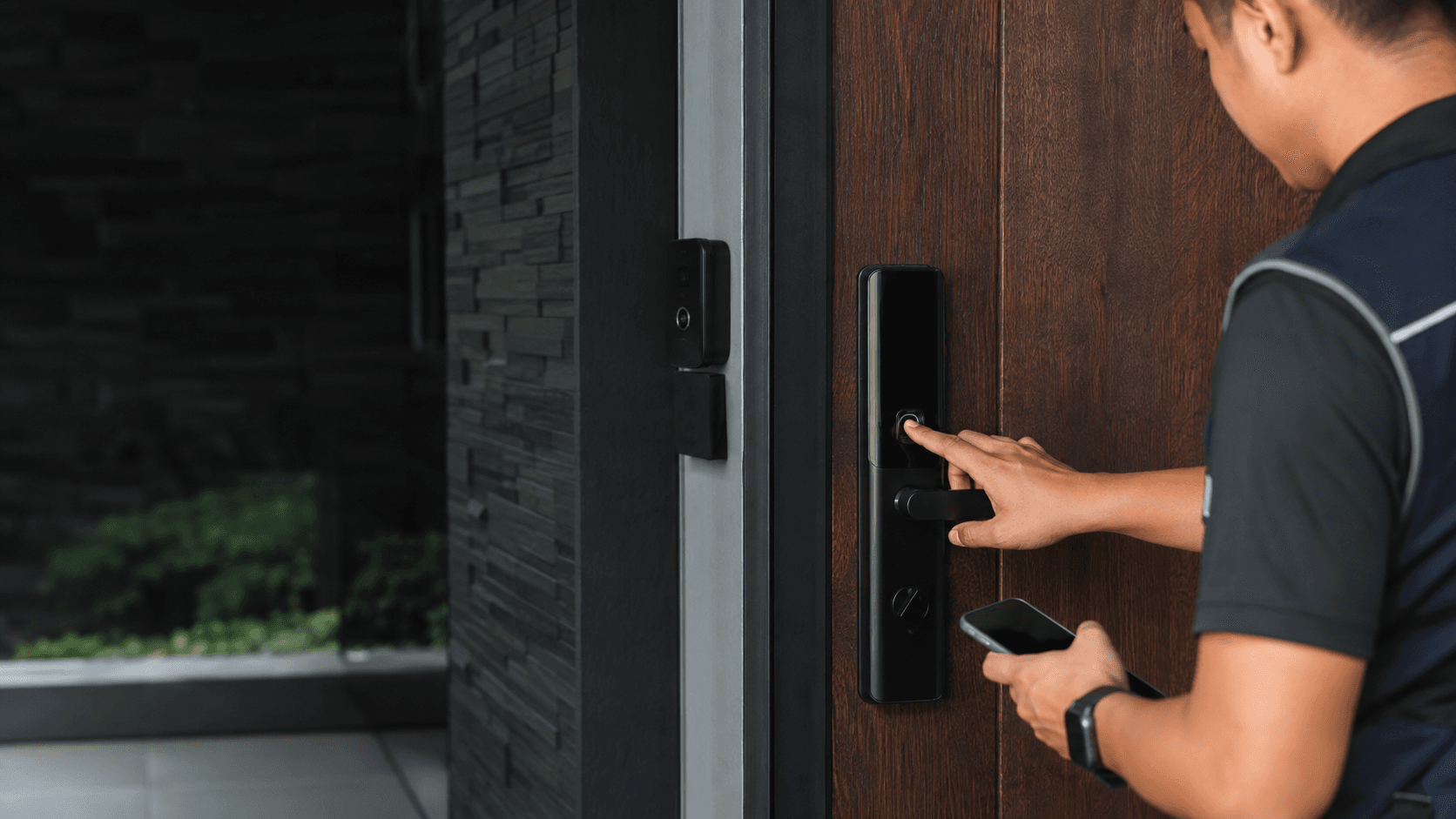
The exact-match query keyless exterior door lock describes hardware that grants entry to an exterior door without a cut key. In Malaysia, that hardware usually sits on a front door, a shop lot entrance, an office door, or a gate-side pedestrian door. The decision is rarely about the lock alone. Door condition, who needs access, and what happens when a battery or network fails decide whether the installation works in daily use.
Eyonic Sdn Bhd is a security system supplier in Sarawak that plans, supplies, and installs CCTV and ELV systems for homes, offices, shops, and industrial sites. Its product review notes that smart locks work best when door condition, user roles, and backup method are reviewed before installation, and that business use usually requires checking whether a standalone smart lock or an access-control panel is more appropriate.
Keyless Exterior Door Lock. What Changes at the Door
A keyless exterior door lock changes the credential, not the door. The door still swings, closes, and needs to latch. What changes is how the bolt retracts: a keypad code, a fingerprint, a card, a fob, or a phone app replaces the physical key.
That shift has three practical effects on an exterior door.
First, entry no longer depends on carrying a key. Staff, family members, and regular visitors can be given a credential that can be removed later without rekeying the door.
Second, the lock becomes a small electronic device on the outside of a building. It faces heat, rain, dust, and humidity. Any exterior installation in Malaysia has to account for that exposure, which is why the review step matters more than the product box.
Third, the lock now has a power source and, in many cases, a network connection. Both can fail. A keyless exterior door lock that has no mechanical or offline fallback turns a flat battery into a locked-out situation.
Eyonic's smart lock review frames the same point directly: smart locks work best when door condition, user roles, and backup method are reviewed before installation. Those three checks come before any model discussion.
Door Condition and User Roles Before Installation
Two questions decide most installations: will the lock physically fit the door, and who is allowed through it.
Door condition covers the door leaf, the frame, and the existing preparation. A door that already has a deadbolt cutout is a different job from a door with no preparation at all. Door material, thickness, and alignment affect whether the bolt lines up cleanly when the door closes. A door that has swollen, dropped, or been repaired may need adjustment before any electronic hardware is fitted, because an electronic bolt has less tolerance for misalignment than a hand-turned key.
User roles cover the people who need entry and how their access should behave. A family home, a shop with rotating staff, and an office with visitors have different requirements. The relevant questions are how many people need credentials, whether access should differ by time of day, and whether credentials need to be removed when someone leaves.
Eyonic's own project work shows why this matters. For the Kuching Immigration Office, the focus was arrival flow, staff areas, visitor movement, and dependable daily operation. For KTA Sarawak Sdn Bhd, an engineering consultancy site, the focus was staff movement, visitor handling, tidy cabling, and clearer daily site control. Both projects treated movement and roles as the design problem, not the hardware list.
Before any keyless exterior door lock is ordered, four checks should be completed in order:
- Inspect the door leaf, frame, and existing preparation to confirm the lock can be fitted and the bolt will align.
- List the user roles, including who needs entry, how often, and whether access should differ by person or by time.
- Agree the backup entry method that works when the battery is flat, the network is down, or the credential fails.
- Decide whether a standalone smart lock is sufficient or whether an access-control panel is needed for the site.
Those four checks are the same ones Eyonic applies in its smart lock review, and they are the reason a site survey comes before a proposal in Eyonic's installation process.
Backup Entry and Daily Reliability
Backup entry is the question readers care about most, and it deserves a direct answer. A keyless exterior door lock should never be the only way through the door.
Every electronic lock depends on something that can fail: a battery, a power supply, a network link, or a credential that has been deleted by mistake. The backup method is what keeps the door usable when that happens. Common approaches include a mechanical key override, an external power point for emergency power, or a second independent entry route.
Daily reliability is a separate concern from failure. A lock that works perfectly but adds three seconds to every entry, every day, will be resented by the people using it. Auto-lock behaviour, how quickly the bolt retracts, and whether the credential is easy to present one-handed all affect whether the installation is accepted.
For exterior doors in Malaysia, exposure is part of reliability. Heat, rain, and humidity act on the lock body, the keypad surface, and the seal around the electronics. The practical response is to keep the lock under cover where possible, to keep the door hardware clean and dry, and to treat the lock as equipment that needs periodic attention rather than a fit-and-forget item.
Eyonic's review of ColorVu-style cameras makes a comparable point about verification: actual conditions should be checked before placement is confirmed. The same principle applies to an exterior lock, where the real door and the real weather decide whether the hardware performs.
Standalone Lock or Access-Control Panel
A standalone smart lock manages its own credentials. It is fitted to one door, holds its own user list, and does not depend on a central system. It suits a single entrance where the number of users is small and access rules are simple.
An access-control panel manages credentials centrally across one or more doors. It suits sites where access needs to be granted, changed, or removed in one place, and where more than one entry point needs consistent rules.
Eyonic's smart lock review states that for business use, the company usually checks whether a standalone smart lock or an access-control panel is more appropriate. That check is not about which product is better. It is about whether the site's user roles can be managed from one door or need a central point.
The trade-off is straightforward. A standalone lock is simpler to install and simpler to run, but each door is managed separately, and removing a person's access means visiting each lock. A panel adds a central point of control and a single place to manage users, but it also adds equipment, cabling, and a dependency on that panel being available.
Edge cases decide the answer more often than the average case. A shop with one entrance and a handful of staff rarely needs a panel. A site with a main door, a staff door, and a delivery entrance usually does, because managing three separate user lists by hand becomes the operational problem.
What to Compare Across Keyless Exterior Door Lock Options
Comparison should follow the site checks, not lead them. Once door condition, user roles, and backup method are settled, the remaining questions are narrower.
Credential type is the first. Keypad codes suit shared entry because a code can be changed without issuing hardware. Cards and fobs suit staff who already carry an access card. Fingerprint entry suits a small number of regular users. App-based entry suits sites where remote management matters, but it introduces a dependency on the phone and the network.
Backup method is the second. A mechanical override, an emergency power point, or a second entry route should be confirmed before purchase, not after the first lockout.
Management method is the third. The question is where credentials live and how they are removed. A lock with no clear way to delete a departed user's access creates a standing risk.
Exposure and maintenance is the fourth. An exterior door in Malaysia sees rain and humidity, so the lock's position relative to the weather, and the ease of cleaning and checking it, belong in the comparison.
Integration is the fifth, and it should be judged against the site rather than against a feature list. If the property already runs CCTV, an alarm system, an autogate, or a keyphone intercom, the lock's role in that wider setup is worth deciding early. Eyonic supplies and installs CCTV, alarm systems, autogates, keyphone intercoms, and Starlink internet, so a lock decision can be made alongside the rest of the property's systems rather than in isolation.
What should not drive the comparison is a specification sheet copied from a manufacturer. The evidence available for this article does not include verified locking mechanisms, ingress protection ratings, battery types, wireless protocols, credential limits, or warranty terms for any specific keyless exterior door lock model. Those details should come from the manufacturer's own documentation for the model under consideration, checked against the actual door.
Planning and Handover for a Keyless Exterior Door Lock
Eyonic's installation process runs through site survey, system proposal, installation, and handover. That sequence applies to a keyless exterior door lock as much as to a camera system, and each stage has a specific output.
The site survey records the door condition, the user roles, and the backup method. The proposal sets out what will be supplied and fitted, and how the lock will be managed. Installation fits the hardware and confirms the bolt aligns and the door closes cleanly. Handover covers the credentials, the backup procedure, and what to do when the lock does not respond.
Handover is where most problems are prevented. The people who use the door daily need to know how to present a credential, how to use the backup method, and who to contact when something fails. That is a short briefing, but skipping it turns a manageable fault into a lockout.
Budget planning should be treated separately from the lock itself. Eyonic publishes package pricing for a Hikvision CCTV package, a Hikvision alarm system, and an autogate package, each at RM 1,599, covering supply, setup, and handover. Completed project budgets have ranged from RM 8,000 to RM 18,000 for an engineering consultancy office setup in Kuching and RM 12,000 to RM 28,000 for public office work. Those figures describe wider security and ELV work, not a keyless exterior door lock on its own, and no verified pricing for keyless lock supply or installation in Malaysia is available here.
For a property in Sarawak that needs a lock decision made alongside CCTV, alarms, an autogate, or an intercom, the practical next step is to share the location, property type, and required system with Eyonic on WhatsApp at +60 11-5111 7959. Eric Yong, the founder of Eyonic Security Systems, has more than ten years in the industry and works on technical installation of digital security solutions for commercial businesses in Sarawak.
The governing standard for this page is SEO Scores Updated August 2026, whose 73 observed factors are directional evidence rather than a guarantee of ranking or inclusion in AI Overviews.