
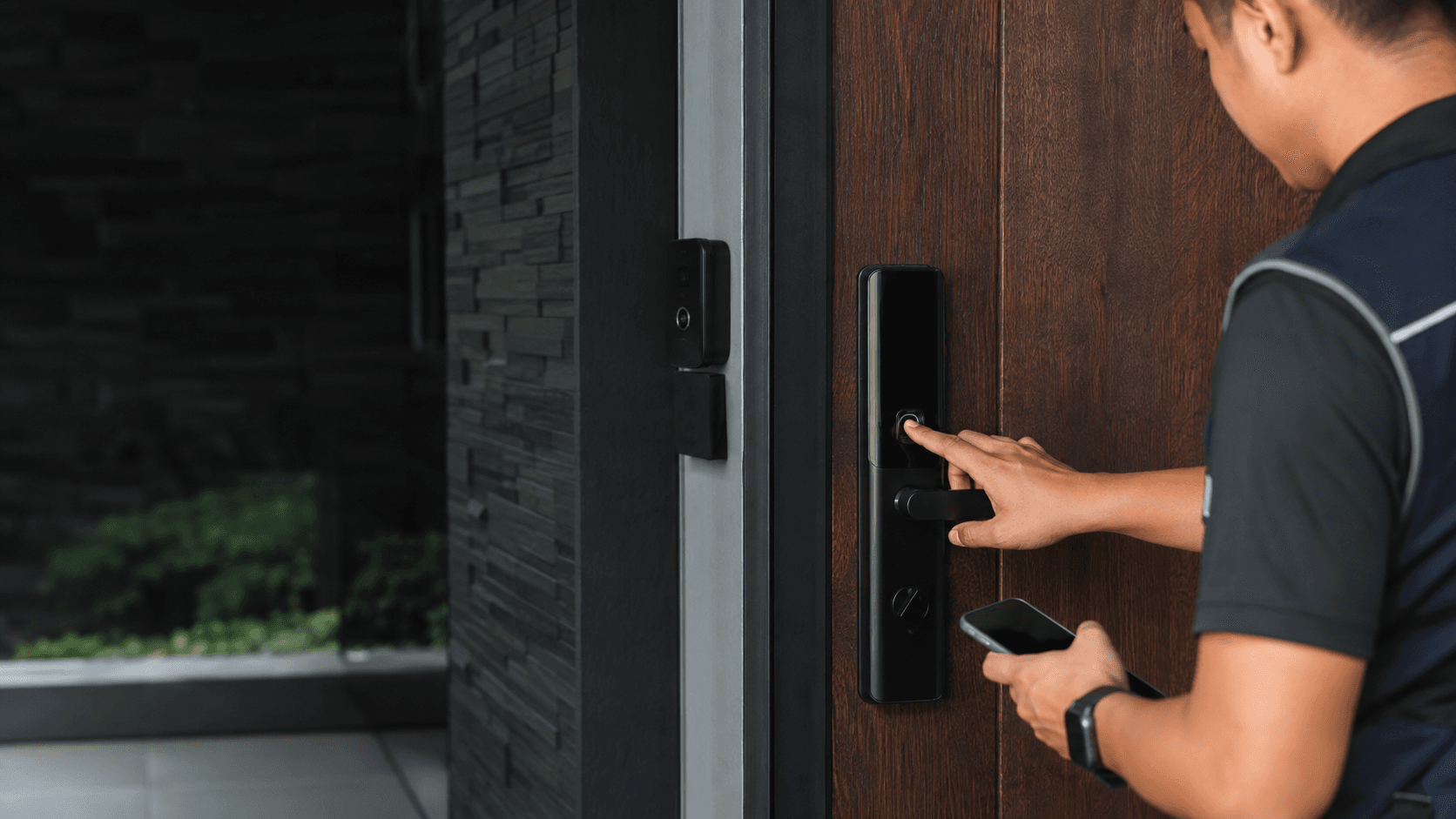
dormakaba builds electronic locking hardware for multifamily housing, offices, hotels, and residential doors, and it publishes companion apps on Google Play and the App Store. The range is broad enough that the practical question is rarely whether a dormakaba smart lock exists, but which series suits a given door, user group, and management routine.
What is dormakaba smart lock?
The phrase covers several distinct product families rather than one device. dormakaba's own product pages group them into electronic locks for multifamily housing, electronic door locks for commercial and enterprise access, and digital door locks aimed at residential and light commercial doors.
On the multifamily side, the published series include Saffire EVO LZ, Saffire LX, Quantum Pixel+, Quantum, and the RT Plus Electronic Lock Series. Credential options listed across those pages include RFID, mobile access, and magstripe, which means the same lock body can often be ordered to read different key types.
On the commercial side, dormakaba lists the E-Plex 2000 Series, the E-Plex 7900 RFID Wireless Lock for Keyscan Aurora integrations, the PowerPlex 2000 Self Powering Lock, and the E-Plex 7900 Series for partner integrations. These are managed locks. access schedules, audit trails, and software integration sit alongside the physical hardware.
On the residential and light commercial side, the digital door lock page lists the DP830/850, Digital Mortise Lock M5/M6, Digital Rim Lock RL599+, IC800, M200, and HP200. These are the models most often described in everyday language as a dormakaba smart lock.
Separately, dormakaba publishes a mobile app under the name dormakaba Smart Lock on both Google Play and the App Store. The app handles remote lock operation, device information, and temporary PIN sharing for visitor access. It is a control layer, not a lock, and it is developed by dormakaba (China) Technologies Ltd.
Choosing the Right Dormakaba Smart Lock
Selection comes down to four variables: the door itself, who needs entry, how access is managed day to day, and what happens when power or connectivity fails. Working through them in order avoids buying a lock that fits the brand but not the doorway.
- Identify the door type and preparation. Mortise, cylindrical, rim, and glass doors take different lock formats, and dormakaba's own product pages note compatibility with common door types rather than universal fit.
- Decide whether the lock stands alone or joins a managed system. Standalone models suit single doors; E-Plex and Saffire series models suit properties where schedules, audit trails, and software integration matter.
- Choose the credential. RFID cards and fobs, mobile credentials, magstripe cards, and PIN codes are all supported across the range, and the choice affects both hardware and how keys get issued.
- Confirm the management software path. Some models integrate with Keyscan Aurora and partner software; others are configured locally or through the dormakaba Smart Lock app.
- Plan the backup entry method before installation, not after. Battery status, mechanical override, and a documented fallback for failed credentials all belong in the plan.
For business premises, the more useful comparison is often between a standalone smart lock and a full access-control panel. A standalone lock is simpler and cheaper to deploy on one door. A panel-based system costs more upfront but centralises permissions, so removing a departed staff member's access is one action rather than a visit to each door.
Dormakaba - Electronic Locks
The electronic locks category is where the multifamily and commercial ranges overlap. dormakaba describes these as proven solutions that are easy to install and compatible with all common door types, with classic and modern design options.
Credential support is the main differentiator within the category. RFID readers, mobile access, and magstripe appear across the published series, and the Saffire EVO line has been positioned around cloud-based access control that can operate without full Wi-Fi coverage. That matters in buildings where running network cable to every door is impractical.
For property managers, the operational value sits in audit trails and access schedules rather than the lock body itself. A lock that records which credential opened which door, and when, changes how incidents are investigated and how access is revoked.
Where the app fits
The dormakaba Smart Lock app is listed on Google Play and the App Store with a shared feature set: remote lock operation, device information management, message browsing, and temporary PIN codes that can be shared with visitors. The App Store listing notes compatibility across iPhone, iPad, iPod touch, Mac, and Apple Vision, and the Google Play listing is published by dormakaba (China) Technologies Ltd.
The app is not a substitute for a managed access platform. It suits households and small sites where a single administrator issues PINs and checks lock activity. Larger sites with rotating staff, multiple doors, and reporting requirements generally need the software layer that the E-Plex and Saffire ranges are built around.
Practical Considerations for Dormakaba Smart Lock
Three constraints decide whether a dormakaba smart lock performs as expected after handover: door condition, user roles, and the backup method. These are the checks that separate a smooth installation from a recurring service call.
Door condition comes first. Alignment, thickness, existing preparation, and whether the door is timber, metal, or glass all affect which model fits. A lock specified for a mortise preparation will not drop into a door cut for a cylindrical latch without additional work.
User roles come second. A household needs one administrator and a handful of PINs. An office needs role-based permissions, time-limited access for contractors, and a clean process for removing access when someone leaves. The hardware may be identical; the management burden is not.
Backup entry comes third. Battery-powered locks need a documented replacement routine, and every deployment needs a mechanical or administrative fallback for the day a credential fails. This is a planning decision, not a product feature.
Connectivity is the fourth consideration and the one most often underestimated. Cloud-managed locks depend on a reliable link to the management platform, and dormakaba has addressed this directly by positioning Saffire EVO around cloud access control that works without full Wi-Fi coverage. Sites with weak coverage should confirm how each model communicates before committing.
What the range does not cover
dormakaba's published catalogue extends well beyond smart locks into safe locks, time recording, entrance systems, interior glass systems, and mechanical key systems. Buyers comparing a dormakaba smart lock against a full security package should treat the lock as one component. Door hardware, access control software, and credential issuance are separate decisions that happen to share a vendor.
Making an Informed Choice About
The range rewards a specification-first approach. Start with the door and the user list, then work back to the model and credential type. Buyers who start with the model name often discover a mismatch at installation.
For sites in Sarawak, local installation support matters as much as the hardware. Eyonic Sdn Bhd plans, supplies, and installs security and ELV systems for homes, offices, shops, and industrial sites, and its published smart lock guidance notes that door condition, user roles, and backup method should be reviewed before installation. For business use, the same guidance recommends checking whether a standalone smart lock or an access-control panel is the better fit.
Eyonic's project record includes the Kuching Immigration Office, where the work focused on arrival flow, staff areas, visitor movement, and dependable daily operation, and KTA Sarawak Sdn Bhd, an engineering consultancy office setup supporting staff movement, visitor handling, and tidy cabling. Both are examples of access and movement planning rather than lock supply alone.
Published package pricing from Eyonic starts at RM 1,599 for a Hikvision CCTV package, RM 1,599 for a Hikvision alarm system, and RM 1,599 for an autogate package, each covering supply, setup, and handover. Smart lock and access-control work is scoped separately because door condition and user count vary so widely between sites.
Share your location, property type and required system with Eyonic on WhatsApp at +60 11-5111 7959 for the next practical step.