
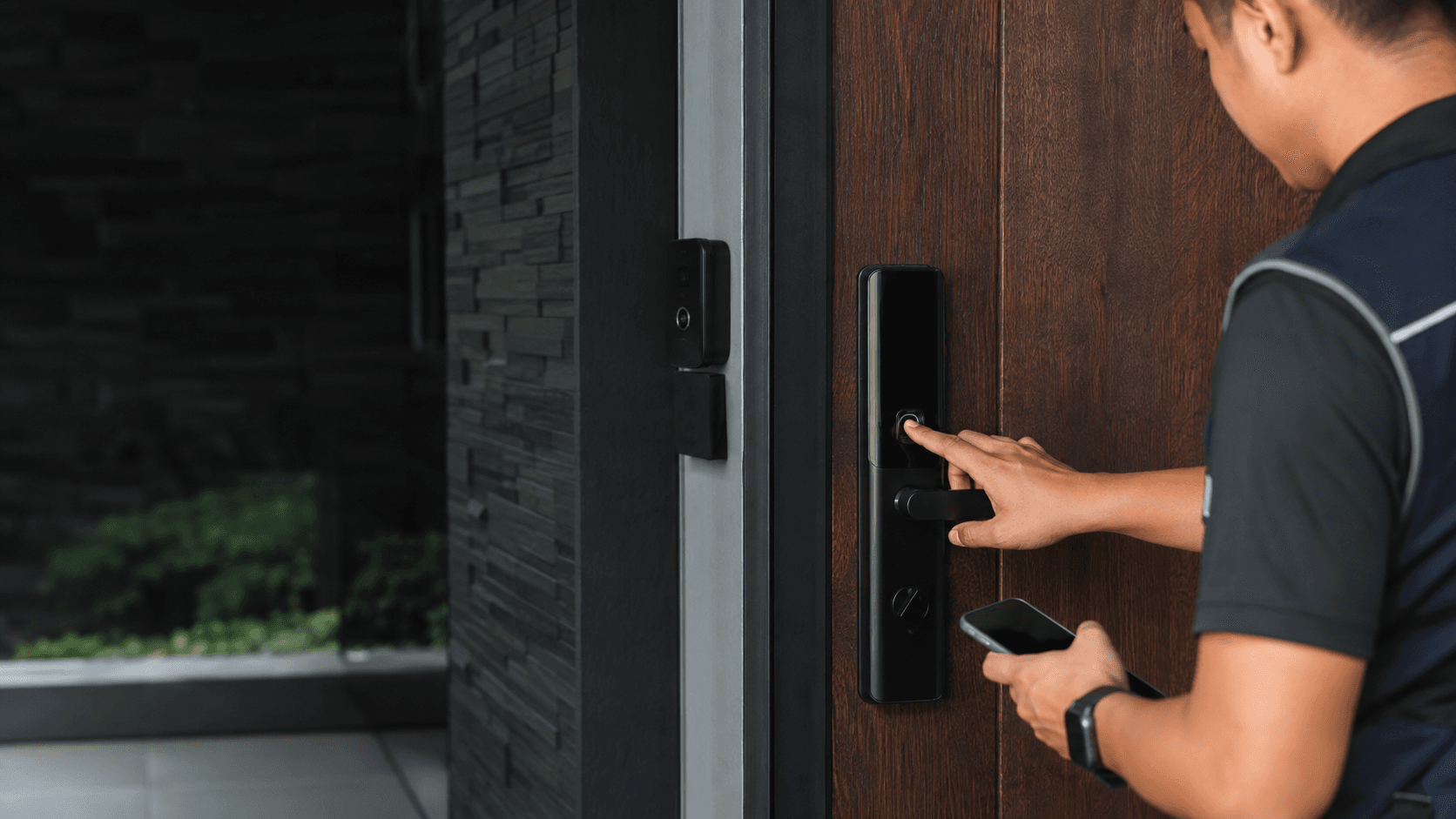
The exact-match query "best keypad locks for home" is a comparison question, but the honest answer depends less on brand rankings than on the door the lock will sit in. A keypad lock is a deadbolt or handle set that opens when a correct code is entered on a pad, with a mechanical key or another fallback for the days the electronics fail. Two things decide whether a given unit suits a house: whether the door and frame accept the hardware, and whether the household has a workable way in when the battery is flat or a code is forgotten.
Eyonic Sdn Bhd, a security system supplier in Sarawak, states that smart locks work best when the door condition, user roles and backup method are reviewed before installation. That order of checking is the spine of this page.
Best Keypad Locks For Home. What Actually Decides The Choice
There is no single best keypad lock for every house, because the lock has to match the door, the household and the fallback plan. A unit that fits a solid timber front door with an existing deadbolt bore may not fit a hollow-core interior door, a narrow aluminium frame, or a gate. The comparison that matters is between lock types and door conditions, not between brand names.
Three questions sort most of the field before any model is considered:
- Confirm the door thickness and the backset, which is the distance from the door edge to the centre of the existing bore.
- Confirm the existing bore and deadbolt position, so the new hardware lines up with the cutout already in the door.
- Confirm whether the door leaf is solid or hollow, because hollow doors and thin frames limit what can be mounted.
- Confirm the closing alignment, since a door that binds or drops will strain a motorised or spring-loaded bolt.
- Confirm the backup entry method, so the household is never locked out by a flat battery or a lost code.
Each of these is a physical measurement or a physical observation. None of them can be answered from a product listing, which is why a shortlist built on model names alone tends to disappoint at the door.
Keypad Entry Compared With A Keyed Deadbolt
A keyed deadbolt has one credential: the key. A keypad lock has at least one code, often several, and usually a key as well. That difference changes daily use more than it changes raw security.
The advantages of keypad entry are practical. Codes can be issued to a household member, a cleaner or a contractor and removed afterwards without rekeying the door. No key needs to be copied or hidden under a pot. Entry and exit can be logged on models that keep an activity history, which is useful when a house has regular visitors.
The trade-offs are equally practical. A code can be shared carelessly, and a simple four-digit code is easier to guess than a cut key. Electronics need power, so a flat battery becomes an access problem rather than an inconvenience. Some units also depend on a phone app or a wireless protocol for their more advanced features, which adds a setup step and a dependency that a plain deadbolt never has.
For a household that wants controlled convenience, the code-based lock wins on daily friction. For a door that is rarely used, or a property where no one wants to manage codes and batteries, a keyed deadbolt remains simpler and has fewer failure points.
Where Keyless Entry Helps Most
Keyless entry pays off where keys are awkward to manage. A rental unit with changing tenants, a home with school-age children who lose keys, a house with a regular cleaner or gardener, and a front door used by several family members all benefit from codes that can be added and removed. The same feature is less valuable on a back door that only one person ever uses.
Door Condition And Door Thickness
Door condition is the most common reason a keypad lock does not fit. The lock body has to pass through the door leaf, and the bolt has to align with a strike plate in the frame. If either side is wrong, the lock will not close cleanly even if it installs.
Door thickness matters because the mounting hardware is sized for a range. A door outside that range may need different fittings or may not accept the lock at all. Backset matters because the bore is already cut; a lock designed for a different backset will not line up with the existing hole. The bore diameter matters for the same reason.
Material matters too. Solid timber doors take a standard cylindrical or mortise preparation well. Hollow-core doors, thin aluminium frames and glass-panel doors often cannot carry the weight or the cutout that a keypad deadbolt needs. A door that has swollen, dropped or been rehung may close with enough resistance to defeat a motorised bolt.
Eyonic's own review of smart lock door access notes that for business use the choice between a standalone smart lock and an access-control panel is worth checking. The same logic applies at home in a milder form: a single front door is a standalone lock decision, while a house with several controlled doors may be better served by a system that manages them together.
User Codes, Guest Access And Backup Entry
User codes are the feature that separates a keypad lock from a keyed one, and the details matter more than the count. A household needs to know how many codes the lock holds, whether codes can be changed without deleting others, and whether a temporary code can be set to expire.
Guest access is the practical test. A cleaner who comes on Tuesdays, a relative staying for a week, and a contractor working on the house all need entry that ends when the arrangement ends. A lock that supports separate codes for each person, and deletion of a single code, handles this cleanly. A lock with one shared code does not.
Backup entry is the part that is easiest to overlook and hardest to live without. The options are a mechanical key, a physical key override, an external power point for a flat battery, or a second entry door. Whichever is chosen, the household needs to know where the backup key is kept and who can reach it. A backup key locked inside the house is not a backup.
Eyonic's stated position is that smart locks work best when user permissions and backup entry are planned properly. That planning is a short conversation about who needs access, for how long, and what happens when the electronics do not cooperate.
Battery, Power And Everyday Reliability
Every keypad lock depends on power, and power is the reliability question. Battery life varies with how often the lock is used, whether it drives a motor, and whether it maintains a wireless connection. A lock on a busy front door will drain faster than one on a side entrance.
What can be checked before buying is the power arrangement rather than a specific figure. A lock that warns before the battery fails is easier to live with than one that does not. A lock with an external power terminal allows a jump start from outside. A lock that keeps its code memory through a battery change avoids reprogramming.
Reliability also depends on the mechanism. A motorised bolt draws more power but needs less physical effort. A manual turn with a keypad release uses less power but requires the user to turn something. Neither is universally better; the choice depends on who uses the door and how often.
For a household in Malaysia, humidity and heat are worth noting as environmental factors that affect any door hardware over time. A lock that binds in a swollen frame will strain its mechanism regardless of how good the electronics are, which is another reason the door check comes first.
. Installation And Handover
Installation is where the earlier checks either pay off or fail. A lock that matches the door thickness, backset and bore goes in with the existing preparation. A lock that does not requires new cutting, a different model, or a different door.
Eyonic's installation process for its security work runs through site survey, system proposal, installation and handover. The same sequence applies to a door lock: the door is measured and checked, the right hardware is proposed, it is fitted, and the household is shown how to use it. Handover is not a formality. It is where codes are set, the backup key is placed, and the battery warning is explained.
For a home with more than one controlled door, or a home that also runs CCTV, an alarm system or an autogate, the lock is one part of a wider access picture. Eyonic's project work for the Kuching Immigration Office focused on arrival flow, staff areas, visitor movement and dependable daily operation, which is the same set of concerns a household has in miniature: who arrives, where they go, and whether the system works every day.
Eyonic's published packages for CCTV, alarm and autogate are each priced at RM 1,599, covering supply, setup and handover. Door lock work is quoted separately because the hardware and the door condition vary.
For a household that wants a practical next step, sharing the location, property type and required system with Eyonic on WhatsApp at +60 11-5111 7959 gives enough to work from.
What To Have Ready Before Asking For A Recommendation
A recommendation is only as good as the information behind it. The useful details are the door thickness, the backset, whether the door is solid or hollow, the number of people who need regular access, and the preferred backup entry method. A photo of the door edge and the existing lock helps confirm the bore and the deadbolt position without a visit.
With those details, the shortlist narrows to locks that fit the door and the household. Without them, any list of best keypad locks for home is a list of locks that fit someone else's door.