
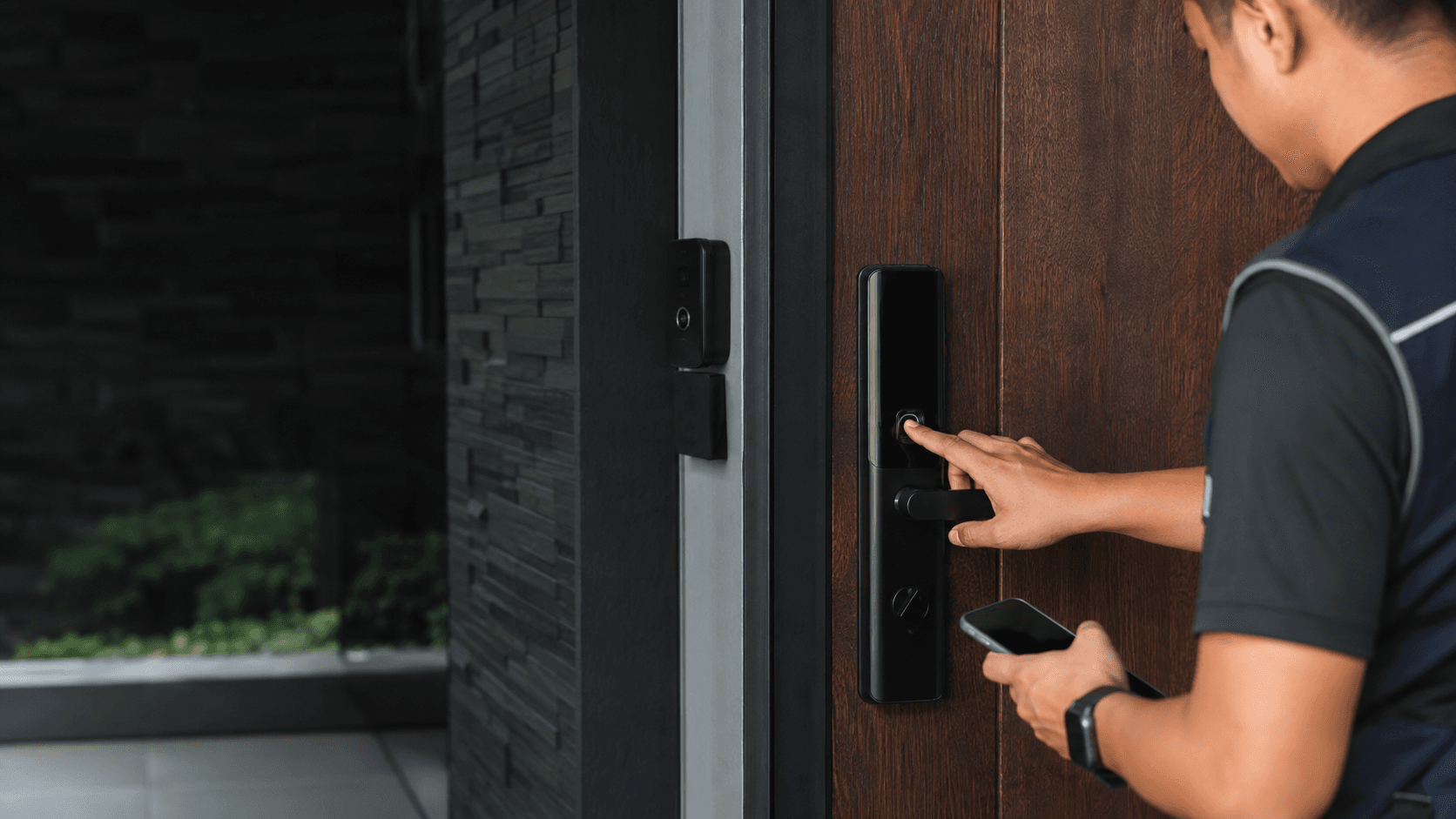
Business owners and facility managers in Malaysia comparing options for offices, shops and controlled-entry sites usually reach the same fork in the road. A standalone lock is quick to plan and simple to run. A panel-based system handles more doors and more complex rules. The right answer depends on the door itself, the people who need to pass through it, and what happens when the network or the power fails.
Eyonic Sdn Bhd is a security system supplier in Sarawak that plans, supplies and installs CCTV and ELV systems, including smart lock door access, for homes, offices, shops and industrial sites. The company's own review guidance states that smart locks work best when the door condition, user roles and backup method are reviewed before installation, and that for business use it usually checks whether a standalone smart lock or an access-control panel is more appropriate.
Commercial Wifi Door Lock. What Businesses in Malaysia Need to Check First
The first check is not the lock. It is the door and the way people use it. A commercial wifi door lock is a networked locking device that grants entry through credentials such as a keypad, card, fob or mobile app, and reports or manages access over a wireless connection. That description covers a wide range of hardware, and the hardware only performs well when it matches the opening it is fitted to.
Three site conditions decide most of the outcome:
- Site survey — the door, frame, traffic pattern and existing cabling are inspected on site.
- System proposal — the recommended lock or panel arrangement is set out before any commitment.
- Installation — hardware is fitted and configured for the agreed user roles.
- Handover — credentials, permissions and backup entry are tested and explained.
That sequence is the same one Eyonic follows for its installation work in Sarawak, where site survey, system proposal, installation and handover form the standard path from enquiry to a working system.
Door condition decides whether a lock can be fitted at all
Glass doors, thin aluminium frames, fire-rated doors, roller shutters and solid timber doors each present different fixing and alignment problems. A lock that fits a timber office door may not fit a frameless glass entrance without additional hardware. Door condition also covers the state of the existing lock case, the frame's squareness, and whether the door closes cleanly under its own weight. A door that drags or sits out of alignment will wear out any electronic locking mechanism faster than a door that closes true.
This is why a site survey matters more than a product comparison. Two offices on the same street can need different hardware because one has a steel-framed entrance and the other has a glass shopfront.
User roles shape how many credentials and rules are needed
A small office with five staff and one entrance has simple needs. A shop with shift changes, a warehouse with delivery access, or a controlled-entry site with visitors and contractors has layered needs. User roles determine how many separate credentials must be issued, whether access should differ by time of day, and whether entry events need to be reviewed later.
Where roles stay simple, a standalone lock usually carries the load. Where roles multiply, or where several doors must follow one rule set, an access-control panel becomes the more practical structure.
Standalone Lock or Access-Control Panel: A Commercial Wifi Door Lock Decision
The decision between a standalone lock and a panel comes down to scale and control. A standalone commercial wifi door lock manages one door with its own credentials and its own app or keypad programming. An access-control panel manages multiple doors, readers and rules from one system, and typically requires more cabling, more planning and a larger budget.
Eyonic's own guidance frames this as a business-use question rather than a product question: for business use, the company usually checks whether a standalone smart lock or an access-control panel is more appropriate. That check happens before hardware is proposed, because the two routes lead to different installation scopes.
When a standalone lock is the better fit
A single controlled entrance, a modest number of regular users, and no requirement to coordinate several doors point toward a standalone lock. The advantages are a shorter installation, fewer components to maintain, and a simpler handover for staff who need to use it daily. The trade-off is that growth is limited. Adding a second and third door later means adding separate locks rather than extending one system.
When a panel is the better fit
Multiple doors, mixed user groups, visitor handling, or a need to review who entered where and when point toward a panel-based access-control system. The advantages are central management and consistent rules across doors. The trade-offs are higher cost, more cabling and a longer installation, plus a greater dependence on the panel and its power and network arrangements.
Neither route is universally correct. The wrong choice in either direction shows up later as either an under-powered system that cannot grow, or an over-built system with complexity the site never uses.
Planning Backup Entry and Permissions for a
Backup entry is the part most often skipped and the part that causes the most disruption when it is needed. If the network drops, the power fails, or a credential stops working, staff still need a way in. Eyonic's review guidance lists the backup method alongside door condition and user roles as one of the three things to review before installation, which places it in the planning stage rather than the afterthought stage.
Permissions deserve the same treatment. Every credential issued is a decision about who can enter, when, and through which door. Staff who leave, contractors who finish a job, and temporary users who no longer need access all represent permissions that must be removed. A system that makes removal difficult will accumulate stale access over time.
Questions worth settling before installation
Who holds the highest level of access, and how is that access transferred if that person is unavailable? Which doors need to open outside normal business hours, and who decides that? What is the process for issuing a credential to a new staff member on their first day? What happens to credentials when someone leaves? These are operational questions, and their answers determine how the lock or panel should be configured at handover.
Edge cases that change the plan
A door that must remain unlocked during trading hours but locked overnight needs a schedule, not just a credential. A door used by delivery drivers needs a method that does not require issuing permanent access. A site with unreliable power needs a backup arrangement that does not depend on the mains. Each of these shifts the plan, and each is easier to handle during the survey than after installation.
Installation Sequence Eyonic Follows for Access and Security Systems
Eyonic's installation work follows a defined sequence that begins before any hardware is chosen. The same sequence applies to access and security systems, and it exists to prevent the common failure where hardware is selected before the site is understood.
The survey establishes the door condition, the traffic pattern and the existing infrastructure. The proposal sets out what will be supplied and installed, so the scope is clear before work begins. Installation fits and configures the hardware. Handover covers credentials, permissions and backup entry, and confirms the system works as intended for the people who will use it.
Eyonic has completed projects for government and engineering consultancy clients in Sarawak. The Kuching Immigration Office project provided practical support for a public office focused on arrival flow, staff areas, visitor movement and dependable daily operation. The KTA Sarawak Sdn Bhd project provided a practical office setup in Kuching to support staff movement, visitor handling, tidy cabling and clearer daily site control. Both projects share the same concerns that shape access planning: how people arrive, how they move through the space, and how the site operates reliably every day.
Those projects are described in general access and office-setup terms rather than as lock installations, so they illustrate the planning approach rather than a specific commercial wifi door lock deployment.
Practical Next Step for a Enquiry
The most useful starting point is a clear description of the site. Location, property type and the system required give enough to work from, and a site survey then confirms what the door and the user mix actually need. Eyonic can be reached on WhatsApp at +60 11-5111 7959 with those details.
For businesses in Kuching and across Sarawak, the practical path is to settle the door condition, the user roles and the backup entry method first. Those three answers determine whether a standalone commercial wifi door lock is sufficient or whether an access-control panel is the more appropriate route, and they prevent the more expensive mistake of installing hardware that does not match the way the site actually operates.