
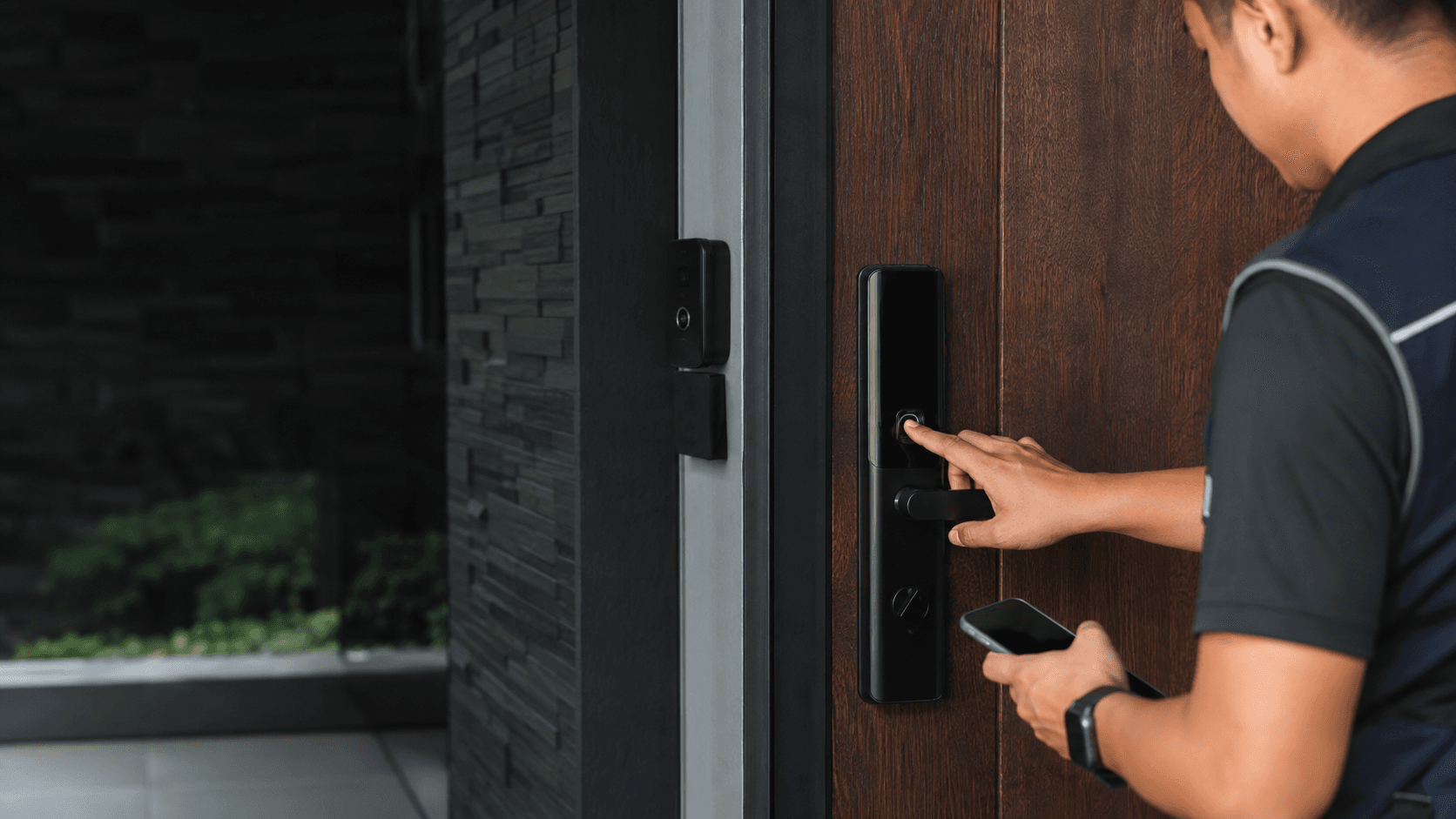
The exact-match query "best keypad lock" is a comparison phrase, and the honest answer in Malaysia is that no single model wins everywhere. What separates a sound choice from a poor one is fit: the door, the power arrangement, the number of people who need entry, and the backup route when the electronics fail. Eyonic's own review guidance puts it plainly — smart locks work best when the door condition, user roles and backup method are reviewed before installation, and for business use the choice between a standalone smart lock and an access-control panel is worth checking first.
Best Keypad Lock: What Matters Before You Choose
A keypad lock changes who can enter and how that entry is recorded. A keyed lock gives every holder the same mechanical secret, and that secret cannot be withdrawn without rekeying or replacing the cylinder. A code-based lock separates users: each person can hold a different code, and a code can be removed when someone leaves a household, a shop, or an office.
The trade-off is dependency. A mechanical lock fails only when its parts fail. A keypad lock also depends on power, on the electronics surviving humidity and heat, and on the code being remembered or stored somewhere sensible. That is why backup entry is not an optional extra in the buying decision — it is part of the lock's basic design.
Eyonic's product review notes describe smart lock door access as good for controlled convenience when user permissions and backup entry are planned properly. That phrasing matters. Convenience is the benefit; permissions and backup are the conditions that make the benefit safe.
Keypad Lock Formats. Deadbolt, Lever, and Knob
Format decides whether the lock fits the existing door preparation or forces new work. Three formats cover most residential and light commercial doors.
A keypad deadbolt replaces the deadbolt above the handle. The handle stays as it is, and the code controls the bolt. This suits doors that already have a separate deadbolt and a passage handle, and it keeps the locking function independent of the latch.
A keypad lever combines the code pad and the latch in one unit, so the handle itself carries the electronics. This suits doors where a single unit is preferred, and it is common on office and shop doors where staff pass through frequently.
A keypad knob follows the same idea in a round format. Knob formats are less common on newer doors, and the shape can matter for grip and for how the pad is angled toward the user.
Format also interacts with door handing and with the bore size already cut into the door. A lock that does not match the existing preparation means additional drilling, patching, or a different door altogether. Checking the existing hardware before choosing a format avoids that.
Standalone or Panel-Controlled
For a single door with a handful of users, a standalone keypad lock is usually the simpler answer. For a site with several doors, staff turnover, or a need to review who entered and when, a panel-based access-control arrangement is the more appropriate structure. Eyonic's review guidance flags exactly this fork for business use, and it is worth resolving before any model is chosen.
Power, Codes, and Backup Entry
Power and codes are the two operational realities of any keypad lock, and both need a decision before purchase rather than after installation.
Most keypad locks run on batteries, which means battery access has to be reachable from outside the secured side, and the low-battery warning has to be noticeable rather than buried in an app. A lock that only warns inside the property is a lock that can strand the people outside it.
Codes need a plan as well. A household may need two or three codes. A shop may need one for opening staff, one for closing staff, and a temporary code for a contractor. A small office may need a code per department plus a way to remove a code the same day someone leaves. The number of user codes a lock supports, and how easily codes are added and deleted, is a practical filter that narrows the field quickly.
Backup entry is the third leg. A mechanical key override, a physical key cylinder, or a documented secondary entry route keeps the door usable when the electronics do not cooperate. The backup method should be stored somewhere that is not inside the property the lock protects.
Door Condition and Fit Before Purchase
Door condition is the most common reason a keypad lock underperforms after installation, and it is the cheapest thing to check beforehand. Eyonic's review guidance places door condition first among the things to review, ahead of user roles and backup method.
Warped frames, swollen timber, misaligned strike plates, and doors that need a shoulder to close will fight any electronic lock. The lock may be blamed for a problem that belongs to the door. Thickness, bore diameter, backset, and the distance between the deadbolt and the handle all determine which formats are even possible.
Exterior doors in Malaysia also face heat, humidity, and direct rain on exposed faces. Placement matters. a covered entrance and an exposed gate present different conditions for the same lock. The same logic Eyonic applies to camera placement — checking actual conditions on site before confirming a position — applies to door hardware, where sun and rain exposure vary from one doorway to the next.
Checks to Run Before Buying a Keypad Lock
- Measure the door thickness and confirm the bore diameter and backset match the lock's requirements.
- Confirm the format — deadbolt, lever, or knob — matches the existing hardware and door preparation.
- Confirm the power source, where the batteries sit, and whether the low-battery warning is visible from outside.
- Count the user codes needed now and in a year, and check how codes are added and removed.
- Confirm the backup entry method and store the backup key or credential away from the protected space.
- Confirm who will install the lock and who will hand over the codes, the app, and the backup method.
Supply and Installation in Sarawak
In Sarawak, the practical question is often less about which model and more about who supplies, fits, and hands over the lock. Eyonic Sdn Bhd is a security system supplier based in Sarawak that plans, supplies, and installs ELV and security systems for homes, offices, shops, and industrial sites, with smart lock door access listed among its product areas.
Eyonic's installation process runs through site survey, system proposal, installation, and handover. That sequence suits door hardware well, because the survey is where door condition, format, and user roles get resolved, and the handover is where codes, app access, and the backup method are transferred to the people who will actually use them.
The company's project record includes the Kuching Immigration Office, where the work focused on arrival flow, staff areas, visitor movement, and dependable daily operation, and KTA Sarawak Sdn Bhd, an engineering consultancy office in Kuching where the setup supported staff movement, visitor handling, tidy cabling, and clearer daily site control. Both are access-and-movement problems rather than lock-model problems, which is the right way to frame a keypad lock decision on a working site.
Eric Yong, founder of Eyonic Security Systems, has worked in the industry for more than 10 years, with experience in technical installation of digital security solutions for commercial businesses in Sarawak.
What the Evidence Does Not Settle
No verified technical specifications, security grades, battery life figures, or model-level performance data for any keypad lock are available here, and no verified pricing for keypad lock models or installation in Malaysia is supplied. That means any claim that one specific model is objectively the best keypad lock is not supported. The comparison that can be made honestly is between formats, power arrangements, code capacity, backup methods, and door fit — the factors that decide whether a lock works in a particular doorway.
For a reader comparing options in Malaysia, the useful shortlist is not a list of model names. It is a list of doors, each matched to a format, a power plan, a code plan, and a backup route, with an installer who has seen the door before the order is placed.
Share your location, property type and required system with Eyonic on WhatsApp at +60 11-5111 7959 for the next practical step.