
The exact-match query cctv 16 channel describes a recorder with sixteen camera inputs. That number is a capacity ceiling, not a promise that sixteen cameras will be fitted. The practical question is how many cameras the site actually needs, and whether the recorder, storage and cabling can carry them.
Eyonic Sdn Bhd is a security system supplier in Sarawak, Malaysia, working on CCTV and ELV systems. Its published service scope covers planning, supply and installation, with camera placement, recording and remote viewing. The company has completed work for government and engineering consultancy clients, including the Kuching Immigration Office.
What a cctv 16 channel recorder covers
A sixteen-channel recorder accepts video from up to sixteen cameras and writes it to local storage. The channel count sets the ceiling on how many camera feeds the device can record at once. It does not set image quality, retention length or how well the site is covered.
Coverage comes from camera placement, not from the recorder. A site with sixteen cameras pointed at the same corridor records that corridor sixteen times. A site with eight cameras placed at entrances, cash points, store rooms and perimeter gates usually produces more useful footage than a larger count aimed badly.
Eyonic's service scope lists camera placement as a distinct step alongside recording and remote viewing. That ordering matters. Placement decisions determine what the recorder is worth.
When sixteen channels fits, and when it does not
Sixteen channels suits sites with several distinct zones: a shop with a front counter, stockroom, side entrance and rear loading area; an office with a lobby, staff floor, server room and car park; a small industrial site with a gate, yard, workshop and store. Each zone may need more than one camera to cover angles and blind spots.
Smaller premises often need fewer. A single shop lot with one entrance and one counter may be served by a handful of cameras, and a sixteen-channel recorder would leave most inputs unused. That is not a fault, but it is money spent on capacity the site does not use.
Larger sites may need more than sixteen. Multi-block compounds, long perimeter walls and sites with separate buildings can exceed the channel count, which means either a second recorder or a move to a different recording architecture. The channel count should follow the camera schedule, not the other way round.
Camera formats and recorder compatibility
Camera format is the first thing to confirm before buying a recorder. Analog and HD-over-coax cameras connect over coaxial cable, while IP cameras connect over network cable. A recorder built for one family of cameras will not accept the other without the right support.
Published competitor material in this category repeatedly raises format verification as a buyer concern, listing analog, HD-over-coax and IP camera types as the formats that must be matched to the recorder. That is a structural signal about what buyers check, not a statement about any specific Eyonic product.
Eyonic supplies Hikvision cameras. Where a site already has cameras installed, the existing camera type and condition should be established before a recorder is chosen, because a mismatch means replacing cameras as well as the recorder.
What to confirm before purchase
Confirm the camera type already on site, or the type being specified for the new system. Confirm whether the recorder accepts that type directly or through an adapter. Confirm the cabling already in the walls, since coaxial and network cable are not interchangeable. Confirm whether the recorder can be expanded later if the site grows.
These checks are cheap before purchase and expensive after. A recorder that cannot accept the cameras on site is a return, not an installation.
Storage, retention and remote viewing
Storage determines how far back recorded footage reaches. Retention length depends on how many cameras record, how much movement each camera sees, and the recording mode in use. Continuous recording fills storage faster than recording triggered by motion.
No single retention figure applies to every site. A quiet store room and a busy front entrance generate very different volumes of recorded activity, even on the same recorder. The honest approach is to decide the retention period the site needs first, then size storage to match, rather than buying a fixed drive and discovering the retention window afterwards.
Remote viewing lets footage and live feeds be checked from a phone or computer away from the site. It depends on the recorder's network configuration and on internet service at the premises. Where internet is unreliable, remote viewing will be unreliable too, regardless of the recorder.
Eyonic lists NVR setup and remote viewing within its CCTV service scope, which places both inside the installation rather than leaving them to the buyer.
Lighting conditions change camera choice
Lighting is a placement constraint that is often missed. Eyonic's published guidance on ColorVu-style cameras recommends checking actual lighting conditions before confirming placement. A camera specified for low-light colour performance is wasted in a position that is already well lit, and a standard camera in a genuinely dark corner will not deliver usable footage.
This is why a survey matters more than a product list. The same camera performs differently at a covered walkway, an open car park and an indoor corridor.
Site survey and installation sequence
Eyonic's published CCTV installation process runs through four stages. The sequence matters because each stage depends on the one before it.
- Site survey — the premises are reviewed to establish camera positions, cabling routes and existing infrastructure.
- System proposal — the survey findings are turned into a proposed system covering cameras, recorder, storage and viewing.
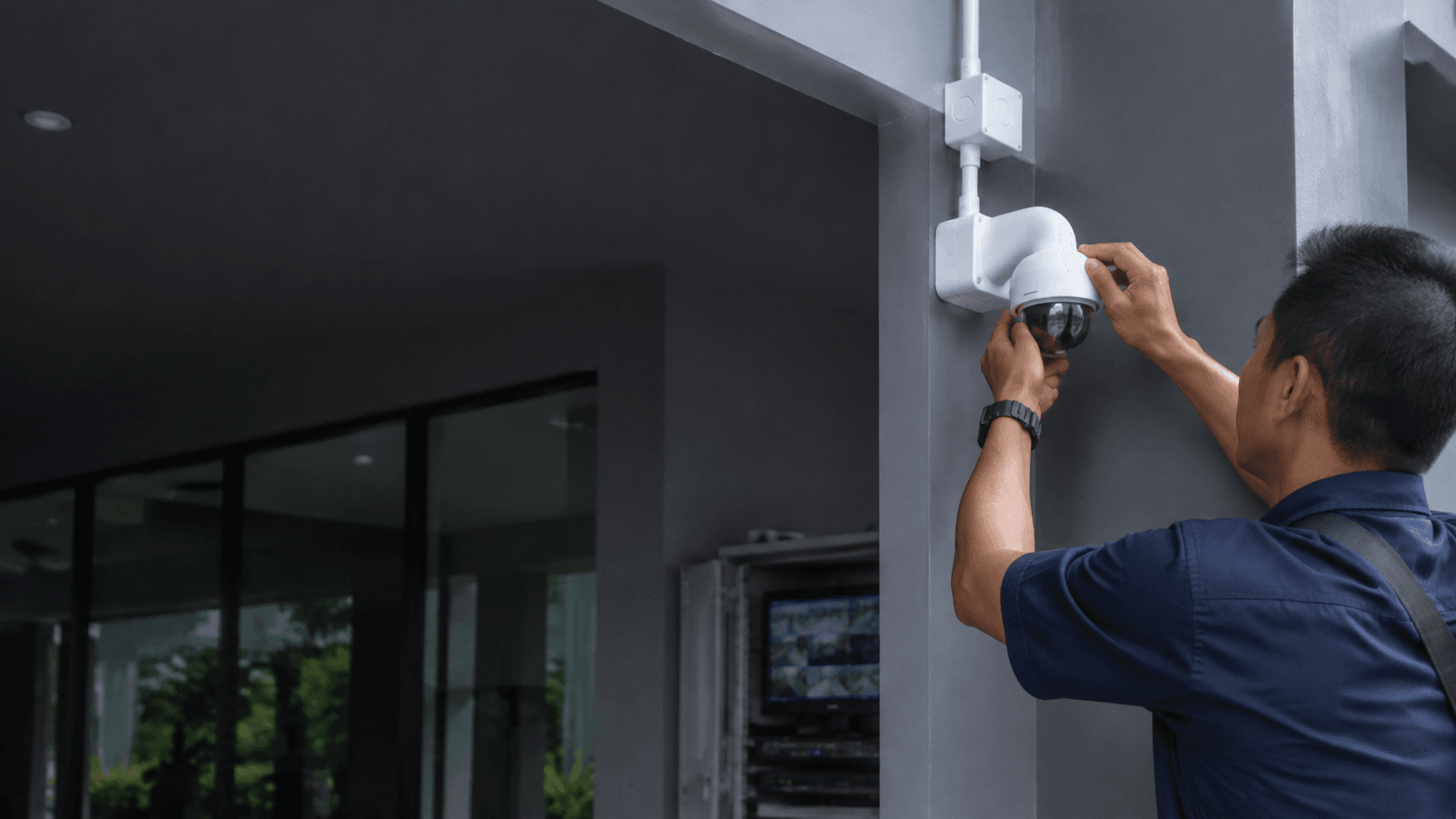
- Installation — cameras, recorder and cabling are fitted and configured on site.
- Handover — the completed system is explained and passed to the user, including mobile viewing.
The survey stage is where channel count gets settled. Walking the site shows how many distinct views are needed, where cable can run, and which positions are blocked by walls, signage or shelving. A channel count decided before the survey is a guess.
The proposal stage is where the buyer sees the trade-offs in writing: how many cameras, which positions, what storage, and what the system will and will not cover. Installation and handover follow once that is agreed.
What the survey should establish
The survey should identify entry and exit points, high-value areas, blind spots and existing cable routes. It should also record lighting at each proposed position and note where power is available. For sites with existing cameras, it should record what is already installed and whether it can be reused.
Eyonic's completed work for the Kuching Immigration Office focused on arrival flow, staff areas, visitor movement and dependable daily operation. That is the kind of brief a survey turns into camera positions: movement routes first, then the areas that need continuous coverage.
Working with Eyonic in Sarawak
Eyonic Sdn Bhd operates from Sarawak and works on CCTV and ELV systems for homes, offices, shops and industrial sites. The founder, Eric Yong, has more than ten years in the industry and works on technical installation of digital security solutions for commercial businesses in Sarawak.
Completed projects include the Kuching Immigration Office and KTA Sarawak Sdn Bhd, an engineering consultancy office in Kuching where the brief covered staff movement, visitor handling, tidy cabling and clearer daily site control. Both are office environments where camera placement follows how people actually move through the building.
Eyonic's published package pricing starts at RM 1,599 for a Hikvision CCTV package covering camera supply and setup, basic recording configuration and mobile viewing handover. That package is not a sixteen-channel specification, and no sixteen-channel package price is published. Sites needing sixteen channels should expect a scope and figure based on the survey rather than a listed package.
For a site in Sarawak, the practical next step is to share the location, property type and required system with Eyonic on WhatsApp at +60 11-5111 7959.
Questions buyers ask before committing
Does a sixteen-channel recorder need sixteen cameras? No. The recorder accepts up to sixteen camera feeds. Fewer cameras can be connected, leaving inputs free for later expansion.
Can existing cameras be reused? Only if their format matches what the recorder accepts. This is established during the survey, before a recorder is chosen.
How long is footage kept? Retention depends on camera count, activity levels and recording mode, so it is sized to the site rather than fixed in advance.
Can footage be viewed away from the site? Remote viewing is part of Eyonic's CCTV service scope and is handed over at completion. It relies on the recorder's network setup and internet service at the premises.
What does a sixteen-channel system cost? No sixteen-channel package price is published. Cost follows the survey, because camera count, positions, cabling and storage all vary by site.