
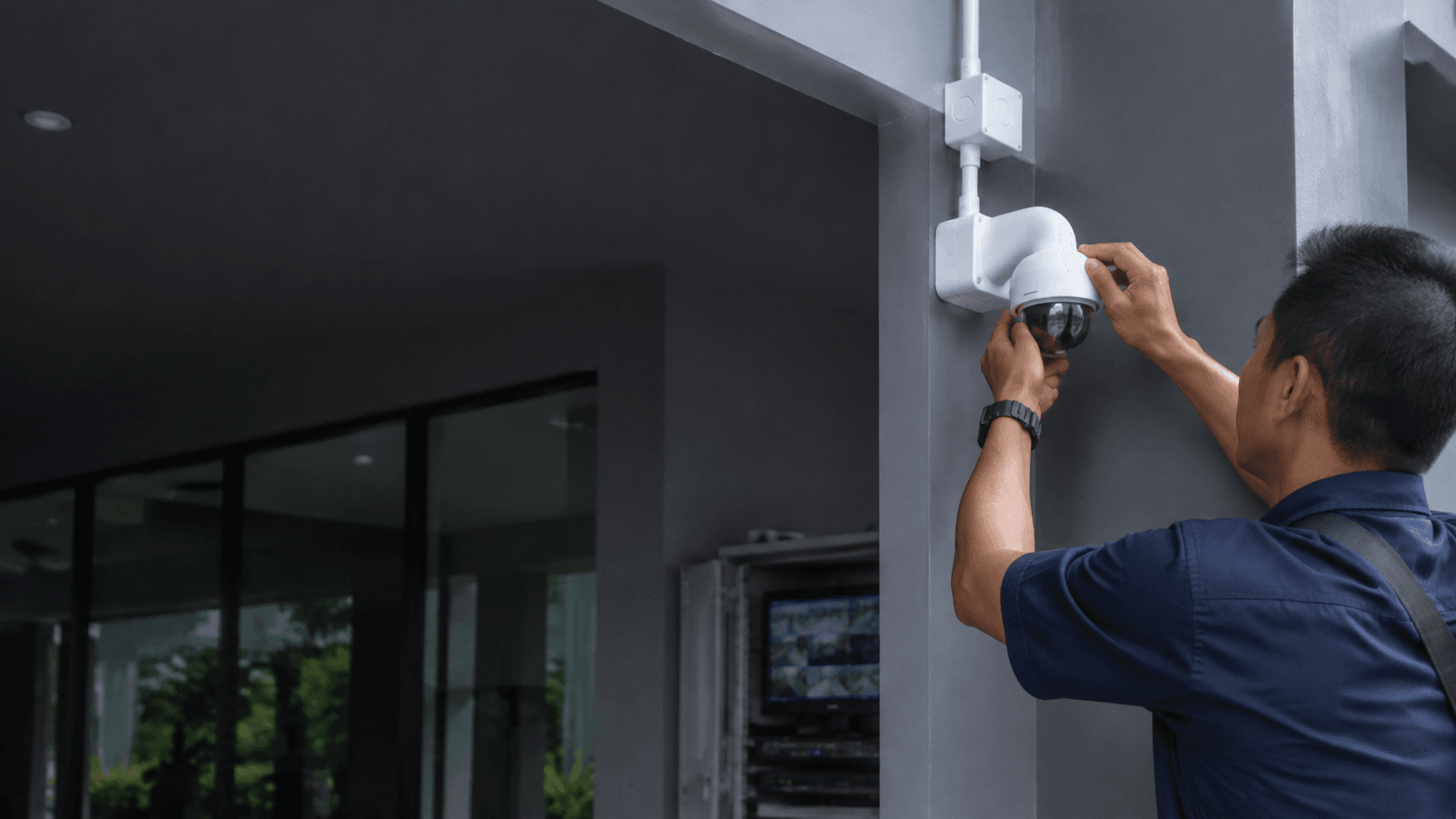
The exact-match query dvr dahua 4 channel describes a recorder class rather than one fixed product. Dahua builds four-channel recorders in several families, and the model number on the box decides what the unit can actually do. That is why the useful question is not whether four channels is enough in the abstract, but whether four channels matches the camera positions a site genuinely needs.
Most pages ranking for this query are product listings. They show a price, a picture and a short specification block, then stop. None of the six pages reviewed for this article carried the query in the H1, and the median page length was 142 words. A buyer in Malaysia still has to work out what four channels covers, what changes when the camera count grows, and what must be confirmed before money changes hands.
What a four-channel Dahua recorder is built to do
A four-channel recorder accepts video from four cameras and writes it to local storage. The recorder is the box that sits behind the cameras; the cameras themselves are chosen separately. Dahua has produced four-channel recorders across different generations and video standards, so two units with the same channel count can differ in recording resolution, compression, supported camera types and storage ceiling.
Because those details vary by model, the model number is the only reliable source for them. A listing that says "4 channel Dahua DVR" without a model number leaves the recording resolution, the compression format and the maximum drive size unresolved. Dahua publishes per-model documentation, and that document is what an installer should be reading before quoting a job.
What four channels does settle is the camera budget. Four inputs means four camera positions, and no more, unless the recorder supports adding IP cameras on top of its analogue inputs. Some four-channel units do; some do not. That single difference changes whether a site can start with four cameras and grow, or has to replace the recorder when a fifth position is needed.
Dvr Dahua 4 Channel compared with larger channel counts
The channel count is the number of cameras the recorder can accept. An eight-channel unit costs more than a four-channel unit in the same family, but the gap is usually smaller than the cost of replacing a recorder later. The trade-off is not only money. A larger recorder takes more space in the cabinet, may need a bigger power supply, and can require more storage to hold the same retention period across more cameras.
Four channels suits a site where the camera positions are already known and unlikely to change. A small shop with one entrance, one counter and one stock area fits that pattern. So does a house covering a gate, a porch and a side lane. The count is stable because the layout is stable.
Larger counts suit sites where the layout is still moving. An office that expects to add a second entrance, a warehouse that may extend its loading bay, or a building with a phased fit-out will outgrow four inputs. In those cases the recorder is the wrong place to save money, because the cameras, cabling and brackets usually survive an upgrade while the recorder does not.
There is also a middle path. A four-channel recorder that accepts IP cameras on top of its analogue inputs can carry a small site further than its channel count suggests. Whether a specific Dahua model offers that depends on the model, and it is one of the first things to confirm.
What to confirm before choosing a four-channel recorder
These checks run in order. Skipping an early one usually forces a rework of a later one.
- Confirm the camera count by walking the site and listing every position that needs coverage, including the ones that are only a maybe.
- Confirm the recording resolution and the storage that resolution needs for the retention period the site wants to keep.
- Confirm how remote viewing will work, including who needs access and from what device.
- Confirm camera placement and the actual lighting at each position, since lighting decides whether a camera performs at night.
- Confirm the installation scope and what handover includes, so the finished system is tested and explained rather than merely powered on.
The camera count check is the one that most often changes the answer. A site that starts with three positions frequently finds a fourth during the walk, and a fourth position that was not planned is easier to accommodate on a four-channel unit than a fifth position discovered after installation.
Storage follows from resolution and retention. Higher recording resolution produces more data per camera per day, so four cameras at a high resolution can fill a drive faster than four cameras at a lower one. The retention period the site actually needs, not the largest drive the recorder accepts, is what sets the requirement.
Remote viewing is a configuration question as much as a hardware one. It depends on the recorder's network capability and on the network at the site. A recorder that supports remote access still needs a working connection and a correct setup before anyone can view footage away from the premises.
Placement and lighting deserve their own pass. Eyonic's own guidance on low-light cameras is to check the actual lighting conditions at each position before confirming placement, because a position that looks adequate in daylight can behave differently after dark. That check costs a site visit and saves a second one.
Installation and handover close the list. Eyonic's CCTV installation process runs through site survey, system proposal, installation and handover, which means the scope is agreed before work starts and the finished system is handed over rather than left running.
How a four-channel recorder fits a small site
A four-channel recorder fits sites where coverage is concentrated rather than spread out. The Kuching Immigration Office project Eyonic completed focused on arrival flow, staff areas, visitor movement and dependable daily operation. That is the kind of brief where camera positions are chosen around specific movements rather than around a target camera count.
The KTA Sarawak Sdn Bhd project followed a similar pattern at a smaller scale: a practical office setup in Kuching supporting staff movement, visitor handling, tidy cabling and clearer daily site control. Both projects show the same principle. The camera count comes out of the site's movement pattern, not the other way round.
For a four-channel system, that principle has a practical consequence. Four well-placed cameras covering the entrance, the counter, the stock area and the rear access will usually tell a site more than four cameras scattered to cover as much floor area as possible. Coverage of a movement matters more than coverage of a room.
Cabling is the other small-site consideration. Four cameras need four cable runs back to the recorder, and the route those runs take affects both cost and how tidy the finished job looks. Tidy cabling was an explicit part of the KTA Sarawak brief, which suggests it is worth raising before installation rather than after.
Dvr Dahua 4 Channel questions to settle with an installer
The questions that matter are the ones a listing cannot answer. Which Dahua four-channel model is being supplied, and what does its own documentation say about recording resolution, compression and maximum storage? Does that model accept IP cameras in addition to its analogue inputs? What retention period will the proposed storage actually deliver at the chosen resolution?
Then the site-specific ones. Which positions are being covered, and what is the lighting at each of them after dark? How will remote viewing be set up, and who will be shown how to use it? What does handover include, and will the system be tested in front of the person who has to operate it?
Budget is worth framing honestly. Eyonic's published package pricing starts at RM 1,599 for a Hikvision CCTV package covering camera supply and setup, basic recording configuration and mobile viewing handover. That figure is for a Hikvision package, not a Dahua recorder, and it is a starting reference rather than a quote for a Dahua four-channel job. Larger scopes sit well above it. the Kuching Immigration Office project carried an approximate budget of RM 12,000 to RM 28,000, and the KTA Sarawak Sdn Bhd project an approximate budget of RM 8,000 to RM 18,000.
Those ranges show how much a project's scope, not its channel count, drives cost. A four-channel recorder on a single shop lot and a four-channel recorder as part of a multi-area office fit-out are different jobs even though the recorder is similar.
One limit is worth stating plainly. Dahua four-channel specifications, Malaysian pricing and warranty terms are not fixed by the channel count, and they should be confirmed against the specific model's documentation and the supplier's terms before committing. Anything stated without a model number is a generalisation.
Share the location, property type and required system with Eyonic on WhatsApp at +60 11-5111 7959 for the next practical step.