
Swann is an Australian security brand that has been selling DIY surveillance equipment for decades, and the Enforcer line sits in its wired range rather than its Wi-Fi range. The name comes from the cameras themselves: Enforcer models add red and blue flashing lights, a spotlight, and a siren to the usual recording functions. Buyers researching the Swann Enforcer Security System in Malaysia are usually trying to work out three things at once — what arrives in the box, whether the wiring suits the property, and what happens after the hardware is mounted.
This page covers kit contents, recorder and storage choices, wired installation and placement, lighting and detection behaviour, and the checks worth completing before money changes hands. It does not quote Malaysian pricing, because no verified local listing was available at the time of writing.
Swann Enforcer Security System. What Buyers in Malaysia Should Know
The Swann Enforcer Security System is sold as a bundle rather than as individual parts. A typical kit pairs a set of Enforcer cameras with a recorder, a hard drive, cabling, and power supplies. Retail listings for the range describe combinations such as four cameras with an eight-channel DVR, or larger sets running to ten cameras on a sixteen-channel NVR.
Two naming conventions matter when comparing listings. A DVR kit uses analogue-style cameras and a digital video recorder. An NVR kit uses network cameras and a network video recorder. Both appear under the Enforcer name, so the recorder type is the first thing to confirm on any listing.
Swann's own support pages group its products into wired security systems, Wi-Fi NVRs, Wi-Fi cameras, and video doorbells, which places the Enforcer range firmly in the wired category. That distinction drives most of the practical decisions that follow.
What the Swann Enforcer Security System Typically Includes
Published retail descriptions of Enforcer kits list the same core components across sizes. A four-camera, eight-channel kit includes the cameras, the recorder, a pre-installed hard drive, camera cables, power adapters, and mounting hardware. Larger kits follow the same pattern with more cameras and a recorder with more channels.
Camera channels and camera count are not the same number. An eight-channel recorder shipped with four cameras leaves four spare channels for later expansion, while a four-channel recorder with four cameras is full from day one. That single figure often decides whether a kit can grow with a property.
Enforcer cameras in the range have been described in retail listings as including built-in microphones for audio recording, weatherproof housings rated for outdoor use, and the flashing-light and siren features that give the line its name. Specifications vary between models, so the model number on the box is the reliable reference point rather than the Enforcer name alone.
Camera, Recorder, and Storage Choices Across Enforcer Kits
Storage is the quiet constraint in any wired kit. Retail listings for the range reference hard drives of 1 TB and 2 TB, with one listing claiming retention of up to twelve months on a 2 TB drive. That figure depends entirely on camera count, resolution, frame rate, and how often motion triggers recording, so it should be treated as a best case rather than a promise.
Resolution also varies across the line. Listings in the range reference 1080p kits and 4K kits under the Pro Enforcer name. Higher resolution produces sharper identification but consumes more storage per hour, which is why a 4K kit and a 1080p kit with the same drive capacity will not retain footage for the same length of time.
Cloud backup appears in some Enforcer listings as an optional extra alongside local recording. Local storage keeps footage on site and under the owner's control; cloud storage adds an off-site copy but depends on upload bandwidth and, in most cases, a subscription. Neither replaces the other, and the choice usually comes down to how much the footage matters after a break-in.
Wired Installation and Placement Planning
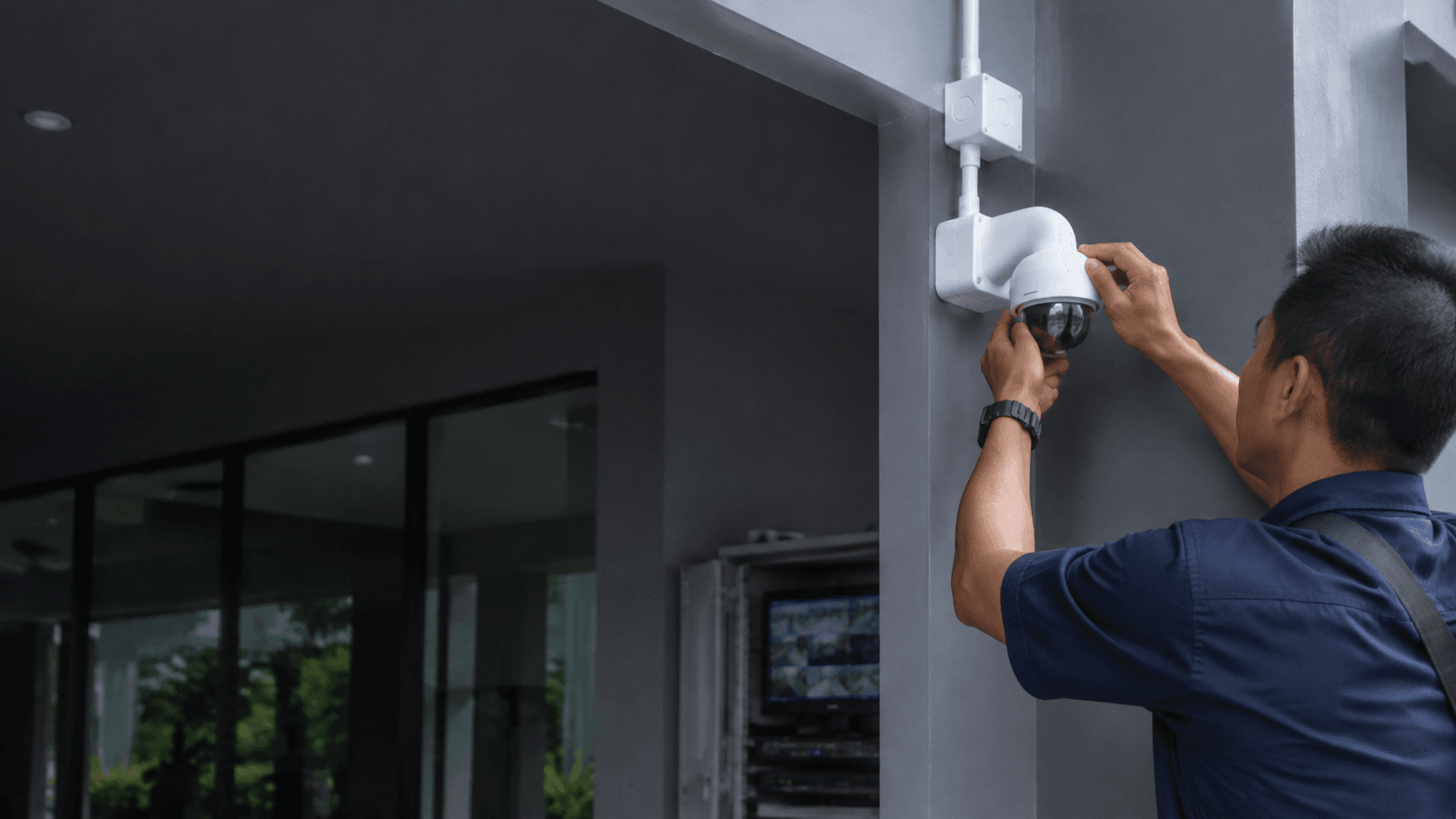
Wired kits need cable runs from every camera back to the recorder. That is the main practical difference between the Enforcer range and a Wi-Fi camera, and it shapes where cameras can realistically go. Cable length, wall construction, and whether the recorder sits in a cupboard or a rack all affect the plan before any drilling starts.
Eyonic's CCTV installation process runs through site survey, system proposal, installation, and handover, which reflects the order that works for wired systems generally. A survey establishes where cable can be routed and where power is available; the proposal fixes camera positions and recorder location; installation follows; handover covers recording configuration and mobile viewing.
Placement decisions usually come down to coverage versus identification. A camera high on a wall covers more ground but produces a smaller, less useful image of a face. A camera lower and closer to an entry point identifies better but covers less. Most properties need a mix rather than a single rule applied everywhere.
Before committing to a layout, a buyer should work through the following checks in order:
- Confirm the recorder type on the listing — DVR for analogue cameras, NVR for network cameras.
- Count the camera channels against the cameras included, and decide whether spare channels are needed later.
- Walk the property and identify every point that needs coverage, then rank those points by importance.
- Check where cable can be routed from each camera position back to the recorder, including wall and ceiling construction.
- Confirm power availability at the recorder location and at any camera that needs a separate supply.
- Assess the actual lighting at each position during the hours that matter, not just in daylight.
- Estimate storage retention from camera count and resolution before choosing a drive size.
- Confirm who supplies the hard drive, the cables, and the mounting hardware, and who handles warranty claims.
- Verify local availability, lead time, and support arrangements before paying a deposit.
Lighting, Night Vision, and Detection Behaviour
Enforcer cameras are marketed around their lighting and deterrence features rather than around image quality alone. The red and blue flashing lights, spotlight, and siren are designed to be noticed, which makes them a deterrent first and a recording device second. Whether that matters depends on the property — a visible deterrent suits a front gate, while a discreet camera may suit an internal corridor.
Night vision performance is the most commonly misunderstood part of any camera specification. Colour night vision depends on available light, and a position that looks bright during the day can be almost dark at 2 a.m. Eyonic's guidance on ColorVu-style cameras is to check actual lighting conditions before confirming placement, and the same principle applies to any camera claiming colour night vision.
Motion detection has a similar practical limit. Heat-and-motion detection reduces false triggers from moving foliage or passing headlights compared with basic pixel-change detection, but it does not eliminate them. Camera angle, field of view, and sensitivity settings all affect how often alerts arrive, and a poorly aimed camera will generate more noise than a well-aimed one regardless of the detection technology inside it.
Audio recording is present on some Enforcer models and absent on others. Where it exists, it captures sound at the camera position, which may be useful at a doorway and less useful on a boundary wall. Local rules on recording audio vary, and that is worth checking before relying on it.
Cost, Support, and Buying Checks in Malaysia
No verified Malaysian retail or distributor listing for the Swann Enforcer Security System was available for this page, so no local price is quoted here. Overseas listings in the range show kit prices that vary widely with camera count, resolution, and drive size, and Malaysian pricing would need to be confirmed with an actual local seller before any comparison is meaningful.
Support is the other open question. Swann operates its own support and video instruction resources, but local warranty handling, replacement parts, and technical help depend on the seller. A kit bought from an overseas listing may arrive without any local support path, which matters more for a wired system than for a plug-in camera because faults are harder to diagnose without help.
For buyers in Sarawak, Eyonic Sdn Bhd plans, supplies, and installs CCTV and ELV systems for homes, offices, shops, and industrial sites, and has completed projects including the Kuching Immigration Office and KTA Sarawak Sdn Bhd. Those projects covered arrival flow, staff areas, visitor movement, and tidy cabling — the same planning questions that apply to any wired camera layout. Eyonic's published packages start at RM 1,599 for a Hikvision CCTV package, an alarm system, or an autogate package, which gives a reference point for what a locally supplied and installed system costs in that market.
Whether the Swann Enforcer Security System falls within Eyonic's supply or installation scope is not confirmed, so that question is best asked directly rather than assumed. A buyer comparing the Enforcer range against a locally supplied alternative should weigh the hardware cost against installation, warranty handling, and who to call when a camera stops recording.
Share your location, property type and required system with Eyonic on WhatsApp at +60 11-5111 7959 for the next practical step.