
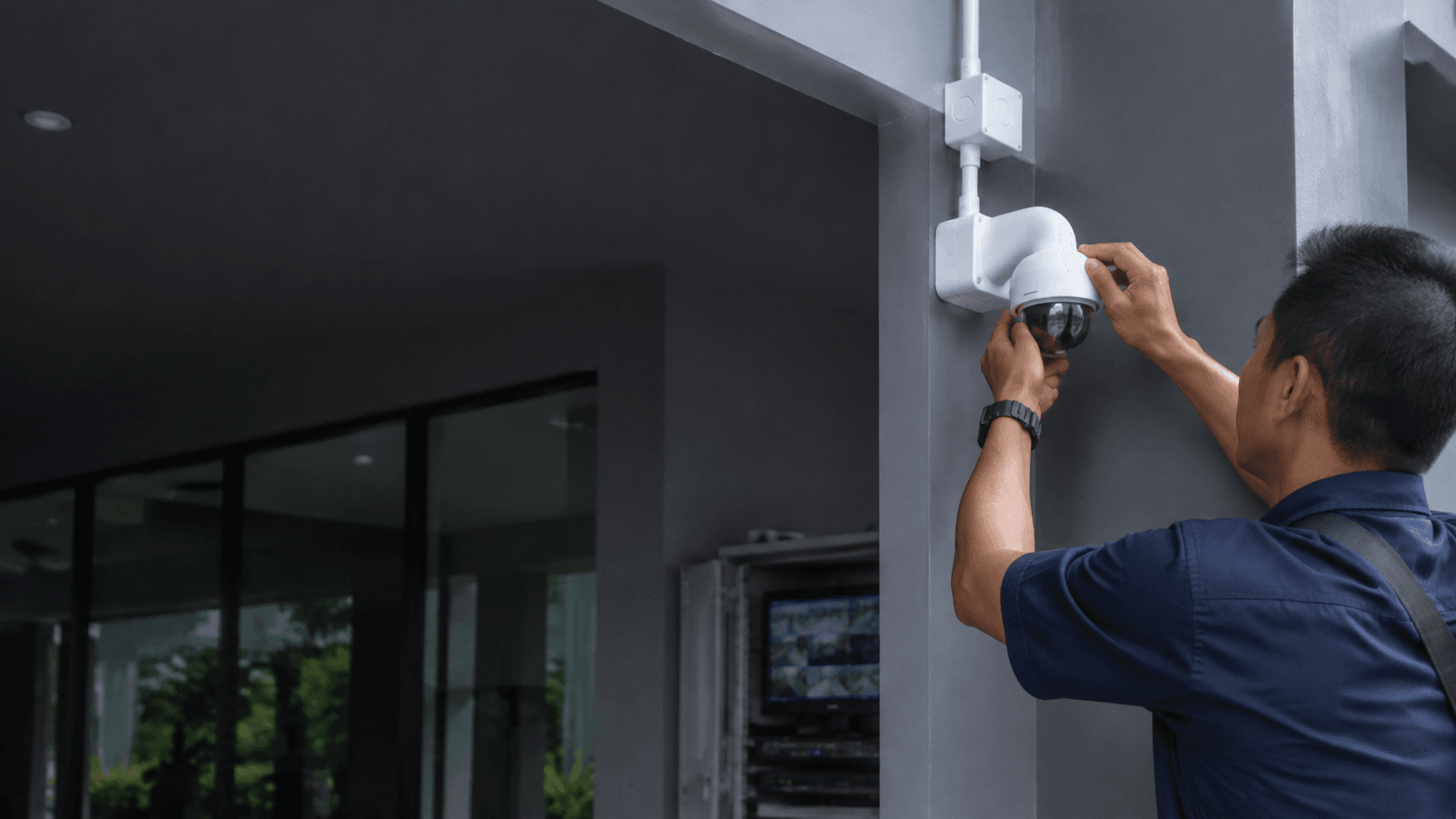
The term gets used loosely online. Retail pages file IP cameras under "IPC" as a product category, a Bahasa Indonesia article uses "CCTV IPC" as a headline phrase, and tester catalogues use "IPC" for the diagnostic tools installers carry. None of that explains what changes when a property moves from analog cabling to a network camera system, which is the decision most readers in Malaysia are actually weighing.
What follows covers what the term points to, how a network setup differs from analog CCTV, what an installation involves from survey to handover, where these systems fit in Malaysian properties, and what to confirm before committing. Model-level specifications are deliberately absent because no verified datasheet for a specific IPC model was supplied for this article.
What CCTV IPC refers to in a network camera system
In practice, CCTV IPC is shorthand for IP cameras — cameras that connect over a network rather than a dedicated analog video cable. The acronym itself is widely used as a product label, but its expansion is not something this article will assert as fact, because no primary definition source was supplied.
What can be said with confidence is the functional difference. An IP camera is a networked device: it has its own network address, it sends video as data over that network, and it is reached through software rather than through a dedicated video input on a recorder. That single change cascades through the rest of the system — the recorder becomes a network video recorder rather than a DVR, the cabling becomes structured network cabling, and remote viewing becomes a software and account question rather than an add-on module.
Eyonic's own service description lists the components of this kind of system plainly: camera placement, recording, NVR setup and remote viewing, planned and installed for homes, offices, shops and industrial sites. Those four items are the practical backbone of any CCTV IPC deployment, regardless of which camera brand sits at the end of the cable.
How an IP camera setup differs from analog CCTV
The difference readers care about is not image quality on a spec sheet. It is what the system demands of the building.
Analog CCTV runs a dedicated video cable from each camera back to a recorder, and power usually runs alongside it. A network camera system runs data over network cabling, which means the building's cabling layout, the recorder's location and the network itself all become part of the design. Where a property already has structured cabling and a network cabinet, that is an advantage. Where it does not, cabling becomes a larger share of the work.
Remote viewing is the second practical difference. On a network system, viewing footage from a phone is a function of the recorder and its software, not a separate device bolted on. That is why NVR setup and remote viewing appear together in Eyonic's service scope — they are configured as one step, not two.
A third difference is expansion. Adding a camera to a network system is closer to adding a device to a network than to adding a channel to a fixed recorder. That matters for shops and industrial sites that expect to grow, and matters less for a single fixed installation in a small home.
One caution applies to both technologies equally: camera placement decides more of the outcome than the camera does. Eyonic's guidance on ColorVu-style cameras is to check the actual lighting conditions on site before confirming placement, because a position that looks correct on a floor plan can behave very differently once the real light in that spot is measured. That advice holds whether the camera is analog or networked.
What a CCTV IPC installation involves from survey to handover
Eyonic documents a four-stage process for CCTV installation work. The sequence matters because each stage constrains the next — a placement decision made before the survey is a guess, and a proposal written before placement is confirmed is a placeholder.
- Site survey. The property is assessed before anything is specified. This is where lighting conditions, sight lines, cabling routes and recorder location get checked against the real building rather than an assumption about it.
- System proposal. The survey findings become a proposed system — which cameras, where they sit, how they connect and how recording and viewing will work.
- Installation. Cameras are mounted, cabling is run, and the recorder and network side of the system are configured.
- Handover. The system is handed over with recording and remote viewing set up and explained, so the people who will use it daily know how it works.
The survey stage is the one most often skipped in do-it-yourself purchases, and it is the stage that determines whether the finished system actually covers the entrances, counters or walkways that prompted the purchase. A camera bought before the survey is a camera chosen without knowing where it will point.
What the survey should establish
At minimum, a survey for a network camera system needs to answer where cameras will mount, what each position will actually see, how cabling will reach each position, where the recorder will live, and how the property's network will carry the video. Lighting at each position belongs on that list too, for the reason above. If a proposal arrives without those answers, it is a product list rather than a system design.
Where CCTV IPC fits in Malaysian homes, offices and public buildings
The fit depends on the property type and what the footage needs to do.
For homes, the common drivers are entrances, gates and perimeter coverage, with remote viewing so the owner can check in while away. A network system suits this when the home already has reasonable network coverage and the owner wants phone access without extra hardware.
For offices and shops, the drivers shift toward staff movement, visitor handling and counter or till coverage. Eyonic's project for KTA Sarawak Sdn Bhd is a useful illustration of the pattern: an office setup in Kuching supporting staff movement, visitor handling, tidy cabling and clearer daily site control. Note that tidy cabling appears as an outcome in its own right — in a working office, cable routing is part of the deliverable, not an afterthought.
For public buildings, the requirement is dependable daily operation rather than feature depth. Eyonic's work for the Kuching Immigration Office focused on arrival flow, staff areas, visitor movement and dependable daily operation. That project's approximate budget range was RM 12,000 to RM 28,000, which gives a sense of scale for a public-office installation; the KTA Sarawak project sat in the RM 8,000 to RM 18,000 range. Both figures are project budgets, not camera prices, and neither is confirmed as an IP camera system specifically.
For industrial sites, the practical questions are coverage of large or awkward areas, cabling over distance, and whether the network can carry the video reliably. These are survey questions, not product questions.
What to confirm before committing to a CCTV IPC system
Several things are worth settling before money changes hands, and several things this article cannot settle for the reader.
First, confirm what the proposal actually includes. Eyonic's published Hikvision CCTV package is priced at RM 1,599 and covers camera supply and setup, basic recording configuration, and mobile viewing handover. That package is not confirmed as an IP camera system, so it should be treated as a reference point for what a basic package contains rather than as a quote for a network deployment.
Second, confirm the network side. A network camera system depends on the property's network carrying video reliably. Whether that requires additional cabling, a dedicated switch or a separate network segment is a site-specific answer, and no verified statement on network requirements for Eyonic installations was supplied for this article — so it belongs in the survey conversation, not in an assumption.
Third, confirm who handles the recorder and remote viewing setup. On a network system these are configuration tasks, and they are the difference between a system that records and a system the owner can actually check from a phone.
Fourth, be clear about what cannot be verified here. No model-level specification — resolution, lens, sensor, weather rating or compression — is stated in this article because no verified datasheet was supplied. No Malaysian pricing for an IP camera system specifically is stated, beyond the package and project figures above. No warranty, licensing or regulatory position for IP cameras in Malaysia is stated, because none was supplied. Readers comparing specific models should get those details from the manufacturer's own documentation for the exact model in question.
Fifth, treat competitor pages with care. Most pages ranking for this term are retail category listings or tester catalogues. They are useful for seeing what the market sells, but they are not evidence about what a specific installation in Malaysia requires.
When the property type, location and required system are known, that is the point at which a practical next step makes sense. Eyonic can be reached on WhatsApp at +60 11-5111 7959 with those three details.