
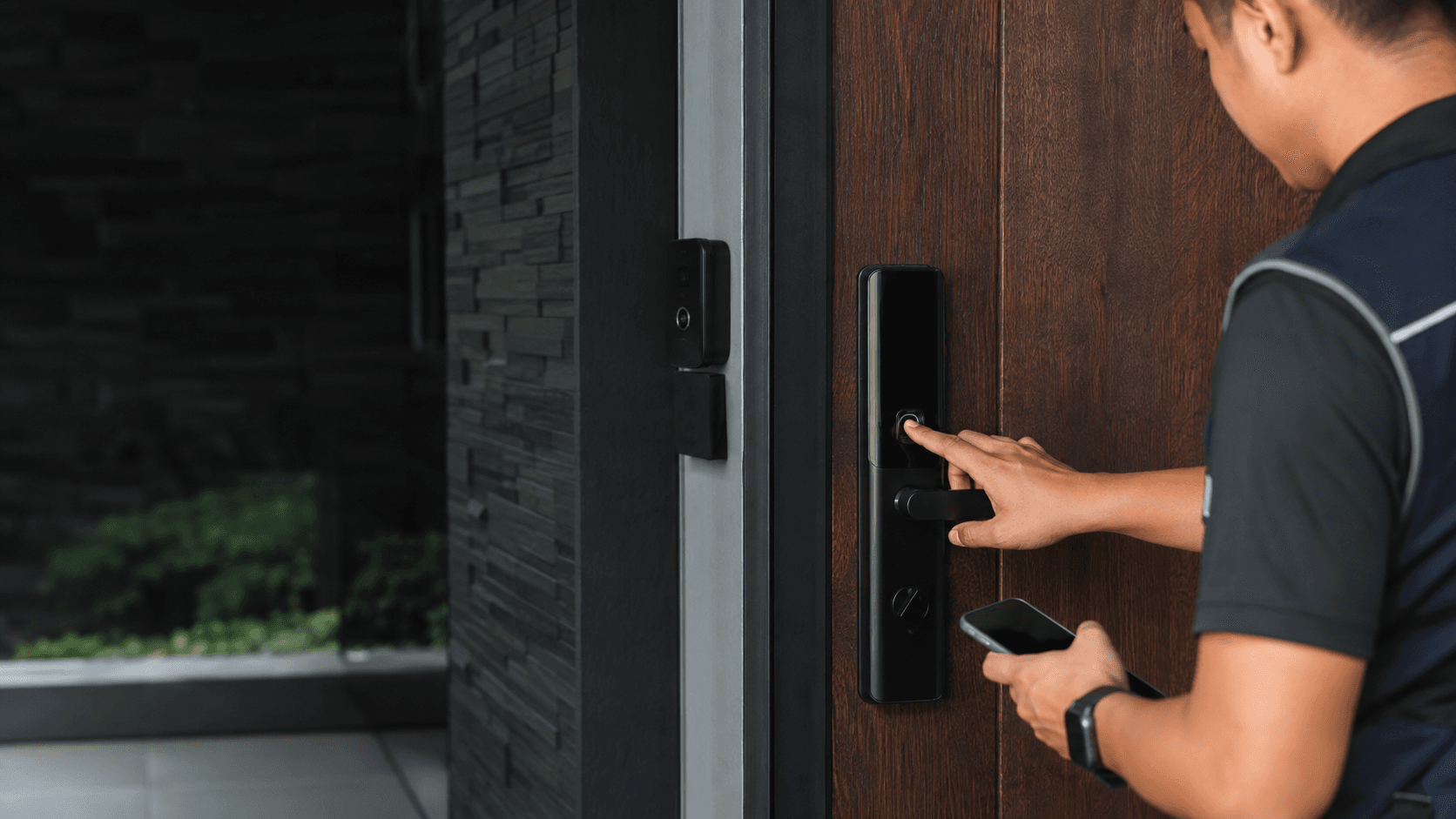
The exact-match query kwikset electronic door lock describes a category rather than a single product. Kwikset builds these locks around two entry surfaces — a keypad and a touchscreen — and both are operated by a personalised access code rather than a cut key. The same product family also keeps a mechanical back-up keyway, which matters when a code is forgotten or a battery is flat.
Readers in Malaysia usually arrive with a practical question rather than a brand question: will this kind of lock suit the door already installed, and how is access handed out to family, staff or tenants. The sections below work through entry surfaces, daily use, door condition, permissions, back-up entry and handover testing in that order.
Kwikset Electronic Door Lock. keypad and touchscreen entry
Kwikset's own electronic lock pages describe the category in one line: electronic locks are operated by an electronic keypad or touchscreen, and a personalised access code opens the door. The same pages note that a back-up keyway is part of the design.
The two entry surfaces differ in how they are touched, not in what they do. A keypad presents physical buttons, so a press is felt and confirmed by touch. A touchscreen presents a flat illuminated surface, so the code is entered on glass. Kwikset's touchscreen material also references SecureScreen technology, which is described as a fingerprint code detection prevention feature on touchscreen models.
That distinction has a practical edge in humid, rainy conditions. Physical buttons give tactile feedback that does not depend on seeing the surface clearly, while a touchscreen depends on the panel being clean and responsive. Neither is automatically better; the choice follows who uses the door and how often hands are wet, gloved or carrying something.
Kwikset also separates its range into electronic locks that work standalone and smart locks that communicate with other devices. The standalone group covers keypad and touchscreen entry with a code. The smart group adds remote locking and unlocking, access control and home management functions through Kwikset's Home Connect technology, which the manufacturer describes as using Z-Wave and Zigbee to communicate wirelessly with other devices.
That split is the first real decision. A household that only wants to stop carrying keys sits in the standalone group. A property that wants to issue and revoke access remotely, or check whether a door is locked, sits in the smart group — and that group brings its own requirements around hubs, networks and app management.
How keyless entry changes daily door use
Keyless entry changes the unit of access from a physical object to a piece of information. A key can be copied, lost or lent indefinitely without the owner knowing. A code can be changed, and a changed code immediately excludes anyone who knew the old one.
That shift shows up in ordinary routines. A domestic helper arriving before the household wakes no longer needs a key that also opens the house at any hour. A short-stay tenant can be given a code that is deleted at checkout. A contractor working on a renovation can be let in for a defined period without a key being cut and later returned.
The trade-off is that codes must be managed. A code shared too widely stops being a control. A code that is never changed after a helper leaves is the same as a key that was never collected. The convenience of keyless entry is real, but it depends on someone actually maintaining the list.
There is a second, quieter change: the door becomes a record. Smart models that support access control and remote locking can show whether the door was locked and, on some systems, which code was used. For a small office or a shop, that is a different kind of information from a key that leaves no trace at all.
Door condition and user roles before choosing a Kwikset Electronic Door Lock
Eyonic's own product review guidance on smart lock door access states that smart locks work best when the door condition, user roles and backup method are reviewed before installation. That order is worth following, because a lock that fits the door badly will not be rescued by better software.
Door condition covers the physical facts of the existing door: whether it is a deadbolt position or a lever, whether the door closes squarely, whether the frame has shifted, and whether the existing cut-out is sound. A door that already needs a firm push to latch will not become easier with an electronic mechanism on it. The supplied evidence does not include verified Kwikset dimensions such as door thickness, backset or mortise size, so those must be confirmed against the actual product documentation for the specific model before any order is placed.
User roles cover who needs access and on what terms. A family home typically needs a small number of permanent codes plus one temporary code for help or guests. A shop or office usually needs a permanent code for each staff member, a shared code for deliveries, and a way to remove a code the same day someone leaves. A rental property needs codes that expire.
For business use, Eyonic's review guidance notes that the usual check is whether a standalone smart lock or an access-control panel is more appropriate. A single door with a handful of users is a different problem from a building with several doors, shift changes and a need for a central record. Choosing a standalone lock for a multi-door site tends to produce a set of locks that cannot be managed together.
Before committing to a Kwikset Electronic Door Lock, four checks are worth completing in sequence:
- Confirm the door condition — deadbolt or lever position, square closing, sound frame and existing cut-out.
- List the user roles — permanent household or staff codes, temporary codes, and who removes a code when someone leaves.
- Decide the back-up entry method — mechanical keyway, a second code held offline, or a documented battery-change routine.
- Plan the handover test — every user opens the door, the back-up method is tested, and the code list is written down.
Each check is cheap before installation and expensive afterwards. A door that fails the first check may need carpentry before any lock is fitted. A user list that was never written down becomes a security problem the first time someone leaves.
Access codes, permissions and backup entry
Access codes are the working part of a Kwikset Electronic Door Lock. The lock stores codes and accepts them at the keypad or touchscreen. What differs between models is how many codes can be held, how they are added and deleted, and whether they can be scheduled — and the supplied evidence does not include verified code capacity or scheduling details for specific Kwikset models, so those figures should be confirmed from the manufacturer's documentation for the model under consideration.
Permissions follow from the code list. A practical structure separates codes into three tiers: permanent codes for people who live or work at the property, recurring codes for regular help, and one-off codes for guests, deliveries or contractors. The tiers matter because they determine what happens when circumstances change. A permanent code that was never reviewed is the most common weak point in any keyless setup.
Back-up entry deserves the same attention as the primary entry. Kwikset's electronic locks include a back-up keyway, which means a mechanical key remains a route in. That key should be stored somewhere other than inside the property, because a key locked behind the door it opens is not a back-up. For smart models, a second consideration is what happens when the network or hub is unavailable — remote functions may stop while local code entry continues, and that difference should be understood before the lock is relied on for access.
Battery behaviour is the other edge case. The supplied evidence does not include verified battery life figures for Kwikset models, so no specific interval can be stated. What can be planned is the routine: know where the battery compartment is, keep the correct battery type on hand, and treat any low-battery warning as a task for that week rather than a note for later. A lock that warns and is ignored becomes a lock that fails at the least convenient moment.
Installation and handover checks
Eyonic's installation process for its security work follows site survey, system proposal, installation and handover. The same sequence applies to a door lock, and the handover stage is where most of the value sits.
Installation on an existing door is a fitting exercise before it is a configuration exercise. The lock body must sit correctly in the door, the latch must meet the strike cleanly, and the door must close without force. If the door needs to be pushed, pulled or lifted to latch, that should be corrected rather than compensated for by adjusting the lock.
Configuration comes next. codes are entered, the back-up keyway is tested with the door closed, and any smart functions are connected and confirmed. Testing should be done with the door shut, not open, because a lock that engages in mid-air may still fail against a strike plate.
Handover is the step that is most often skipped. Every person who will use the door should open it themselves at least once, including anyone who is not comfortable with technology. The back-up method should be demonstrated, not described. The code list should be written down and stored somewhere the property owner controls, with a note of who holds each code and when it should be removed.
For a business or a site with several doors, the same discipline applies at a larger scale. Eyonic's project work for the Kuching Immigration Office focused on arrival flow, staff areas, visitor movement and dependable daily operation — the same concerns that decide whether a door access setup works in practice. A lock that is correct on paper but awkward in the daily flow will be propped open within a week.
Eyonic's project work for KTA Sarawak Sdn Bhd addressed staff movement, visitor handling, tidy cabling and clearer daily site control, which is the pattern a multi-door access decision usually follows: the hardware is the visible part, and the movement of people through the space is the part that determines whether it holds up.
Practical next step with Eyonic
Eyonic Sdn Bhd is a security system supplier based in Sarawak, Malaysia, working on CCTV and ELV systems with planning, supply and installation for homes, offices, shops and industrial sites. Its product range includes smart locks alongside Hikvision cameras, and its published review guidance on smart lock door access covers the door condition, user role and backup method checks described above.
For a single residential door, the decision is usually between a standalone keypad or touchscreen lock and a smart model with remote functions. For a shop, office or rental, the decision is usually between a standalone lock per door and an access-control approach that manages several doors together. The user list and the back-up plan are what separate a workable choice from an expensive one.
Share your location, property type and required system with Eyonic on WhatsApp at +60 11-5111 7959 for the next practical step.