
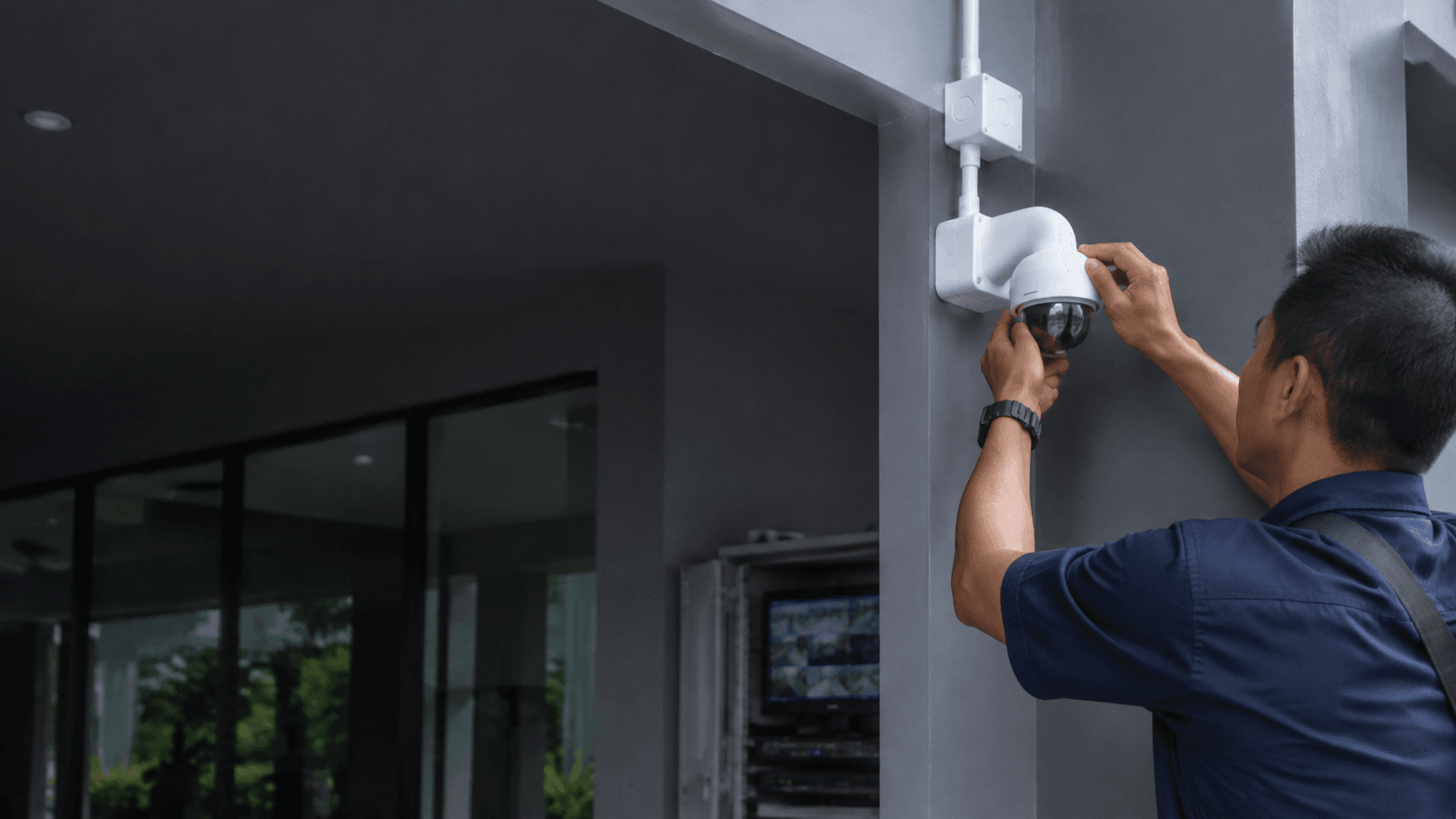
That structure is the reason two households can report very different totals for what sounds like the same camera. The camera itself is only one line inside a wider agreement that also covers the panel, sensors, monitoring service and the technician who installs everything. Understanding which of those lines a quoted figure actually covers matters more than the headline number.
What the Vivint Camera range includes
Vivint markets cameras by role rather than by specification sheet. The range discussed across published Vivint material covers an outdoor camera, a doorbell camera, an indoor camera and a floodlight-style camera, each aimed at a different position on a property.
An outdoor camera handles perimeter and driveway coverage. A doorbell camera covers the approach to an entrance and captures the moment someone arrives. An indoor camera covers interior rooms. A floodlight camera combines illumination with recording, which suits a dark side passage or rear yard where a standard camera would struggle without added light.
Because these are sold as part of a system, the camera choice is usually settled alongside the hub, sensors and monitoring tier rather than in isolation. That is why a search for Vivint Camera cost tends to return package discussions instead of a clean product price list.
How Vivint Camera cost is structured across equipment, monitoring and installation
Vivint Camera cost breaks into four separate components, and each one behaves differently. Equipment is a one-time or financed charge. Monitoring is recurring. Installation is typically tied to the agreement rather than billed as a standalone visit. Contract terms determine how long the recurring charge runs and what leaving early costs.
Published third-party coverage of Vivint pricing consistently separates these layers, which is a useful signal in itself. When a figure is quoted without saying which layer it belongs to, the number is not yet comparable to anything else.
| Cost component | What it typically covers | What to verify in writing |
|---|---|---|
| Camera hardware | The camera units themselves, plus the hub or panel the system runs through | Exact model, camera count, and whether the hardware is purchased outright or financed |
| Monitoring subscription | Recurring professional monitoring and app-based remote viewing | Monthly rate, what the tier includes, and whether video storage sits inside it |
| Professional installation | Technician visit, mounting, wiring and system activation | Whether installation is included in the quoted figure or billed separately |
| Financing or contract terms | Payment schedule, agreement length and early-termination conditions | Total payable across the term, not just the monthly figure |
The table deliberately carries no figures. No primary Vivint price list, package sheet or official quotation was available to this article, so any number placed in those cells would be invented rather than sourced.
Why the equipment layer is the hardest to isolate
Cameras bundled into a system are rarely priced individually on a public sheet. The practical consequence is that a buyer comparing a Vivint Camera quote against a standalone camera purchase is comparing a bundle against a component. Those two numbers will never line up, and treating the gap as a markup misreads what is being sold.
Why the monitoring layer dominates the long-run total
A one-time equipment charge is paid once. A monitoring subscription repeats every month for as long as the agreement runs. Over a multi-year term, the recurring layer usually outweighs the hardware layer, which is why the monthly figure deserves more scrutiny than the equipment figure during a sales conversation.
Vivint Camera cost compared with locally supplied camera packages
For readers in Malaysia, the comparison that actually matters is not Vivint against another American brand. It is a bundled, professionally installed, subscription-backed system against a locally supplied camera package with no recurring monitoring fee.
Eyonic CCTV, a security system supplier based in Sarawak, publishes a Hikvision CCTV package at RM 1,599 covering camera supply and setup, basic recording configuration and mobile viewing handover. The same supplier lists a Hikvision alarm system at RM 1,599 and an autogate package at RM 1,599. Those are one-time figures for supplied and installed equipment, with no monitoring subscription attached.
That difference in structure explains most of the apparent price gap. A subscription-backed system spreads cost across a term and includes ongoing monitoring labour. A locally supplied package concentrates cost at installation and leaves monitoring to the property owner.
Eyonic's own project work shows how scope drives budget at the larger end. A completed project for the Kuching Immigration Office, covering arrival flow, staff areas, visitor movement and dependable daily operation, carried an approximate budget of RM 12,000 to RM 28,000. A separate project for KTA Sarawak Sdn Bhd, an engineering consultancy office in Kuching needing staff movement coverage, visitor handling and tidy cabling, carried an approximate budget of RM 8,000 to RM 18,000. Neither figure is a camera price. Both show that camera count, site size and cabling complexity move the total far more than the camera model does.
What the two structures trade off
A subscription model buys ongoing monitoring and a maintained system. A one-time local package buys lower total outlay and no contractual tie, but places the responsibility for checking footage and responding to alerts on the property owner. Neither is universally better. The right choice depends on whether someone is available to watch alerts and whether the property is occupied during the hours that matter.
Availability is a real constraint
No evidence was available confirming that Vivint products and services are offered in Malaysia through a distributor or local installer. Readers in Malaysia should confirm availability directly before treating any Vivint Camera cost figure as applicable to a local installation.
What to confirm before accepting a quotation
These checks apply to any bundled camera quotation, Vivint or otherwise. Working through them in order prevents the most common misunderstanding, which is assuming a quoted figure covers more than it does.
- Confirm whether the figure is equipment-only or bundled with monitoring.
- Confirm the monitoring term and the total contract length.
- Confirm whether installation and activation are included or billed separately.
- Confirm the exact camera model and how many units are included.
- Confirm recording and storage terms, including how long footage is retained.
- Confirm cancellation and early-termination terms before signing.
Item five deserves particular attention. Storage retention determines how far back footage can be reviewed after an incident, and it is frequently the term buyers discover only when they need it.
Placement decisions affect the final bill
Camera count is not the only driver. Placement determines whether additional cabling, power runs or lighting work is needed. Eyonic advises checking actual lighting conditions on site before confirming placement for low-light cameras, because a position that looks adequate on a floor plan can perform poorly once the real light levels are measured. That check happens before installation, not after, which is when it can still change the quote.
Ask what happens at the end of the term
Equipment financed across an agreement raises a question worth settling early: what the buyer owns once the term completes, and what the system does if monitoring is cancelled. The answer varies by agreement, and it is not something to infer from the monthly figure.
questions worth settling early
Is a one time payment or a monthly charge
It is both, in most cases. The camera hardware is a one-time or financed charge, while monitoring is recurring. A quotation that presents a single monthly figure is usually combining the two, which makes the underlying equipment cost invisible.
Does the quoted figure include installation
Not always, and this is the most common source of a final bill exceeding the quoted one. Installation should be confirmed as included or excluded in writing before any agreement is signed.
Can a be bought without a monitoring plan
Published third-party coverage describes professional installation and monitoring as required elements of the Vivint system rather than optional add-ons. Buyers wanting camera hardware without a recurring subscription are looking at a different category of product entirely.
How does a locally supplied package compare on total cost
A one-time local package such as Eyonic's RM 1,599 Hikvision CCTV package avoids recurring monitoring charges entirely. Over a multi-year horizon, that structural difference usually matters more than any single equipment figure, though it shifts monitoring responsibility to the property owner.
What drives the total beyond the camera count
Site size, cabling runs, lighting conditions at each position, and whether the property needs coverage across multiple buildings. The Kuching Immigration Office and KTA Sarawak projects both show budgets set by scope and site conditions rather than by camera specification alone.
For readers weighing a locally supplied alternative, Eyonic's installation process runs through site survey, system proposal, installation and handover, which means the quoted scope is settled against the actual property rather than a standard package. Sharing the location, property type and required system with Eyonic on WhatsApp at +60 11-5111 7959 is the practical next step for a scope-based figure.