
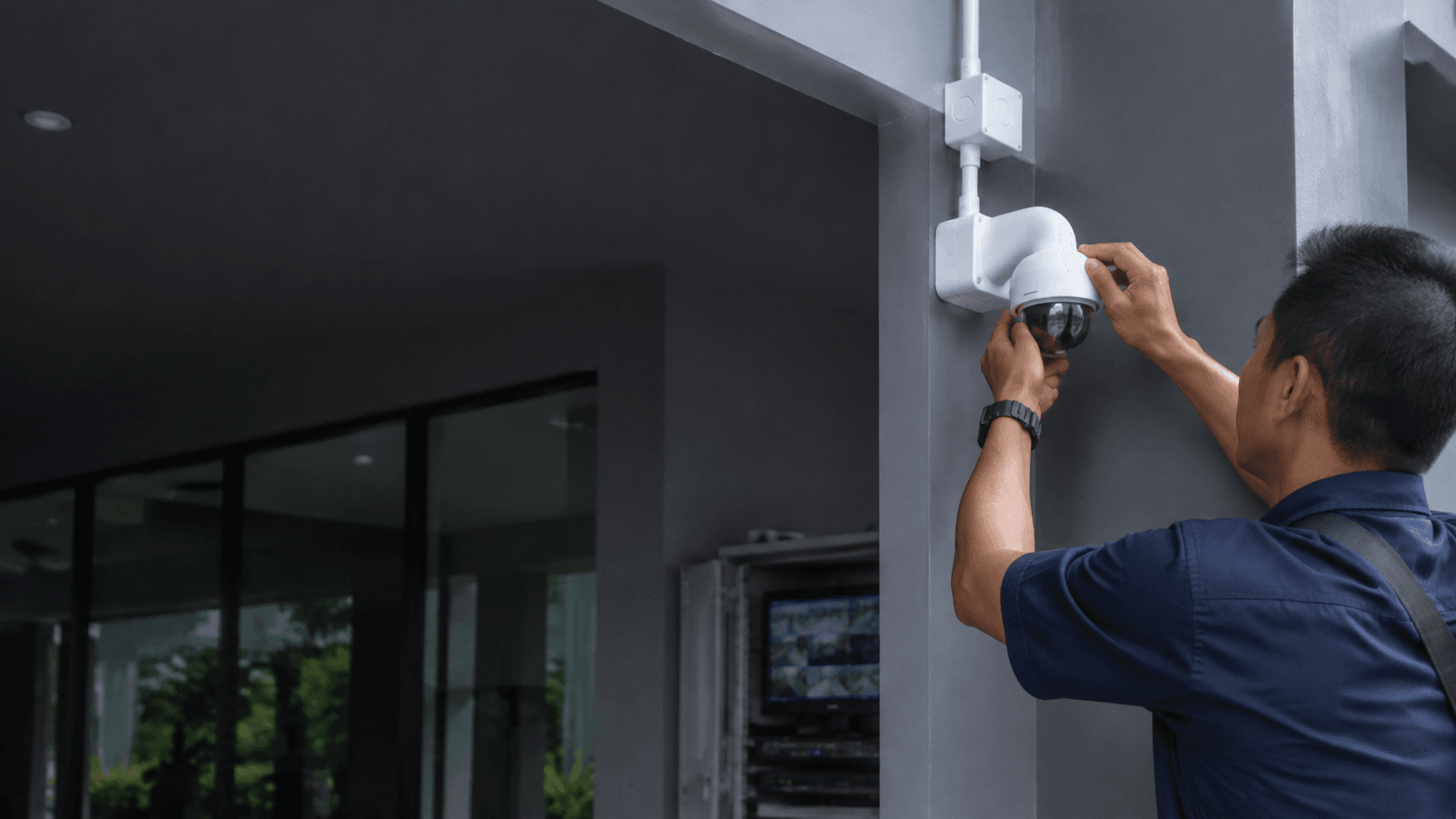
The phrase is Spanish, but the intent behind it is practical: a camera that lives outside, survives weather, and still produces usable images at night. Dahua builds cameras for that job, and the term "exterior" simply marks the outdoor branch of the range. What matters for a buyer in Malaysia is not the label but the fit between the camera, the mounting position, and the light that actually falls on the scene after dark.
Eyonic Sdn Bhd is a security system supplier in Sarawak that plans, supplies and installs monitoring systems for homes, offices, shops and industrial sites. Its documented process runs through site survey, system proposal, installation and handover, which is the same sequence any outdoor camera decision should follow.
Camara Dahua Exterior. what the term covers
A Camara Dahua Exterior is a Dahua camera intended for outdoor mounting rather than indoor use. The distinction is about housing and placement, not about a single product. Dahua's own product structure separates outdoor cameras from the rest of its range, which confirms the category exists as a recognised grouping.
Competitor pages in this space consistently describe exterior Dahua cameras through a small set of themes: weather-sealed housings, night vision delivered either by infrared or by white light, fixed versus varifocal lenses, and compression formats that reduce storage load. Those themes describe what buyers compare. They are not verified specifications for any particular unit, and no model number, resolution, rating or codec should be treated as confirmed here.
The practical reading is that "exterior" answers one question — can this camera be mounted outside — and leaves several others open. Lens choice, night behaviour, and recording format all vary between units inside the same category. Two cameras can both be exterior-rated and still suit completely different sites.
Why the Spanish phrasing still leads to a local decision
Searchers using this phrase in Malaysia are usually comparing listings, often from overseas marketplaces, and then looking for someone local to supply and install. The listing tells them the category exists. It does not tell them whether the camera will see a number plate at a gate, or whether a white-light unit will annoy neighbours at 2am.
That gap is where a site survey earns its place. A survey records what the camera will actually look at: the approach path, the gate, the parking bay, the back lane. It also records where power and network cable can reach, because an exterior camera with no cable route is a plan, not an installation.
Camara Dahua Exterior placement and lighting checks before purchase
Placement and lighting decide more outcomes than brand does. A well-placed camera with modest specifications outperforms a high-specification unit aimed at the wrong angle. Eyonic's own product guidance for ColorVu-style cameras makes the same point: check the actual lighting conditions before confirming placement, rather than assuming a low-light camera removes the need to think about light.
Three conditions deserve attention before any commitment.
Light at the scene. A camera facing a bright street lamp while the subject stands in shadow will silhouette the subject. A camera facing a dark lane with no ambient light depends entirely on its own illumination. The check is simple. stand at the proposed position after dark and look at what the camera would see.
Mounting height and angle. Higher is not automatically better. A camera mounted very high looks down at the tops of heads and loses facial detail. A camera mounted low is easy to reach and easy to disable. The useful band is usually the height that captures faces at the distance people actually approach.
Cable and power route. Exterior runs need a path that is protected from standing water and physical damage. This constraint often decides the final position more than the view does, because a perfect angle with no viable cable route is not buildable.
Fixed or varifocal, and what that changes on site
A fixed-lens camera is set at one field of view. A varifocal camera can be adjusted to narrow or widen the view, which helps when the exact framing is uncertain until the camera is on the wall. The trade-off is straightforward: varifocal units cost more and need adjustment during commissioning, while fixed units are simpler but leave no room to correct a framing mistake later.
For a gate where the goal is identifying a person or vehicle, a narrower view usually serves better than a wide one. For a compound where the goal is general awareness, a wider view covers more ground. Deciding which of those two jobs the camera is doing prevents most placement errors.
Camara Dahua Exterior supply and installation in Sarawak
Supply and installation is where an overseas listing stops being useful. A camera shipped from abroad arrives without a mounting plan, a cable route, a recorder configuration, or anyone to call when the image drops. Local supply and installation keeps those pieces together.
Eyonic's documented service scope covers planning, supply and installation of monitoring systems with camera placement, recording and remote viewing for homes, offices, shops and industrial sites. That scope is the relevant one for an outdoor camera project in Sarawak, regardless of which camera brand is finally selected.
One point of honesty matters here. Eyonic's published product evidence references Hikvision cameras and smart locks. Whether Dahua units are supplied or installed is not something the available evidence confirms, so it should be checked directly rather than assumed. The planning and installation process applies either way; the brand availability question is separate and answerable in one conversation.
What a Sarawak installation typically has to account for
Exterior work in Sarawak involves long cable runs on larger compounds, mounting surfaces that range from brick to metal cladding, and positions that are exposed to heavy rain. Each of those affects the hardware chosen for the run and the fixings used at the camera. None of it is exotic, but all of it is easier to plan before drilling than after.
Government and commercial sites add a further layer. Eyonic's project for the Kuching Immigration Office focused on arrival flow, staff areas, visitor movement and dependable daily operation, with an approximate budget range of RM 12,000 to RM 28,000 for that type of work. A separate project for KTA Sarawak Sdn Bhd covered a practical office setup in Kuching supporting staff movement, visitor handling, tidy cabling and clearer daily site control, with an approximate budget range of RM 8,000 to RM 18,000. Both illustrate the same principle: the camera positions follow the movement pattern the site needs to observe.
How Eyonic plans an outdoor camera installation
The process is documented and sequential. Each stage produces something the next stage depends on, which is why skipping ahead usually costs more than it saves.
- Site survey. The property is reviewed for camera positions, lighting conditions, cable routes and mounting surfaces.
- System proposal. The survey findings are turned into a proposed system covering camera placement, recording and remote viewing.
- Installation. Cameras, cabling and the recorder are installed and configured, including NVR setup.
- Handover. The system is tested and remote viewing is set up so the owner can check the site from a phone.
Eric Yong, founder of Eyonic Security Systems, has worked in the industry for more than ten years and is experienced in technical installation of digital security solutions for commercial businesses in Sarawak. That experience sits mostly in the survey and proposal stages, where a wrong assumption is cheapest to correct.
Eyonic's published packages are priced at RM 1,599 for a Hikvision CCTV package, RM 1,599 for a Hikvision alarm system, and RM 1,599 for an autogate package. Those figures cover the listed package contents — camera supply and setup, basic recording configuration and mobile viewing handover for the CCTV package — and are not a quotation for an outdoor Dahua camera installation, which would depend on the survey.
Where the plan usually changes after the survey
Two things commonly shift once a site is walked. The first is camera count. a position that looked adequate on a floor plan often turns out to leave a blind approach, and one extra camera closes it. The second is the recorder location, because the NVR needs power, network and a reasonable environment, and the most convenient cupboard is not always suitable.
Neither change is a failure of planning. Both are the reason the survey comes first.
questions buyers ask before deciding
Does an exterior camera need a recorder? A camera can record to a memory card, but most multi-camera sites use an NVR so footage from every camera sits in one place with one retention setting. NVR setup is part of Eyonic's documented installation scope.
Can the footage be viewed remotely? Remote viewing is part of the documented service scope and is handed over at the end of installation, so the owner can check the site from a phone.
What happens if the camera brand is unavailable? The survey and proposal stages exist to match the site to what can actually be supplied and supported. If a specific Dahua unit cannot be sourced, the placement plan and recording design still hold, and the camera selection adjusts around them.
How long does installation take? Duration depends on camera count, cable distance and mounting conditions, all of which the survey establishes. No fixed timeline should be assumed before that step.
Is a higher resolution always better? No. Resolution helps identification at distance, but it also increases storage and bandwidth demand. A well-placed camera at moderate resolution frequently identifies better than a high-resolution camera aimed at the wrong spot.
For a site in Sarawak, the next practical step is to share the location, property type and required system with Eyonic on WhatsApp at +60 11-5111 7959, so the survey can be scoped against the actual property rather than a product listing.