
The exact-match query residential camera systems describes a category that is usually sold as a box of hardware, yet the outcome depends far more on how the property is read before anything is mounted. A house is not a shop lot. Entry points, roof lines, gate positions, corridor lighting and the family's daily movement all shape where a camera can actually see something useful.
Eyonic Sdn Bhd is a security system supplier based in Sarawak that plans, supplies and installs monitoring systems with camera placement, recording and remote viewing for homes, offices, shops and industrial sites. The company's documented installation process runs through site survey, system proposal, installation and handover.
Residential Camera Systems. Planning and Installation
Planning starts before product selection. A supplier who quotes a package without seeing the property is guessing at cable routes, camera angles and recorder location. The four documented stages below are the sequence Eyonic follows, and they apply whether the property is a single-storey terrace house or a two-storey semi-detached home.
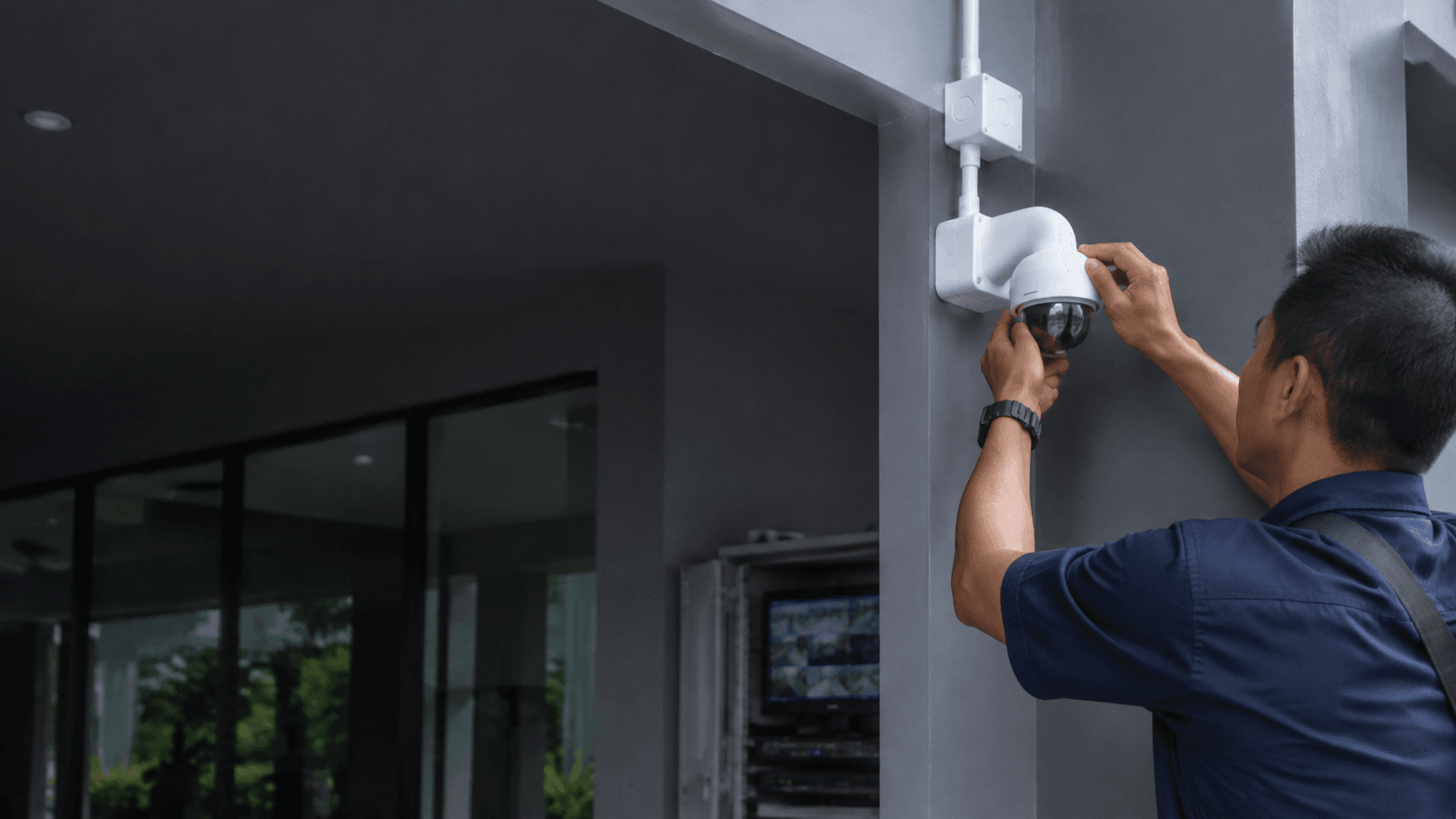
- Site survey. The property is walked through to identify entry points, existing cabling, power availability, roof and wall mounting surfaces, and the lighting each camera position would face.
- System proposal. Camera positions, recorder location, storage approach and viewing method are set out before installation begins, so the homeowner can confirm coverage priorities.
- Installation. Cameras, cabling and the recorder are installed and configured, with attention to tidy routing and weather exposure at outdoor positions.
- Handover. Recording, playback and remote viewing are demonstrated, and the homeowner is shown how to check footage and manage the system day to day.
The order matters because each stage constrains the next. A survey that misses a dark corner produces a proposal with a camera pointed at nothing. A proposal that ignores where the recorder can sit produces an installation with cables running the long way around a house.
What Residential Camera Systems Cover in a Home Setup
A home setup typically covers the front gate and car porch, the main entrance, side and rear access points, and any area where a break-in would be difficult to see from the street. Coverage is decided by what needs to be observed, not by how many cameras fit a budget.
Three practical questions shape the scope:
- Which approaches can be reached without passing a neighbour or a main road?
- Which areas are dark for most of the evening?
- Which recordings would actually need to be reviewed after an incident?
Recording and remote viewing sit inside the same scope. A camera that records but cannot be checked from a phone is less useful for a household where nobody is home during the day. A camera that streams but stores nothing leaves no record once the moment passes.
Eyonic's published Hikvision CCTV Package is listed at RM 1,599 and covers camera supply and setup, basic recording configuration, and mobile viewing handover. That package describes a starting scope rather than a fixed specification, because the number of cameras and the recorder size depend on the property.
How a Site Survey Shapes Residential Camera Systems
The survey is where most of the value is created or lost. A surveyor is looking for mounting height, the direction of the afternoon sun, whether a wall is load-bearing or hollow, where power can be drawn, and how a cable can reach the recorder without crossing a doorway or a finished ceiling.
For a typical Malaysian terrace house, the constraints are predictable. The car porch is often the most important view and the hardest to light. The rear lane is usually the least visible from inside the house. The gate is the point where a camera either captures a face or captures the top of a head, depending on height and angle.
Survey findings also determine whether a wired or wireless approach suits the property. A house with existing conduit and a convenient recorder position favours wired cameras. A house where drilling through finished walls is unacceptable may push the plan toward fewer, better-placed positions instead of more cameras in awkward spots.
Camera Placement and Lighting Checks Before Confirming Residential Camera Systems
Placement is confirmed only after the lighting at each position is checked at the time of day that matters. Eyonic recommends checking actual lighting conditions before confirming placement for ColorVu-style cameras, because a position that looks adequate in daylight can behave very differently after dark.
Two placement errors are common. The first is aiming a camera into a light source, which washes out the image at night. The second is mounting too high, which widens the view but pushes faces below the frame. A camera at a lower height with a tighter view often produces more usable footage than a wide view from the eaves.
Privacy is part of placement too. A camera that overlooks a neighbour's window or a shared corridor creates a problem that no amount of resolution fixes. Adjusting the angle during installation is simpler than adjusting it after a complaint.
Recording, Remote Viewing, and Handover for Residential Camera Systems
Recording is configured so that footage is retained for a useful period and can be found quickly. The recorder position matters as much as the camera position: it needs power, ventilation, and a location that is not the first thing a burglar takes.
Remote viewing is set up on the household's own devices during handover. This is the stage where the system either becomes part of daily routine or gets ignored. A homeowner who can open the app and check the porch while at work uses the system. A homeowner who was handed a manual does not.
Handover also covers the limits. Footage retention depends on storage size and how much motion the cameras record. Night performance depends on the lighting at each position. Internet outages interrupt remote viewing even though local recording continues. Knowing these limits prevents the system from being blamed for something it was never configured to do.
Practical Next Step for Residential Camera Systems
The useful starting point is a survey, not a package. A property's entry points, lighting and cable routes determine what a system should include, and those details are only visible on site.
Eyonic's documented project work is Sarawak-based, including a Kuching Immigration Office project focused on arrival flow, staff areas, visitor movement and dependable daily operation. That project is commercial rather than residential, but it shows the same planning logic: coverage is designed around how a space is actually used.
For a home, the equivalent questions are simpler. Where does the household enter and leave? Which areas are dark? Which recordings would need to be reviewed? Answers to those three questions produce a workable scope.
Share the property location, property type and required system with Eyonic on WhatsApp at +60 11-5111 7959 to arrange the next practical step.