
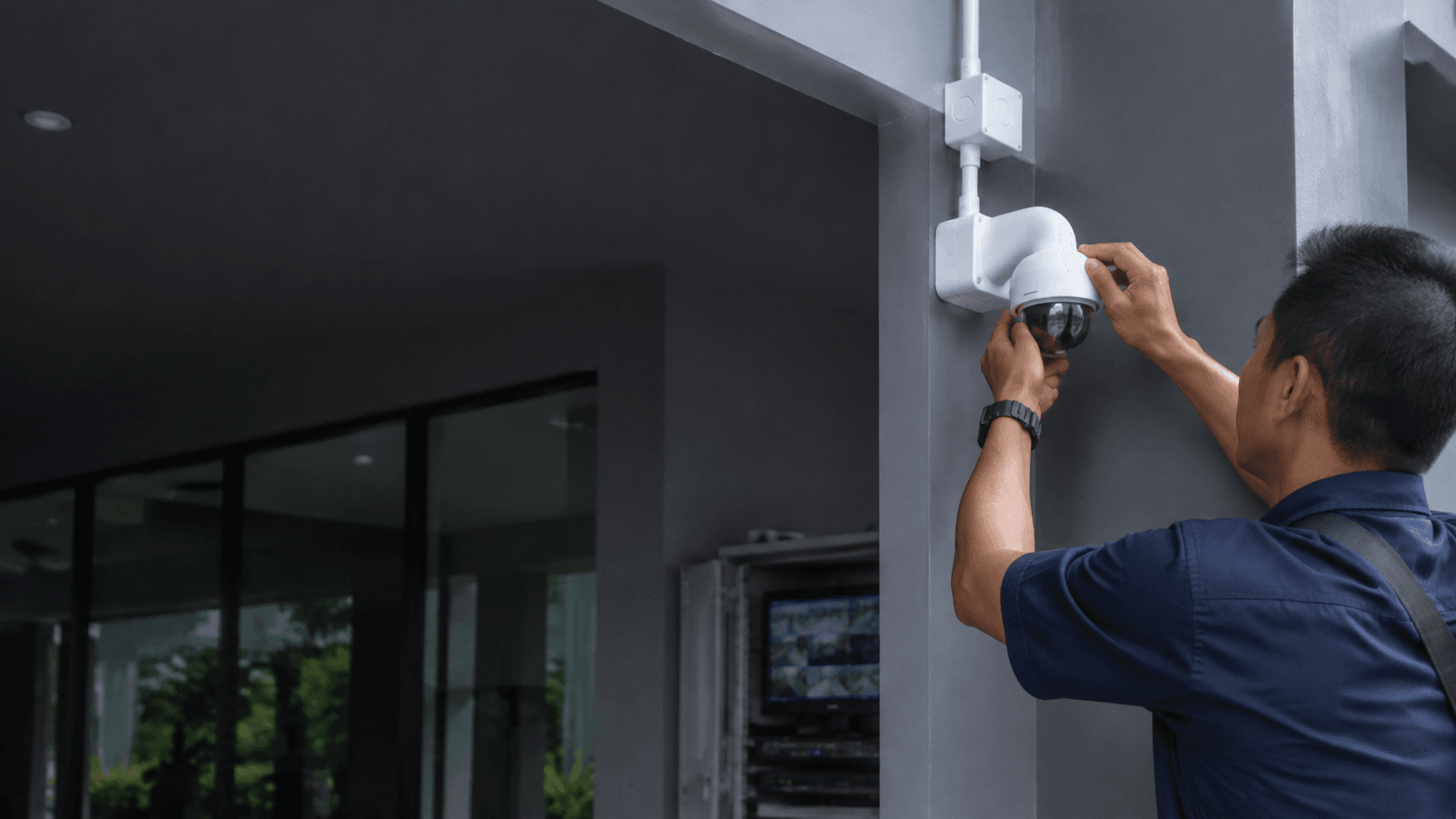
The 2MP figure describes how much picture detail a camera captures, not how well it will perform at a specific gate, counter or car porch. Two megapixels is a long-standing baseline in CCTV work, and it remains a common choice because it balances file size, storage cost and usable daytime clarity. What decides the outcome is where the camera points, what light falls on that scene after dark, and how the recorder is configured.
Eyonic's own installation process starts with a site survey and a system proposal before any hardware is fixed to a wall. That order matters for a 2MP camera because the same unit can look sharp over a doorway and disappointing across a wide open yard.
Hikvision Camera 2mp: What the 2MP Figure Actually Tells You
Megapixels count the pixels in a single frame. A 2MP camera produces an image of roughly 1920 by 1080 pixels, which is the same shape as standard 1080p video. That number sets the ceiling on detail, and everything else in the chain either preserves it or throws it away.
Three practical consequences follow from that ceiling.
- Site survey — Eyonic reviews the property, the areas to be covered and the existing cabling or network before proposing anything.
- System proposal — the camera type, placement, recorder and storage are set out so the coverage matches the actual risk points.
- Installation — cameras, cabling and the recorder are fitted and configured, including recording schedules and mobile viewing.
- Handover — the system is tested with the user, and viewing access is explained so the setup can be operated day to day.
Those four stages come from Eyonic's published CCTV installation service description for Sarawak. They are the sequence the company follows, not a generic industry template.
Resolution is a ceiling, not a guarantee
A 2MP sensor can only resolve so much detail across a given field of view. Point the same camera at a narrow doorway and a face fills a useful portion of the frame. Point it at a long driveway and the same face occupies a small cluster of pixels. The camera has not changed; the geometry has.
This is why a resolution number alone cannot answer whether 2MP is enough. The honest answer depends on the distance from camera to subject and how much of the frame the subject needs to occupy.
What 2MP does not tell you
The megapixel count says nothing about low-light behaviour, lens width, weather sealing, compression format or whether the unit is a network camera or an analogue one. Those are model-level details, and they vary across the Hikvision range. Any statement about a specific model needs that model's own documentation behind it.
Where a 2MP Hikvision camera fits in Malaysian homes, shops, and offices
For many Malaysian premises, 2MP remains a sensible working resolution. The case is strongest where the camera covers a defined zone at a moderate distance rather than an entire compound.
Typical fits include a shop entrance where faces and clothing need to be distinguishable, a back lane or service door, an office reception area, a staircase landing, and a residential gate where the camera sits close to the approach path. In each case the subject passes through a predictable band of the frame.
Weaker fits include wide perimeter coverage where a single camera is expected to identify people at the far fence line, and large open car parks where number plate legibility is the goal. Those situations usually push toward either more cameras at closer range or a higher-resolution unit.
Homes
A terrace house or semi-detached property usually has a small number of genuine risk points: the front gate, the car porch, a side passage and a rear door. A 2MP camera covering each of those at close range gives a recognisable record without generating enormous files.
Shops and offices
Retail and office premises tend to need coverage of entrances, counters and cash-handling areas. These are close-range, well-lit scenes during trading hours, which suits 2MP well. The harder question is what happens after closing, when lighting drops and the same camera has to work with far less light.
Eyonic's project work for the Kuching Immigration Office centred on arrival flow, staff areas, visitor movement and dependable daily operation. That is the kind of brief where coverage is planned around how people actually move through a building rather than around a raw camera count.
What to check on site before confirming a placement
Placement decisions made on a floor plan alone often fail once the building is in front of you. Several things are worth confirming physically before a position is locked in.
The first is the actual lighting at the scene, at the hours the camera needs to work. Eyonic's guidance on ColorVu-style cameras is to check real lighting conditions before confirming placement, because a scene that looks adequately lit during a daytime visit can behave very differently at night. The same discipline applies to any 2MP camera being positioned for night coverage.
The second is the distance and angle from the proposed mount to the subject. Standing at the mount point and looking along the intended line of sight reveals obstructions, glare sources and awkward angles that a plan view hides.
The third is the route for cable and power. A position that gives perfect coverage but no practical cable path usually gets abandoned during installation, and the fallback position is rarely as good.
The fourth is what the camera will see beyond the target area. A camera pointed at a neighbouring window or a public walkway creates problems that have nothing to do with resolution.
Lighting conditions
Lighting is the single most common reason a 2MP camera underperforms expectations. A scene with strong backlight from a shopfront window, or a porch lit by a single warm bulb, will not behave like a evenly lit indoor room. Checking the scene at the right hour is more useful than reading a specification sheet.
Distance and field of view
Two numbers matter together. how far the camera sits from the subject, and how wide the lens spreads the view. A wider view covers more ground but places fewer pixels on each person. Narrowing the view puts more pixels on the subject at the cost of coverage. That trade-off is decided on site, not in a catalogue.
How Eyonic plans a installation from survey to handover
Eyonic Sdn Bhd is a security system supplier based in Sarawak, working on CCTV and ELV systems for homes, offices, shops and industrial sites. The company's stated approach is planning, supply and installation, with camera placement, recording and remote viewing handled as part of the same job.
The founder, Eric Yong, has worked in the industry for more than 10 years, with a focus on technical installation of digital security solutions for commercial businesses in Sarawak. That background shapes how surveys are run: the questions asked on site are about how the premises operate, not only about where a camera can be mounted.
For a 2MP installation, the survey stage establishes which zones need identifiable coverage and which only need general awareness. The proposal then matches camera positions to those zones, sets the recorder and storage to suit the retention period required, and confirms how remote viewing will be delivered at handover.
Budget expectations vary widely with scope. Eyonic's published project figures give a sense of range: work of the kind carried out for the Kuching Immigration Office sits in an approximate budget band of RM 12,000 to RM 28,000, while the KTA Sarawak Sdn Bhd office project sits in an approximate band of RM 8,000 to RM 18,000. A basic Hikvision CCTV package covering camera supply and setup, basic recording configuration and mobile viewing handover is listed at RM 1,599.
Lighting distance and recording decisions that shape the result
Once placement is settled, three further decisions determine whether the footage is actually useful months later.
Recording resolution and frame rate affect how much detail survives into the archive. Recording at the camera's full resolution preserves the most detail but consumes more storage. Reducing either resolution or frame rate extends retention at the cost of clarity on moving subjects.
Retention period is a policy decision as much as a technical one. A shop that reviews footage weekly needs a different storage plan from an office that only retrieves clips after an incident. Storage sizing follows from that answer, not the other way round.
Remote viewing setup determines who can see what and from where. It is worth confirming at handover that the intended users can actually open the feed on their own devices, because a system nobody can operate remotely tends to be checked less often.
Compression and storage
Modern recorders compress video to reduce file size, and the compression setting interacts directly with how long footage is kept. Higher compression saves space and can soften fine detail. The right setting depends on whether the priority is long retention or maximum clarity on the clips that matter.
Night performance
Night performance depends on the light available at the scene and how the camera handles it. Infrared illumination extends usable range in darkness but produces monochrome images. Cameras designed for colour at night depend on ambient light being present. Neither approach removes the need to check the actual scene after dark.
Questions to settle before a 2MP camera is installed
Several questions are worth answering before installation day, because each one changes what gets fitted.
Which specific areas need identifiable coverage, and which only need to show that something happened? How far is each camera from the people it needs to record? What is the lighting like at those positions during the hours that matter? How long does footage need to be kept? Who needs remote access, and on what devices? Is there an existing recorder or cabling that will be reused?
Answering those before the survey shortens the process considerably. Leaving them open usually means the installation is designed around assumptions that get corrected later at extra cost.
One further point is worth stating plainly: no resolution figure, including 2MP, can be confirmed as sufficient for a specific site without knowing the distance, the lighting and the level of detail required. Those three facts come from the site, not from a product listing.
For premises in Sarawak, sharing the location, property type and the system required with Eyonic on WhatsApp at +60 11-5111 7959 gives a practical starting point for the next step.