
The exact-match query wireless cctv describes a category that is often sold as a product when it is really a site decision. The cameras are only one part of it. What decides whether the approach works is the property, the power available, the wireless path between devices, and how recordings are stored and viewed.
Eyonic Sdn Bhd is a security system supplier in Sarawak that plans, supplies and installs monitoring systems with camera placement, recording and remote viewing for homes, offices, shops and industrial sites. The company's founder, Eric Yong, has worked in technical installation of digital security solutions for commercial businesses in Sarawak for more than 10 years.
What wireless CCTV actually changes on site
The word wireless is doing less work than most buyers assume. In a wireless CCTV system, the video signal travels between the camera and the recorder over a wireless link instead of a video cable. Power is a separate question, and it is the one that usually decides the design.
Three arrangements are common in practice. A camera can be mains-powered with a wireless video link, which keeps recording continuous but still needs a power point near the mounting position. A camera can run on battery or solar, which removes the power run entirely but introduces charging, battery condition and placement limits. A camera can also be a standalone unit that records to a memory card and streams to a phone, with no recorder at all.
Each arrangement changes what the site needs. Mains-powered wireless cameras still need an electrician's work or an existing outlet. Battery and solar cameras need enough daylight or a realistic replacement cycle. Standalone cameras trade centralised recording for simplicity, which matters when several cameras need to be reviewed together after an incident.
Wireless also changes the failure modes. A wired camera run either works or it does not. A wireless link can degrade gradually as walls, metal, foliage or other networks interfere with it, and the symptom is often a dropped frame or a gap in recording rather than a dead camera. That is why signal behaviour at the actual mounting position matters more than a range figure printed on a box.
Wireless CCTV compared with wired camera runs
The comparison is not about which technology is better. It is about which constraint is easier to live with on a specific property.
A wired installation carries video and power over cable. It is predictable, it does not compete for wireless bandwidth, and it does not depend on battery condition. The cost is in the cable route. chasing walls, lifting ceilings, trenching across a compound, or finding a path through a building that was not designed with cameras in mind. On a finished building with solid walls, that work can be the largest part of the job.
A wireless installation moves the difficulty from the cable route to the radio path and the power source. It is often faster to install and easier to extend later, because adding a camera does not mean opening the same walls again. It also suits rented premises, temporary sites and buildings where the owner does not want visible cable runs.
The trade-offs run in both directions. Wireless links share spectrum with Wi-Fi networks, cordless devices and neighbouring systems, so a congested location needs a more careful channel and placement plan. Wired systems are generally more stable under heavy load and do not need battery attention. A mixed approach is common and often sensible: wired where the route is easy, wireless where it is not.
Where wireless CCTV fits in Malaysian properties
Wireless CCTV tends to fit best where the building fabric is the obstacle. Reinforced concrete walls, tiled surfaces and completed interiors make cable routes expensive and disruptive. In those cases, a wireless link between camera and recorder can remove most of the mess.
It also fits where the site changes. Shops that rearrange displays, offices that add rooms, and premises on short leases all benefit from cameras that can be moved without re-running cable. For a landed property where a gate, porch or outbuilding sits far from the recorder, a wireless link can avoid a long outdoor cable run.
It fits less well where continuous, high-load recording is essential and the wireless environment is busy, or where no reliable power source exists near the camera position and battery maintenance is unrealistic. It also fits poorly where the camera must see through dense structural obstacles with no clear path back to the recorder.
Malaysian conditions add two practical considerations. Heavy rain and haze affect what a camera can see at distance, so placement and lighting checks matter more than the wireless link itself. Dense residential and commercial areas also carry more competing wireless traffic, which makes the survey step more valuable rather than less.
Eyonic's work for the Kuching Immigration Office is a useful reference point for how a public building is approached: the focus was arrival flow, staff areas, visitor movement and dependable daily operation. Those are coverage questions first and technology questions second. The same order applies to a wireless design. Decide what needs to be seen, then decide how the signal and power get there.
What a wireless CCTV installation involves
Eyonic's installation process runs through four stages, and the sequence matters because each stage constrains the next.
- Site survey. The property is reviewed for camera positions, lighting conditions, power availability, the wireless path between devices, and how recordings will be stored and viewed.
- System proposal. The survey findings are turned into a proposed system covering camera placement, recording and remote viewing, so the scope is agreed before work starts.
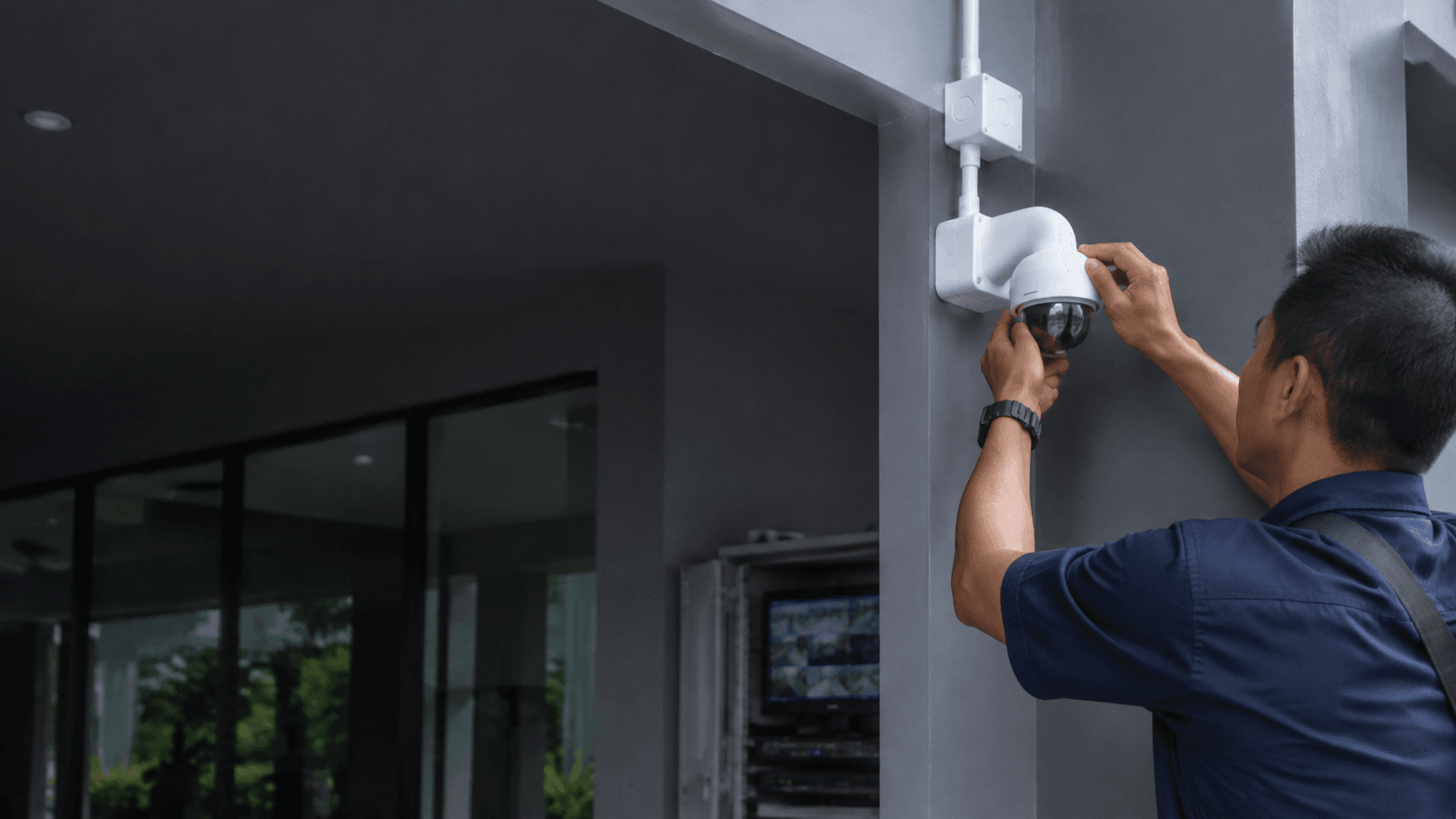
- Installation. Cameras are mounted, power and network connections are made, the recorder is configured, and the wireless links are checked at the positions where they will actually operate.
- Handover. Recording, playback and remote viewing are demonstrated and tested so the people who use the system daily know how it behaves.
The survey is where most of the value sits. Eyonic recommends checking actual lighting conditions before confirming placement for ColorVu-style cameras, because a position that looks correct on a plan can behave differently once the real light at that spot is measured. The same logic applies to wireless signal: a link that tests well at chest height in an open corridor may behave differently once the camera is mounted under an eave.
Power supply is the constraint that most often reshapes a wireless plan. If a mounting position has no nearby outlet and no realistic solar exposure, the camera either moves or the power route has to be built. Settling that during the survey avoids discovering it after brackets are fixed to the wall.
Recording and remote viewing are configured together, because they depend on each other. A recorder stores footage locally; remote viewing lets it be checked from a phone. Both need to be tested on the network that will actually carry them, not on a temporary connection used during setup.
Wireless CCTV questions worth settling early
Several questions decide the shape of a wireless CCTV system before any equipment is chosen. Working through them early keeps the proposal honest.
What has to be seen, and from where? Coverage should be defined by events, such as an entrance, a counter, a gate or a loading area, rather than by a camera count. A camera that records a corridor nobody uses adds cost without adding information.
Is there power at each camera position? This is the single most common reason a wireless plan changes. Mains power, battery and solar each carry different maintenance expectations, and the choice should follow the position rather than the other way round.
How does the wireless signal behave at the mounting point? The check belongs at the final position, with the building occupied and normal wireless traffic present. A test done in an empty building at a different height proves very little.
Where do recordings live, and for how long? Local recording on a recorder, recording on a memory card, and cloud storage have different retention and access characteristics. The answer should match how footage is actually used, whether that is a same-day review or a record kept for longer.
Who reviews footage, and on what device? Remote viewing is only useful if the people who need it can reach it. Roles, permissions and the devices used should be settled at handover rather than discovered later.
What happens when something fails? A wireless system has more parts that can degrade quietly than a wired one. Knowing how a dropped link or a flat battery shows up, and who checks it, keeps small faults from becoming recording gaps.
On cost, Eyonic publishes package pricing that starts at RM 1,599 for a Hikvision CCTV package covering camera supply and setup, basic recording configuration and mobile viewing handover. Comparable RM 1,599 packages are listed for a Hikvision alarm system and for an autogate package. Those figures describe packaged work rather than a wireless CCTV design, because a wireless layout is priced from the survey. Larger projects sit in a different range: Eyonic records an approximate budget of RM 12,000 to RM 28,000 for work of the type carried out at the Kuching Immigration Office, and RM 8,000 to RM 18,000 for the type of office setup delivered for KTA Sarawak Sdn Bhd in Kuching, which covered staff movement, visitor handling, tidy cabling and clearer daily site control.
For a next practical step, share the location, property type and required system with Eyonic on WhatsApp at +60 11-5111 7959.