
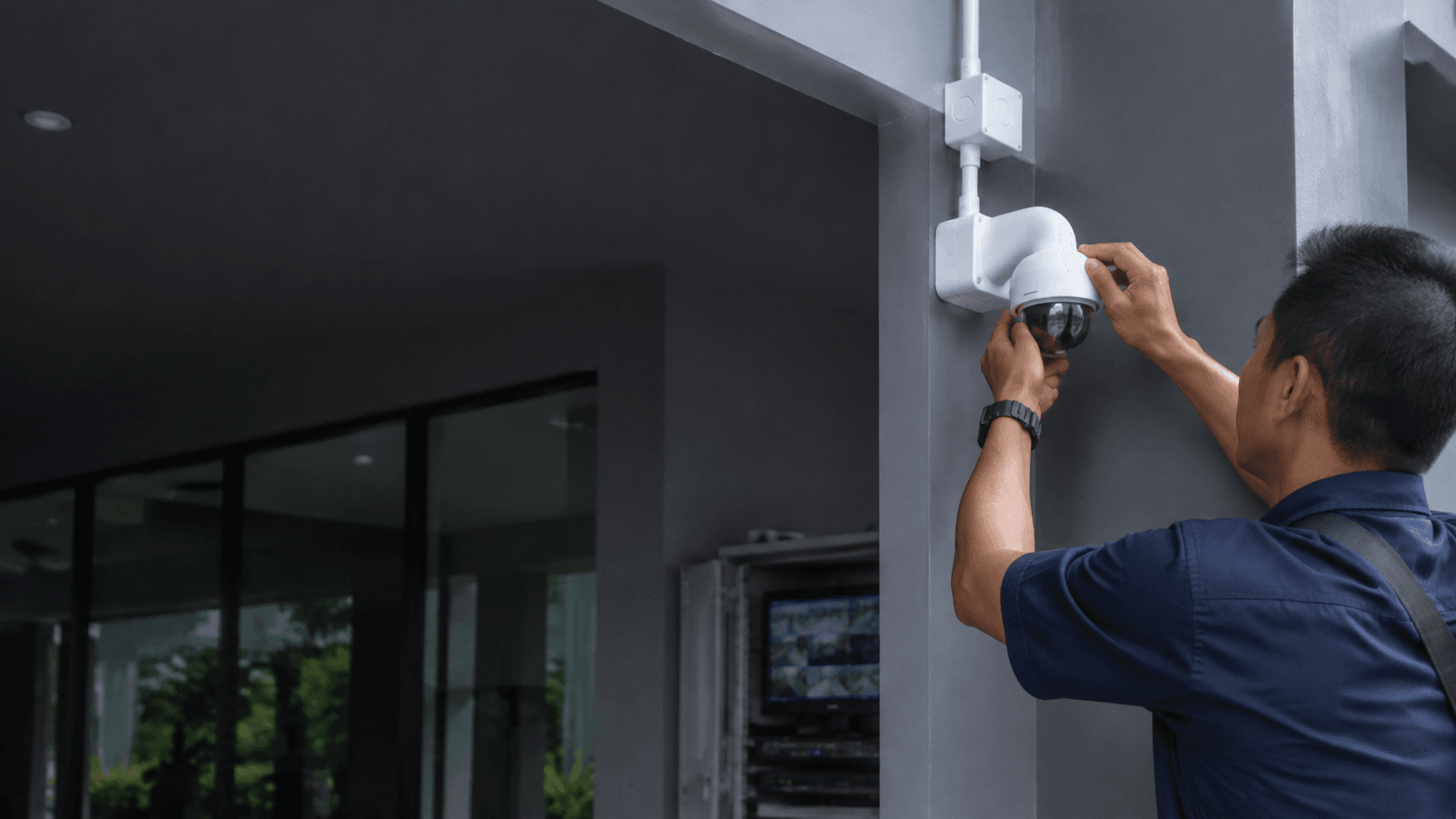
The exact phrase adt floodlight camera points to a specific question: does ADT sell a camera with a built-in floodlight, and what does a buyer need to settle before choosing one? The honest answer is narrower than most search results suggest. ADT's camera range is built around Google Nest hardware, and the floodlight model in that range is the Nest Cam with floodlight, sold, installed and serviced through ADT in supported markets. That is a real product, but it is not an ADT-branded floodlight camera, and no verified specification, price or Malaysian availability for it appears in the evidence behind this page.
That distinction matters in Malaysia, where the practical question is rarely the brand name. It is whether a floodlight camera can be supplied, positioned, powered and supported on a specific property. The sections below work through what the product actually covers, how lighting decides placement, what power and mounting demand, and how a local installation is planned.
What an Adt Floodlight Camera actually covers
A floodlight camera combines two jobs in one housing: a motion-triggered light and a camera that records what the light reveals. The light is not decoration. It changes the exposure the camera works with, which is why a floodlight model behaves differently from a standard outdoor camera on the same wall.
Coverage is usually described in three ways, and each one constrains the others:
- Field of view — how wide the lens sees. A wider view covers more of a driveway or yard but makes distant detail smaller.
- Detection zone — the area that triggers recording and the light. A zone set too wide fires on passing traffic; too narrow and it misses the approach.
- Light throw — how far the floodlight actually illuminates. Beyond that distance the camera is recording in the dark.
Those three interact. Widening the view to cover a corner often pushes the detection zone into a neighbour's gate or a public road, and the light throw may not reach the far edge of the new frame. The result is a camera that records a lot of nothing and misses the one approach that matters.
ADT's own camera line is organised around Google Nest models, with the floodlight variant sitting inside that range rather than as a separate ADT-designed product. Buyers searching for an ADT floodlight camera are therefore usually comparing a Nest floodlight camera supplied through ADT against other floodlight cameras on the local market. No verified resolution, lumen output, field-of-view figure or price for that model is available in the evidence used here, so those numbers should be confirmed with the supplier before any commitment.
Lighting conditions decide where a floodlight camera works
Placement is a lighting decision before it is a camera decision. A floodlight camera performs well where the scene is dark enough for its light to matter and controlled enough that the light is not fighting a stronger source.
Three conditions change the answer:
- Existing light. A porch lamp, streetlight or shop sign already lighting the area can wash out the floodlight's contribution and confuse motion detection.
- Reflective surfaces. Wet tarmac, polished tile, glass doors and car bodies bounce light back into the lens, producing glare that hides faces and plates.
- Direction of approach. A camera facing the direction people walk toward captures faces. A camera watching people walk away captures backs.
Eyonic's own guidance on low-light cameras is to check the actual lighting conditions on site before confirming placement, rather than assuming a model's night performance from a specification sheet. That advice applies directly to floodlight cameras, because the floodlight is only useful if the scene genuinely needs it.
Edge cases worth naming. a covered car porch may be too bright for the floodlight to trigger usefully, while an open compound with no ambient light may need the floodlight plus a second camera covering the gate. A camera mounted under a wide eave can have its light blocked by the eave itself, lighting the wall instead of the ground.
Power, wiring and mounting before any model choice
Floodlight cameras draw more power than a standard camera because the light and the camera share a supply. That single fact drives most of the installation constraints.
What has to be settled before a model is chosen:
- Power source. A permanent live feed is needed for the light to work on demand. Battery models exist in the wider market, but a floodlight that only wakes on battery behaves differently from a wired one.
- Cable route. The route from the nearest supply point to the mounting position determines cost and tidiness more than the camera itself does.
- Mounting height. High enough to be out of reach, low enough that the light reaches the ground and the lens captures faces rather than the tops of heads.
- Weather exposure. In Malaysian conditions, rain driving sideways into a housing and heat cycling on a cable joint are routine failure points.
- Network reach. A camera position with weak Wi-Fi produces a camera that records locally but streams poorly to a phone.
No verified local wiring standard, voltage requirement or warranty term for floodlight cameras in Malaysia is present in the evidence behind this page, so those specifics belong with the installer doing the work. What can be said plainly is that the power and cable decision is made on site, not from a product page, and it usually costs more to change after the wall is drilled than before.
How Eyonic plans a floodlight camera installation
Eyonic Sdn Bhd is a security system supplier in Sarawak that plans, supplies and installs CCTV and ELV systems for homes, offices, shops and industrial sites. The company's founder, Eric Yong, has worked in technical installation of digital security solutions for commercial businesses in Sarawak for more than ten years.
The installation sequence is fixed, and it applies to a floodlight camera the same way it applies to any camera position:
- Site survey. The property is walked to check lighting, approach routes, existing cabling and where a camera can actually be mounted.
- System proposal. The survey findings become a proposed layout, camera positions and scope of work.
- Installation. Cabling, mounting, recording setup and configuration are carried out to the agreed layout.
- Handover. Recording, playback and remote viewing are demonstrated and tested with the user before the job closes.
That order matters because it puts the lighting and power questions before the product question. A floodlight camera chosen first and positioned second tends to end up wherever the cable already runs, which is rarely where the coverage is needed.
Eyonic's completed work includes the Kuching Immigration Office, a public office project focused on arrival flow, staff areas, visitor movement and dependable daily operation, and KTA Sarawak Sdn Bhd, an engineering consultancy office in Kuching set up to support staff movement, visitor handling and tidy cabling. Neither project is a floodlight camera installation, and no completed Eyonic floodlight camera project is claimed here. They are useful as evidence of how the company scopes camera positions around movement and lighting rather than around a product list.
Eyonic's published packages start at RM 1,599 for a Hikvision CCTV package covering camera supply and setup, basic recording configuration and mobile viewing handover. That package is a CCTV package, not a floodlight camera package, and no floodlight camera price is published.
Adt Floodlight Camera questions worth settling early
Does ADT make its own floodlight camera? The evidence available here does not support an ADT-branded floodlight camera. ADT's camera range is built around Google Nest models, and the floodlight model in that range is the Nest Cam with floodlight, which ADT sells, installs and services in supported markets.
Is an ADT floodlight camera available in Malaysia? No verified ADT Malaysia availability, dealer network, subscription plan or monitoring arrangement appears in the evidence behind this page. Buyers in Malaysia should confirm availability and support directly rather than assuming a global product page applies locally.
What should be confirmed before choosing any floodlight camera? Four things: the actual lighting at the mounting position, the direction people approach from, whether a permanent power feed can reach that position, and how the footage will be viewed remotely. A camera that satisfies all four is more useful than a higher-specification model that satisfies two.
Does a floodlight camera replace a standard outdoor camera? Not always. A floodlight camera covers one approach well. A property with two approaches, a gate and a side lane usually needs more than one camera position, and the floodlight model is best used where its light adds something the scene does not already have.
What happens at handover? Recording, playback and remote viewing are tested with the user so the system is understood before the installer leaves. That step is where most day-to-day problems surface, because a camera that records correctly but streams poorly is discovered at handover rather than months later.
For a property in Sarawak, the practical next step is a site survey rather than a product comparison. Share the location, property type and required system with Eyonic on WhatsApp at +60 11-5111 7959 to arrange that step.