
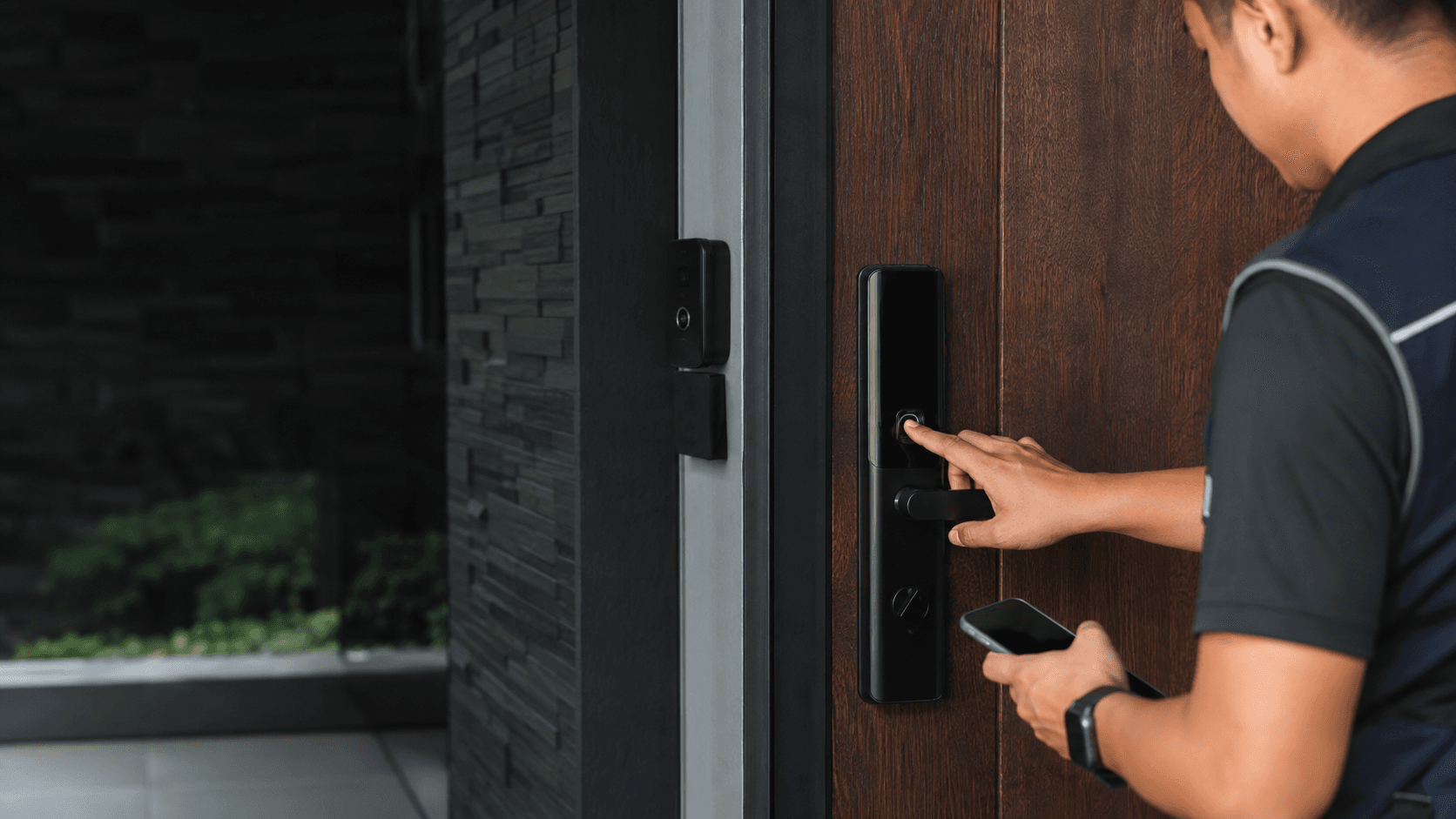
The term covers a family of small locks rather than one product. Most are hidden inside the furniture, so the outside of the drawer keeps its original look. That hidden mounting is why the category is often searched as a hidden drawer lock or a smart cabinet lock.
Interest in Malaysia tends to come from three places: homes that want medicines, documents or liquor kept out of reach; offices that need controlled access to files and cash; and retail or workshop sites where lockers hold tools and personal items. The hardware is small, but the decision behind it is not, because the lock has to match the drawer, the people who open it, and what happens when the battery runs down.
Drawer smart lock. what the term covers
A drawer smart lock combines a small locking mechanism with an electronic credential. The mechanism sits inside the cabinet or behind the drawer front. The credential is what the user presents: a phone app over Bluetooth, an RFID card or tag, a code, or a mechanical key.
Three features separate this category from an ordinary cabinet lock.
- Electronic release. The bolt moves when a valid credential is presented, not when a key turns.
- User management. Many models let an administrator add or remove users without changing hardware.
- Access history. Some app-controlled locks record which credential opened the compartment and when.
Not every model carries all three. A basic battery-powered lock may offer only card access with no app and no log. A fuller system may add auto-lock, so the drawer relocks itself after it closes, and low-battery alerts before the cell goes flat.
Two limits are worth stating plainly. First, a drawer smart lock secures a compartment, not a room. It does not replace door access control, an alarm system or CCTV, and it should not be described as if it does. Second, published specifications vary widely between models. Drawer thickness limits, battery type, wireless range and ingress rating differ from one product to the next, so those figures have to come from the datasheet of the exact model under consideration rather than from the category as a whole.
Where a drawer smart lock fits in a Malaysian home or office
Fit is decided by the furniture, not by the lock. A drawer smart lock suits a compartment with a solid front, enough internal clearance behind the panel for the lock body, and a frame that can take a striker or catch. Thin plywood drawer boxes, loose runners and warped fronts are the usual reasons an installation turns awkward.
In homes, the common placements are kitchen and bathroom cabinets holding cleaning chemicals, medicine drawers, liquor cabinets, and home-office drawers with passports or title documents. The appeal is child safety and privacy rather than high-security storage.
In offices and commercial premises, the pattern shifts. A drawer smart lock is used on filing cabinets, cash drawers, stationery cupboards, staff lockers and equipment cabinets. Here the value is controlled access and a record of who opened what, which matters when several people share the same furniture.
Malaysian conditions add two practical considerations. Humidity in coastal and lowland areas works against any lock with exposed metal parts, so the mounting position and the finish matter over time. And in rented premises, drilling into a landlord's cabinet is often unwanted, which pushes some buyers toward surface-mounted or adhesive-assisted options where the model supports them.
Eyonic's own project work in Sarawak has centred on offices and public buildings where staff movement, visitor handling and dependable daily operation were the priorities, including the Kuching Immigration Office project and an office setup for KTA Sarawak Sdn Bhd. Those projects were security and ELV installations rather than cabinet-lock jobs, and they are useful mainly as a reminder that compartment-level locking is usually one small part of a wider site plan.
Access methods compared. app, RFID card, and keyed backup
The access method decides who can open the drawer, how quickly, and what happens when something fails. The table below compares the three common approaches at the level of use and verification, without model-specific figures.
| Access method | Typical use | What to verify |
|---|---|---|
| App or Bluetooth control | One person or a small team opening the same drawer regularly; useful where an access log is wanted | Whether the app needs an account, whether the lock works offline, and what happens if the phone is lost or the battery is flat |
| RFID card or tag | Shared furniture where several staff need entry without handing over a phone | Card frequency and type, how cards are enrolled and revoked, and whether a lost card can be cancelled |
| Keyed or mechanical backup | Emergency entry when power, battery or connectivity fails | Where the key is stored, who holds it, and whether the key cylinder can be re-keyed |
App control is the most flexible and the most dependent. It usually relies on Bluetooth, so the user has to be within range of the lock, and remote opening generally needs a bridge or gateway that the manufacturer supports. If the phone is unavailable, the drawer stays shut unless a second method exists.
RFID is the better fit for shared furniture. A card or tag is quick to present, does not need a charged phone, and can be issued to a cleaner, a technician or a temporary staff member without giving them app access. The trade-off is that cards get lost, so enrolment and revocation have to be managed deliberately.
Keyed backup is not a fallback to be added later. It is the method that keeps the compartment usable during a flat battery, a failed reader or a lost phone. Where a lock offers a mechanical override, the key should be stored somewhere that is itself controlled, and the person responsible for it should be named before installation rather than after the first lockout.
What to check before choosing a drawer smart lock
Most disappointing installations trace back to a question that was never asked before the order. Working through the checks below in order prevents the common mismatches.
- Confirm the drawer or cabinet construction and clearance. Check the panel material, the internal depth behind the front, and whether a striker or catch can be fixed without fouling the runners.
- Confirm the access method and who needs entry. Decide whether the compartment serves one person, a small team or a rotating group, because that choice drives app, card or code.
- Confirm the backup entry method. Establish how the drawer opens when the battery is flat, the phone is lost or the reader fails, and where the override key or credential is kept.
- Confirm the power source and low-battery behaviour. Ask what the lock runs on, how the user is warned before the cell is exhausted, and whether the lock fails locked or fails open.
- Confirm whether a standalone lock or an access-control panel suits the site. A single drawer usually needs a standalone lock; a bank of lockers or a site with many users may need a managed panel instead.
The last check is the one buyers skip most often. Eyonic's own guidance on smart lock door access is that locks work best when the door condition, user roles and backup method are reviewed before installation, and that for business use the choice between a standalone smart lock and an access-control panel should be settled first. The same logic applies one size down, at drawer level.
Two further questions are worth settling early. If the drawer holds something regulated or genuinely valuable, a compartment lock is a deterrent and an access record, not a vault. And if the site already runs CCTV, an alarm or door access control, the drawer lock should be treated as one layer in that system rather than a separate purchase with its own rules.
Installation and handover for drawer smart lock projects
Installation quality decides whether the lock survives daily use. A mechanism that is slightly misaligned will still open on day one and start binding within weeks, usually because the drawer front shifts on its runners or the striker was set against a soft panel.
The work itself follows a predictable sequence: survey the furniture and the users, propose the lock and access method, install and align the mechanism, then hand over credentials and the backup method. Eyonic's published installation process for its security work follows the same shape, covering site survey, system proposal, installation and handover.
Handover is where most value is lost. A drawer smart lock is only as good as the person who knows how to add a user, remove a departed staff member's card, and open the drawer when the battery dies. That knowledge should be written down and given to a named person, not left with the installer.
For multi-unit sites, such as a bank of staff lockers or a row of cash drawers, the practical questions change. Enrolment has to be repeatable across units, revocation has to be quick, and the site needs a rule for what happens when a credential is lost. A managed access-control approach usually suits that scale better than a set of independent locks.
Where a project spans several systems, the sensible order is to settle the wider security layout first and treat compartment locking as a detail within it. Eyonic's project work in Sarawak has covered CCTV, alarm, autogate, keyphone intercom and Starlink installation for homes, offices, shops and industrial sites, and the same survey-first approach applies when cabinet or drawer locking is added to an existing setup.
Drawer smart lock questions buyers ask before ordering
Does a drawer smart lock work without Wi-Fi? Bluetooth and RFID models generally work locally without an internet connection. Remote opening and cloud access history usually need a bridge or gateway, so the requirement should be confirmed against the specific model.
What happens when the battery runs flat? Behaviour depends on the model. Some provide a low-battery warning and a mechanical override; others may need external power to release. This is a question for the supplier before purchase, not after.
Can one lock secure a double-door cabinet? Some cabinet locks are designed for single or double doors, but the mounting and striker arrangement differs. The furniture should be assessed rather than assumed compatible.
Is a drawer smart lock suitable for a business with many staff? For a handful of users, a standalone lock is usually enough. For larger groups, rotating staff or multiple compartments, a managed access-control panel is generally the more workable choice.
How is the lock powered and maintained? Most models in this category are battery-powered, which means battery replacement is part of routine upkeep. The replacement interval depends on usage and on the model, so it should be confirmed from the manufacturer's documentation.
Buyers in Malaysia should also confirm what is actually available locally before committing to a model. Availability, pricing and installation scope for drawer smart locks vary by supplier, and a specification that looks suitable on a foreign product page may not be supported in this market.
For sites in Sarawak that need compartment locking as part of a wider security setup, share the location, property type and required system with Eyonic on WhatsApp at +60 11-5111 7959.