
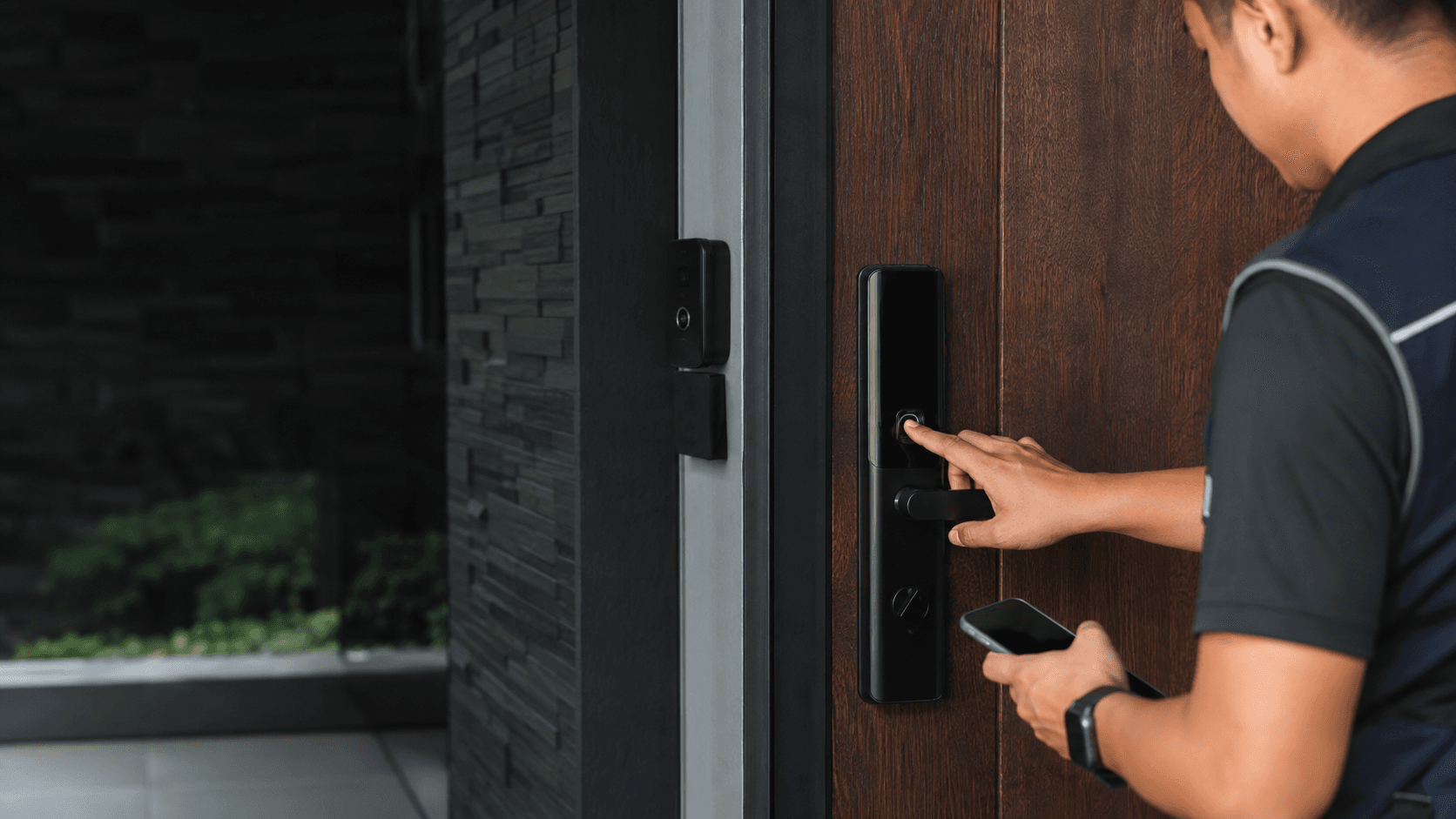
The exact-match query yale keyless door lock describes a category rather than one product. Yale Home's own smart lock collection names several distinct families, including the Assure Lock 2, Assure Lock 2 Touch, Assure Lock 2 Plus, Approach Lock, Assure Lever and Code Keypad Lock. Each family changes how a door is opened, who can open it, and what happens when power or connectivity fails.
That distinction matters in Malaysia, where a single property can mix a timber main door, a metal gate, a glass office entrance and a rented unit that cannot be permanently modified. The sections below cover what keyless entry changes, how the model families differ, what to check on the door before buying, and how the choice shifts between homes, offices and rental units.
What keyless entry changes at the door
A keyed lock grants access through one physical object. A keyless lock grants access through a credential: a numeric code, a fingerprint, a phone, a card or a digital wallet pass. The mechanical deadbolt still throws and retracts, but the decision about who may enter moves from the key to the lock's electronics and user list.
Three practical consequences follow.
First, access becomes revocable without rekeying. Removing a code or a user from the lock's list ends that person's entry, which is why keyless entry suits properties with changing occupants such as rental units, serviced offices and staffed counters.
Second, access becomes auditable in models that log events. A lock that records which credential opened the door at what time gives a property owner a record that a mechanical key cannot produce.
Third, access becomes dependent on power and on the credential channel. A keypad lock needs battery power. An app-based lock needs the phone, the app and, for remote control, a network connection. That dependency is the main reason backup entry has to be planned before installation rather than after.
Eyonic's own product review guidance states that smart locks work best when door condition, user roles and backup method are reviewed before installation, and that for business use the choice between a standalone smart lock and an access-control panel should be checked first. That is a fit question, not a brand question.
Yale keyless door lock models and access methods
Yale's range separates mainly by access method and by how the lock attaches to the door. The named families below come from Yale Home's smart lock collection and from retailer listings; the access method is the useful comparison point, because it determines daily use.
Keypad and code entry
The Code Keypad Lock family is the simplest form: a pushbutton or touchscreen keypad on a deadbolt, with no app requirement for basic entry. This suits a main door where the household wants to stop carrying keys but does not want to manage a phone app. The trade-off is that code sharing is manual, and a shared code has to be changed when it is no longer appropriate.
Touchscreen and fingerprint entry
The Assure Lock 2 line appears in retailer listings in several configurations, including touchscreen keypad versions and a fingerprint access version. Fingerprint entry removes the need to remember or type a code, which helps at a door where hands are full. The trade-off is enrolment. every user's fingerprint has to be registered at the lock, and a failed read still needs a fallback such as a code.
App, Bluetooth and Wi-Fi entry
Yale Home describes adding Wi-Fi and Bluetooth so the lock can be controlled through the Yale app. Bluetooth covers close-range phone unlocking; a Wi-Fi module extends that to remote control and notifications. Remote control is the feature most likely to be over-specified for a single household and most likely to be genuinely useful for a landlord or an office administrator.
Retrofit and adapter locks
The Approach Lock is an adapter-style lock, and Yale also lists a smart lock conversion kit that works with an existing deadbolt and keys. These options matter where the existing deadbolt is sound and the property owner prefers not to replace the whole assembly. The trade-off is that the finished door keeps the original exterior hardware, so the visible upgrade is smaller.
Lever and handle formats
The Assure Lever replaces a lever handle rather than a deadbolt. This is relevant for doors that use a lever rather than a deadbolt, and for internal doors where a full deadbolt is not the right hardware.
Door condition and installation checks before buying
Most keyless lock problems trace back to the door, not the electronics. A lock that binds, misaligns or drains batteries usually sits on a door that was already out of alignment. Working through the checks in order avoids buying hardware that cannot be fitted properly.
- Confirm the door and frame condition, including whether the door closes squarely, whether the existing latch lines up with the strike plate, and whether the frame is solid enough to hold the lock body.
- Confirm door thickness and the existing deadbolt, because replacement and retrofit locks mount differently and a conversion kit depends on the current deadbolt being suitable.
- Decide the access method, choosing between keypad, fingerprint, app or a combination, based on who needs to enter and how often.
- Plan user permissions, deciding who gets a permanent credential, who gets a temporary one, and who can add or remove users.
- Plan a backup entry method, covering what happens when the battery is flat, the phone is unavailable or the network is down.
- Confirm who installs and hands over, including who tests the lock, registers users and explains the backup procedure.
Eyonic's installation process for its security work follows site survey, system proposal, installation and handover. The same sequence applies to door hardware: the survey establishes whether the door suits the lock, and the handover establishes that the users know how to get in when the primary method fails.
Two edge cases are worth naming. A metal gate or a door with unusual thickness may not accept a standard replacement lock, and a fire-rated door may restrict what can be fitted. Neither can be settled from a product page; both need the actual door checked.
Keyless entry for homes offices and rental units in Malaysia
The same lock category serves three different jobs, and the priorities shift with each.
For a home, the priority is daily convenience and a reliable fallback. A keypad or fingerprint lock on the main door removes key handling for a household, and the backup is usually a code plus a mechanical key where the model supports one. Remote app control adds little to a home where someone is normally present.
For an office, the priority is user management. Staff join and leave, visitors arrive at set times, and someone has to be able to revoke access without changing hardware. This is where the standalone-versus-panel question becomes real: a standalone smart lock manages a single door with its own user list, while an access-control panel manages multiple doors and integrates with other systems. Eyonic's review guidance flags exactly this check for business use.
For a rental unit, the priority is turnover. A short-stay unit benefits from per-guest codes that expire, so no key handover is needed and no key is copied. A long-term rental benefits from the ability to remove a former tenant's access immediately. In both cases the owner needs a way to manage users remotely, which points toward a Wi-Fi connected model rather than a keypad-only lock.
Eyonic's completed work in Sarawak has centred on movement and access in occupied buildings. The Kuching Immigration Office project covered arrival flow, staff areas, visitor movement and dependable daily operation, and the KTA Sarawak Sdn Bhd project covered staff movement, visitor handling and clearer daily site control. Both illustrate the same principle that applies to a keyless door: the hardware serves a movement pattern, and the pattern should be defined first.
questions before installation
Does a keyless lock remove the need for a key entirely? Not always. Some models are key-free, while others retain a keyed cylinder or work with an existing deadbolt and keys. The choice affects both the backup plan and whether the property's existing keys remain valid.
What happens when the battery runs flat? Every battery-powered lock needs a defined fallback, which may be a mechanical key, an external power contact or a second entry method. The fallback should be tested at handover, not assumed.
Can a keyless lock be fitted to an existing door? Often yes, but it depends on door thickness, the existing deadbolt and the frame condition. A conversion kit or adapter lock can avoid replacing the whole assembly where the current deadbolt is suitable.
Is a standalone lock or an access-control panel the better fit? A standalone lock suits one door with a small user list. A panel suits multiple doors, shared rules and integration with other building systems. The deciding factor is the number of doors and the number of people whose access changes regularly.
Who should install it? A lock that is installed out of alignment will keep binding and draining batteries, so installation quality matters as much as the model. Eyonic's own process begins with a site survey and ends with handover, which is the sequence that catches door problems before hardware is ordered.
Eyonic Sdn Bhd is a security system supplier in Sarawak that plans, supplies and installs monitoring and ELV systems for homes, offices, shops and industrial sites, and lists smart lock door access among its reviewed product categories. Its founder, Eric Yong, has worked in technical installation of digital security solutions for commercial businesses in Sarawak for more than 10 years.
Share your location, property type and required system with Eyonic on WhatsApp at +60 11-5111 7959 for the next practical step.