
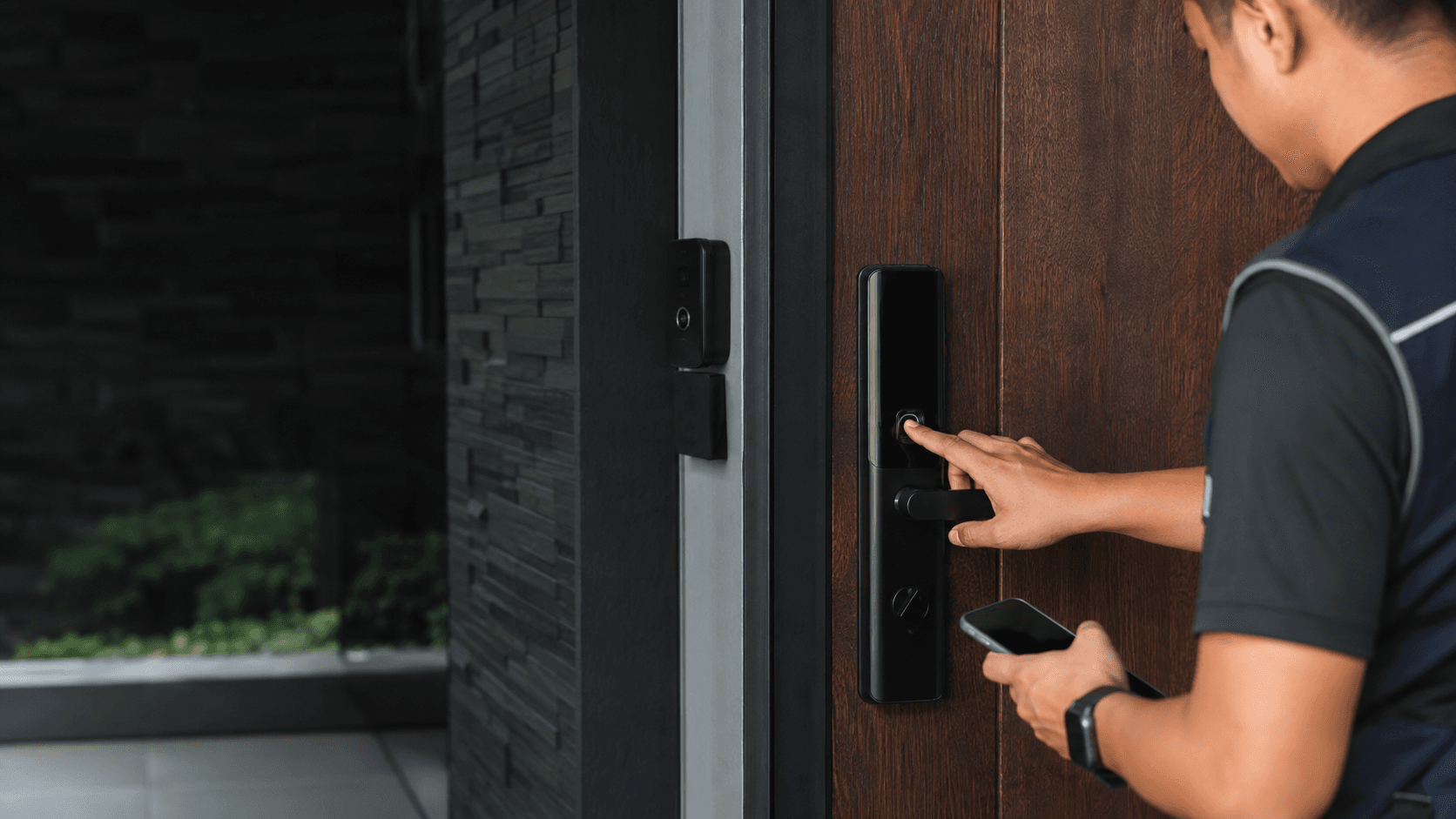
SmartRent builds access hardware for rental housing and multifamily properties, and its lock line sits inside a wider access-control offering that covers credentials, resident access management and community activity monitoring. Eyonic Sdn Bhd, a security system supplier in Sarawak, reviews smart locks on the same practical basis: whether the door itself is suitable, who needs entry, and what happens when the electronics fail.
That review-first approach matters because a smartrent door lock is not a universal fit. The device type, the door it mounts on, and the way users are managed all change the outcome, and none of those can be settled from a product photo alone.
What a Smartrent Door Lock Is Used For
A smartrent door lock replaces or supplements a mechanical key with an electronic credential. Across the competitor set, the recurring uses are keyless entry, mobile access, PIN codes and remote management, with lock boxes and access-control hardware appearing alongside the locks themselves.
In practice that means three everyday jobs:
- Giving a resident, staff member or visitor entry without issuing a physical key.
- Changing or removing that entry right when a tenancy, shift or booking ends.
- Keeping a record of who was granted access and when, where the platform supports it.
The rental-property angle is the strongest signal in the competitor set. SmartRent's own material frames locks around rental housing, and August markets renter-friendly locks that fit over an existing deadbolt. Both point at the same problem. keys are hard to track when people move in and out.
Eyonic's product review notes reach a similar conclusion from the installation side. Smart locks work best when the door condition, user roles and backup method are reviewed before installation, and for business use the usual question is whether a standalone smart lock or an access-control panel is more appropriate.
Smartrent Door Lock Compared With Other Access Options
The comparison that decides most projects is not brand against brand. It is standalone smart lock against access-control panel, because the two solve different scales of problem.
A standalone smart lock is a single-door device. It suits a home, a small office, a server room or a unit where one entrance needs controlled convenience and the user list is short. It is the simpler path when the door is already in good condition and the property does not need centralised credential management.
An access-control panel sits at the other end. It suits buildings where many doors, many users and many permission changes have to be managed together, and where credentials need to be issued and revoked from one place. SmartRent's access-control product line is built around that multifamily scenario, where credentials and community activity are managed centrally.
Between those two ends sit options that are not locks at all. A keyphone intercom controls who is admitted at a gate or lobby without touching the door hardware. An alarm system covers intrusion detection rather than entry. An autogate package handles vehicle access. Each answers a different question, and mixing them up is a common reason a project ends up with hardware that does not match the actual traffic.
There is also a practical middle path worth naming. August's renter-focused approach fits over an existing deadbolt rather than replacing the lock, which keeps the original hardware in place. That is a different trade-off from a full replacement, and it matters where a landlord or building owner restricts modifications.
What to Check Before Choosing a Smartrent Door Lock
Four checks decide whether a smartrent door lock is the right choice for a specific door. They are worth completing before any hardware is ordered, because each one can rule a device in or out.
- Confirm the door condition, including alignment, thickness and how freely it currently closes.
- Define user roles, so it is clear who needs permanent, temporary or one-time entry.
- Plan a backup entry method for the moment power, battery or network fails.
- Decide between a standalone smart lock and an access-control panel based on how many doors and users must be managed together.
Door condition comes first because it is the least negotiable. A door that binds, sits out of alignment or has been modified previously may not accept a replacement lock cleanly, and the fix is often carpentry rather than electronics. This is the same discipline Eyonic applies to camera placement, where actual site conditions are checked before a position is confirmed rather than assumed from a plan.
User roles come second because they determine whether a standalone device is enough. A household with four people needs very little. A building with rotating tenants, cleaners, contractors and maintenance staff needs a way to issue and revoke access without visiting the door, and that requirement pushes the decision toward a panel.
Backup entry is the check most often skipped. Any electronic lock depends on power, and any networked lock depends on connectivity. A mechanical key, a physical override or a documented manual release keeps a property usable when the electronics do not cooperate. The plan should be written down and the people who need it should know where it is.
Where a Smartrent Door Lock Fits in a Wider Security Setup
A door lock controls entry at one point. It does not see what happens after entry, and it does not detect an intrusion attempt at a window or a rear access point. That is why locks are usually one layer in a larger setup rather than the whole answer.
The natural pairing is a lock at the entrance and cameras covering the approach. A camera records who arrived and when, which is useful when an access record and a physical event need to be matched. Eyonic's CCTV work covers camera placement, recording and remote viewing for homes, offices, shops and industrial sites, and the same site-survey-first process applies.
For properties with a gate or a lobby, a keyphone intercom handles the conversation before entry is granted, and an alarm system covers the periods when a building is empty. These are separate systems with separate jobs, and the useful question is which one is actually missing rather than which one is newest.
Public and commercial sites show the pattern clearly. Eyonic's project for the Kuching Immigration Office focused on arrival flow, staff areas, visitor movement and dependable daily operation, and a separate project for KTA Sarawak Sdn Bhd supported staff movement, visitor handling, tidy cabling and clearer daily site control. Both are access and visibility problems, and both were solved by matching the system to the movement pattern rather than by adding hardware at random.
One constraint is worth stating plainly. No approved evidence confirms that a SmartRent lock integrates with Eyonic-supplied alarm, CCTV or access-control systems, or with any other named platform. Integration should be verified against the specific model and the specific platform before it is assumed, because a lock that cannot talk to the rest of the setup changes the design.
Practical Next Step for a Smartrent Door Lock
The decision usually comes down to three facts about the property: the condition of the door, the number of people who need entry, and whether access has to be managed from one place. Those three answers point to a standalone lock, a panel, or a different system entirely.
Eyonic's installation process runs through site survey, system proposal, installation and handover, which means the survey stage is where door condition and user roles get settled. Eric Yong, the founder of Eyonic Security Systems, has worked in technical installation of digital security solutions for commercial businesses in Sarawak for more than 10 years, and the review-first habit in the product notes reflects that field experience.
Budget context helps set expectations for a wider access or security project. Eyonic's published packages list a Hikvision CCTV package, a Hikvision alarm system and an autogate package at RM 1,599 each, and completed project budgets have ranged from RM 8,000 to RM 18,000 for an office setup and RM 12,000 to RM 28,000 for a public office. Those figures cover the wider systems, not a lock on its own, and no approved evidence states pricing for a SmartRent lock in Malaysia.
Share the location, property type and required system with Eyonic on WhatsApp at +60 11-5111 7959 for the next practical step.