
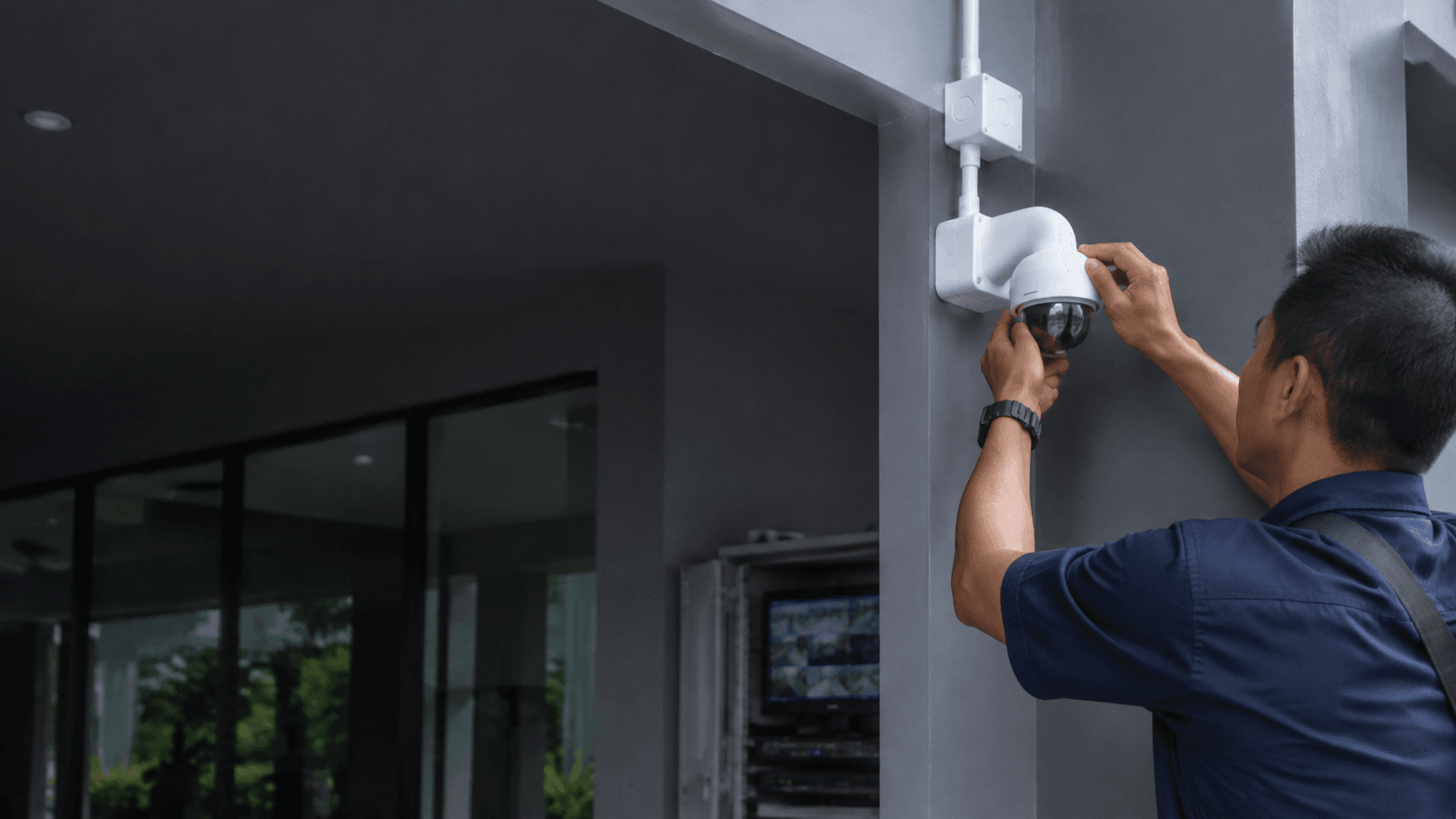
The exact-match query wifi cctv system describes a setup where cameras reach a recorder or hub over Wi-Fi rather than through a dedicated video cable run to each unit. The label covers two different builds that buyers often treat as one: cameras that talk to a Wi-Fi network video recorder, and standalone cameras that record to a memory card or hub. Both remove the long cable run from each camera position back to a central box, and both still need power at the camera unless the unit runs on battery or solar.
Eyonic Sdn Bhd is a security system supplier in Sarawak, Malaysia, working on CCTV and ELV systems. The company's founder, Eric Yong, has been in the industry for more than 10 years and is described as highly experienced in technical installation of digital security solutions for commercial businesses in Sarawak. That background matters because wireless video quality depends on radio conditions at the site, not only on the camera specification.
Wifi Cctv System. What Matters Before You Choose
Wireless describes the video path, not the whole installation. A camera still needs electricity, a mounting point with a usable view, and a wireless signal strong enough to carry the chosen resolution. Where any of those three is weak, the system underperforms regardless of the brand on the box.
Competitor catalogues in this category lean heavily on resolution, night vision, storage and app features. Those are real differences, but they sit downstream of placement and signal. A 4K camera on a wall with a blocked sightline or a weak signal produces worse evidence than a modest camera positioned correctly.
- Confirm what the site needs to record: entrances, counters, walkways, storage, or perimeter.
- Check power availability and wireless signal at each intended camera position.
- Decide where recordings live. recorder hard drive, memory card, hub, or cloud.
- Confirm how footage will be viewed day to day, including on a phone.
- Agree the installation sequence. site survey, system proposal, installation, handover.
- Test the finished system before handover, including remote viewing.
Eyonic's CCTV installation process follows that shape: site survey, system proposal, installation, and handover. The survey stage is where signal, power and sightline questions get answered before hardware is fixed to a wall.
Choosing the Right Wifi Cctv System
The choice usually narrows to three shapes. A Wi-Fi NVR kit pairs wireless cameras with a recorder that holds the hard drive. A hub-based setup uses a central unit with expandable cameras and local storage. A standalone camera records to its own card and suits a single position. Each shape carries a different trade-off between storage control, expansion and installation effort.
Resolution, night vision and detection features appear across all three. The practical filter is what happens when the network drops: a recorder-based system keeps recording locally, while a cloud-dependent camera may not. Local storage also avoids a recurring subscription in many designs, which competitor pages in this category frequently highlight.
What is wifi cctv system?
A wifi cctv system is a camera setup that sends video over a wireless network to a recorder, hub or storage device instead of using a dedicated cable from every camera to a central recorder. Power still reaches each camera by cable, battery or solar, and the recorder or hub handles storage and playback.
Wi-Fi Systems – Night Owl SP, LLC
Night Owl's wireless collection illustrates the recorder-based shape: cameras connect wirelessly to a Wi-Fi NVR, which reduces cable runs through walls and ceilings. That structure is one common form of the query, and it is the form most often sold as a kit with a hard drive included.
Wireless Security Cameras | WiFi Cameras for Home & Business
CCTV Camera World frames the same category around plug-in power, local recording options and no required monthly fees, and it separates wireless NVR systems from standalone cameras with SD card storage. That split is the clearest way to sort options before comparing brands.
Wireless (Wi-Fi) Security Cameras & Systems
Lorex presents indoor Wi-Fi cameras as a smart-home category with detection, two-way talk and dual-band Wi-Fi. Indoor-only deployments are simpler because signal travel is shorter and lighting is more controllable.
Best Wireless Cameras 2026 Expert Tested & Reviewed Security.org
Security.org reviews wireless cameras by use case, including whole-home coverage, outdoor positions and night vision. Review-led pages are useful for feature comparison, though testing conditions differ from a specific site in Sarawak.
Wi Fi Security Cameras Reolink 2.4/5 GHz Wireless Cameras
Reolink emphasises dual-band 2.4 GHz and 5 GHz connectivity, local storage without subscription, and plug-in power for continuous monitoring. Dual-band support matters where the 2.4 GHz band is crowded and the 5 GHz band has shorter range.
Best Wireless Home Security Cameras of 2026 Versatile Protection CNET
CNET organises its picks around battery-powered cameras and the trade-offs of battery life, detection and storage. Battery cameras remove the power cable but add maintenance and charging cycles.
Practical Considerations for
Wireless video competes with every other device on the same network. A camera streaming continuously at high resolution consumes bandwidth and storage, and a weak signal forces the camera to reduce quality or drop frames. Wired power with wireless video is often the most stable middle ground because it removes battery maintenance while keeping cable runs short.
Lighting is the other variable that decides whether a camera is worth its specification. Eyonic recommends checking actual lighting conditions before confirming placement for ColorVu-style cameras, because low-light performance depends on what light is genuinely present at night rather than on the marketing description.
Storage planning follows from retention expectations. A recorder with a hard drive keeps footage locally and supports multiple cameras from one place. Memory-card cameras are simpler per unit but spread storage across devices, which complicates review after an incident.
For commercial sites, the pattern Eyonic has worked with is practical coverage of movement rather than blanket coverage. At the Kuching Immigration Office, the focus was arrival flow, staff areas, visitor movement and dependable daily operation. At KTA Sarawak Sdn Bhd, the work supported staff movement, visitor handling, tidy cabling and clearer daily site control. Both cases point to the same lesson: camera positions follow the flow of people through a site.
Budget expectations vary with scale. Eyonic's published package pricing lists a Hikvision CCTV Package at RM 1,599, covering camera supply and setup, basic recording configuration and mobile viewing handover. Larger commercial work sits well above that level; the Kuching Immigration Office project carried an approximate budget of RM 12,000 to RM 28,000, and the KTA Sarawak Sdn Bhd project an approximate budget of RM 8,000 to RM 18,000.
Making an Informed Choice About
The decision usually comes down to three constraints: how many positions need coverage, whether power is available at each position, and how long footage must be retained. Those three answers determine whether a Wi-Fi NVR kit, a hub-based system or standalone cameras fit better.
Where the network is unreliable or the site is large, a recorder-based design with local storage is the safer structure. Where coverage is limited to a few indoor positions, standalone cameras with local cards can be sufficient. Where cameras sit far from any power point, battery or solar units remove the cable but add upkeep.
Installation quality decides how much of the specification survives contact with the site. Tidy cabling, correct mounting angles and a tested remote-viewing setup at handover are the difference between a system that works on day one and one that works six months later.
Eyonic's service scope covers planning, supply and installation of monitoring systems with camera placement, recording and remote viewing for homes, offices, shops and industrial sites. The company also works across related systems including alarm, autogate, keyphone intercom and Starlink internet installation in Sarawak, which matters where a site needs several systems coordinated rather than one standalone product.
Share your location, property type and required system with Eyonic on WhatsApp at +60 11-5111 7959 for the next practical step.