
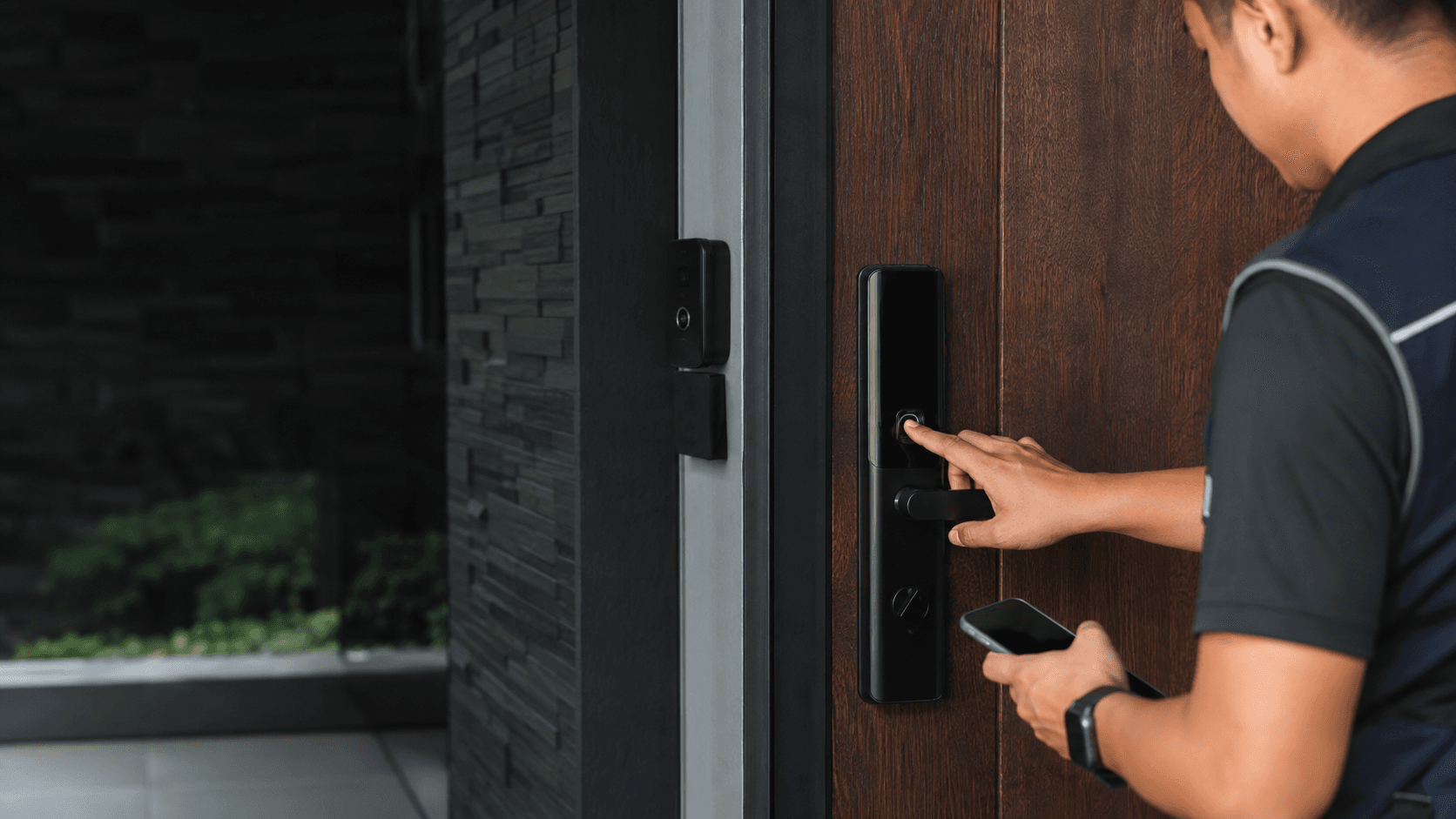
Malaysian entrances vary far more than product listings suggest. A single-leaf apartment door, a double-leaf landed-house entrance, a shoplot grille and an office glass door each change which hardware fits and which access method makes sense. The practical question is not which lock is newest, but which lock suits the door already in place and the people who must pass through it daily.
Eyonic Sdn Bhd plans, supplies and installs security and ELV systems in Sarawak, and its product reviews cover smart lock door access alongside CCTV, alarm and autogate work. That combination matters because a main door lock rarely stands alone; it usually sits beside an intercom, a gate motor or a camera system that already governs how visitors arrive.
Digital Lock For Main Door. What Malaysian Entrances Need
A digital lock for main door replaces or augments the mechanical key cylinder with an electronic credential: a code, a card, a fingerprint, a phone, or a combination. The lock still has to do the mechanical job of a deadbolt or mortise lock, holding the door against force and aligning with the existing strike plate.
Three conditions decide whether a specific unit will work on a Malaysian main door.
- Door condition and thickness, including whether the leaf is solid timber, metal, glass or a hollow-core composite, and whether the existing cutout matches a mortise or cylindrical format.
- User roles, meaning who needs permanent access, who needs temporary access, and whether staff, family, tenants or cleaners require separate credentials that can be revoked.
- Access method, chosen from keypad codes, RFID cards, fingerprint, mobile app or mechanical key override, based on how each user actually arrives at the door.
- Backup entry, covering what happens when the battery drains, the network drops or the electronics fail, and who holds the physical key or override credential.
- Power source, confirming whether the lock runs on internal batteries, wired low-voltage supply, or a combination, and where that supply is located.
Working through those five checks before purchase avoids the common outcome where a lock is bought first and the door is modified afterwards. Eyonic's stated approach to smart lock door access follows the same sequence: door condition, user roles and backup method are reviewed before installation, and for business use the choice between a standalone smart lock and an access-control panel is checked first.
Access Methods And What Each One Changes
Access method is the decision most buyers treat as a preference when it is really a constraint. Each method shifts who can enter, how quickly credentials change, and what happens during a failure.
Keypad codes suit households and small offices because a code can be shared and changed without hardware. The trade-off is that shared codes leak; a cleaner's code is only as private as the last person told. Individually issued codes with separate records solve that, but only if the lock supports multiple distinct users rather than one shared PIN.
RFID cards and fobs behave like physical keys with an audit trail. They are fast for staff who pass a door many times a day, and a lost card can be disabled without rekeying the door. The cost is that cards must be issued, tracked and collected, which is administrative work rather than technical work.
Fingerprint access removes the carrying problem entirely and is convenient for family members. It is also the method most sensitive to enrolment quality and to finger condition, so it works best as one option among several rather than the only way in.
Mobile app and remote access add convenience and visibility, letting an owner unlock for a delivery or check an entry log. That convenience depends on network availability at the door and on the lock's own connectivity, so it should be treated as an addition to local access, not a replacement for it.
Mechanical key override is not an access method in the marketing sense, but it is the one that decides whether a lock is safe to rely on. A main door that can only be opened electronically has a single point of failure.
Door Condition And Hardware Fit Before Purchase
Hardware fit is where most installation problems originate, and it is decided before any model is chosen. A mortise lock sits inside a pocket cut into the door edge; a cylindrical or deadbolt format passes through the face of the door. These are not interchangeable without cutting, and cutting a metal or fire-rated door is a different job from cutting timber.
Door thickness, backset and the position of the existing handle all constrain which units will mount cleanly. A door that already carries a mortise lock with a narrow backset may accept only a limited range of replacements, while a door with no existing cutout offers more freedom but requires more work.
Material matters for a second reason. Solid timber and metal doors hold screws and resist force well. Hollow-core and some composite doors may need reinforcement or a different fixing approach, because the lock's security depends on the door as much as on the cylinder.
Alignment is the quiet failure mode. A door that has swollen, dropped or never closed cleanly will fight an electronic lock's motor or solenoid, producing jams that look like a lock fault. Correcting the door and frame first is usually cheaper than replacing a lock that was never the problem.
For entrances that combine a main door with a grille or a second leaf, the sequence of locking matters too. If the grille is the outer barrier and the digital lock is on the inner door, the access method has to work from outside the grille, which changes where the keypad or reader can be positioned.
Power, Backup Entry And Daily Reliability
Reliability on a main door comes down to three things: where power comes from, what happens when it stops, and how the lock behaves on an ordinary Tuesday.
Battery-powered locks avoid wiring and survive a power cut, but they introduce a maintenance task. Low-battery warnings are only useful if someone acts on them, and a rental property or a shop with rotating staff is exactly where that warning gets ignored. Wired low-voltage supply removes the battery task but ties the lock to a power source that itself needs protection.
Backup entry should be decided at the same time as the access method, not after the first lockout. A mechanical key override kept somewhere other than inside the house, a second independent credential, or a documented override procedure for a business all count. The test is simple. if the electronics are dead and the phone is flat, can the door still be opened by someone authorised to open it?
Daily reliability also depends on how the lock is used. Auto-lock features that secure the door after a set delay reduce the chance of an unlocked main door overnight, but they can also lock someone out mid-task if the delay is short. Passage mode, which temporarily disables auto-lock, is useful for moving furniture or for a shop during trading hours, provided it is easy to switch off again.
For businesses, the reliability question extends to user permissions. A standalone smart lock manages a handful of users well. Once a site needs scheduled access, multiple doors, or a record of who entered when, an access-control panel becomes the more appropriate structure, and Eyonic checks that distinction before recommending hardware.
Digital Lock For Main Door Planning For Homes And Businesses
The same product category serves two quite different jobs, and the planning differs accordingly.
A home main door usually needs a small number of permanent users, occasional access for family, helpers or deliveries, and a backup that a household member can reach. Convenience features such as auto-lock and app notifications carry most of the value, and the installation is typically a single door with no integration beyond an existing gate or intercom.
A business entrance needs the opposite emphasis. Credentials must be issued and revoked as staff change, access records may be needed for accountability, and the door often sits within a wider system of cameras, alarms and intercoms. A shoplot with a public-facing entrance also has to consider how visitors are handled during trading hours versus after closing, because a single access rule rarely fits both.
Eyonic's project work reflects that split. The Kuching Immigration Office project focused on arrival flow, staff areas, visitor movement and dependable daily operation, which is the pattern of a public-facing entrance where different groups pass through the same door for different reasons. The KTA Sarawak Sdn Bhd project addressed staff movement, visitor handling, tidy cabling and clearer daily site control in an office setting. Both are planning problems before they are hardware problems.
Budget expectations should be set against the whole entrance rather than the lock alone. Eyonic's published package pricing for related systems sits at RM 1,599 for a Hikvision CCTV package, RM 1,599 for a Hikvision alarm system and RM 1,599 for an autogate package, and larger project work has been scoped in the RM 8,000 to RM 18,000 and RM 12,000 to RM 28,000 ranges. Those figures describe other systems, not digital lock supply, and they are useful mainly as a signal that entrance security is usually priced as a system rather than as a single device.
Installation, Handover And Support In Sarawak
Installation quality decides whether a digital lock for main door feels dependable or fragile. The work includes checking the door and frame, confirming the cutout and fixing points, mounting the lock and reader, connecting any wired supply, and testing every credential that will actually be used.
Eyonic's installation process runs through site survey, system proposal, installation and handover, and that sequence applies to entrance hardware as much as to cameras. The survey is where door condition and user roles get confirmed against the physical door rather than against a product listing.
Handover is the step most often skipped and the one that prevents most support calls. It should cover enrolling and removing users, changing codes, replacing batteries or confirming the wired supply, using the mechanical override, and knowing what to do when the lock misbehaves. For a business, it should also cover who administers credentials after the installer leaves.
Support matters most in the first weeks, when enrolment habits and door alignment are still settling. A lock that jams intermittently is usually reporting a door problem, and having the installer revisit rather than the buyer replacing hardware is the cheaper path.
Eyonic is based in Sarawak and works across homes, offices, shops and industrial sites, with founder Eric Yong bringing more than ten years in technical installation of digital security solutions for commercial businesses in Sarawak. For entrance hardware that has to integrate with cameras, alarms or intercoms, that local installation experience is the practical difference between a lock that works on day one and one that keeps working.
Share the location, property type and required system with Eyonic on WhatsApp at +60 11-5111 7959 for the next practical step.