
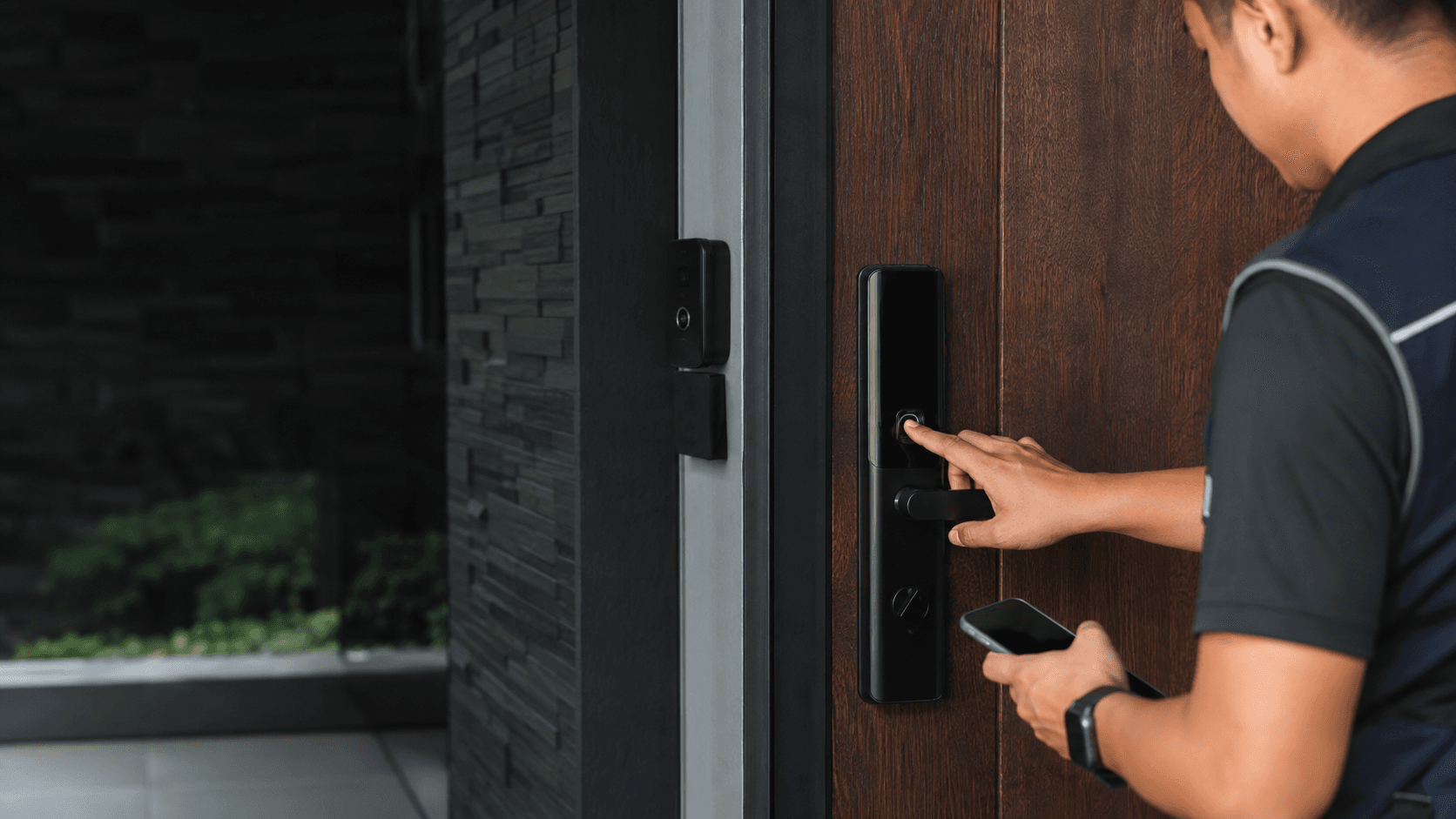
The term covers more than one product. It can mean a lock with its own Android app, a lock that joins a wider access control system, or a retrofit unit that sits behind an existing cylinder. Each route changes what gets installed, who holds a credential, and what happens when a phone is lost or a battery runs flat.
Eyonic Sdn Bhd plans, supplies and installs security and ELV systems in Sarawak, and its product reviews index lists smart lock door access as a multi-brand category. The company's stated position is that smart locks work best when door condition, user roles and the backup method are reviewed before installation, and that for business use it usually checks whether a standalone smart lock or an access-control panel is more appropriate.
Android Door Lock. what phone-based entry actually covers
Phone-based entry replaces or supplements a physical key with a credential held on a phone. The credential is usually issued through an app, and the lock decides whether that credential is valid at that moment.
Three arrangements appear in practice:
- A standalone smart lock with its own app, where the phone talks to the lock directly or through a bridge.
- A lock connected to an access-control panel, where the panel decides who may enter and when.
- A retrofit device fitted to an existing lock, keeping the original key as a fallback.
The distinction matters because it decides who administers access. A standalone lock is managed by whoever holds the app account. A panel-based system is managed centrally, which suits offices where staff join and leave and where visitor movement needs to be visible.
Eyonic's work for the Kuching Immigration Office focused on arrival flow, staff areas, visitor movement and dependable daily operation. That is the same set of concerns a door access decision raises: who arrives, which door they use, and whether the arrangement holds up on an ordinary working day.
How an Android Door Lock connects to a phone
The connection method is the part most buyers skip, and it is the part that decides whether the lock feels instant or unreliable.
Short-range wireless links suit a phone that is already at the door. A network connection suits remote checking and central administration. A bridge or hub can extend a short-range lock to the network, which is common in homes where the door is far from the router.
Two practical consequences follow. First, a lock that depends on the internet will not open if the internet is down, unless it also supports a local method. Second, a lock that depends on short-range wireless needs the phone close enough, which is usually fine at the door and useless from another building.
App features that matter day to day include issuing and revoking access for a named person, setting time windows, and reviewing an activity record. Features that matter less include voice control and scene automation, which are convenient but do not decide whether the door opens.
Eyonic's smart lock review notes that user permissions and backup entry need planning. A permission that cannot be revoked quickly is a liability in a rental or an office. A backup that depends on the same phone is not a backup.
Door and phone conditions that decide the setup
Door condition is the first constraint. A lock has to fit the door's existing preparation, and a door that is misaligned, swollen or fitted with an unusual cylinder limits what can be installed without additional work.
Eyonic's review of smart lock door access puts door condition first for that reason. The check is physical. how the door closes, whether the frame is square, what cylinder or mortise is present, and whether the door is shared with other hardware.
Phone condition is the second constraint. The phone must run a supported Android version and provide whatever radio the lock uses. A phone without the required radio cannot act as the key regardless of the app.
Power is the third constraint. A battery-powered lock needs a replacement routine, and a lock that fails closed is a safety problem. Backup entry should be independent of the phone: a mechanical key, a keypad code, or a card held separately.
Network is the fourth. Remote administration needs a stable connection at the lock, and a weak signal at the door produces slow responses that users read as faults.
Android Door Lock choices for homes, offices and rentals
The right choice follows the number of people who need access and how often that list changes.
A home usually has a small, stable set of users. A standalone smart lock with an app, a keypad and a mechanical key covers most households, and the main decision is whether remote access is needed at all.
An office has a changing list. Eyonic's review states that for business use it usually checks whether a standalone smart lock or an access-control panel is more appropriate. A panel becomes the better fit when access must be granted by role, when several doors must be managed together, or when entry records need to be reviewed.
A rental sits between the two. Guests need temporary access that expires, and the owner needs to revoke it without visiting. A lock that supports time-limited credentials handles this; a lock that only supports permanent users does not.
Eyonic's project for KTA Sarawak Sdn Bhd covered staff movement, visitor handling, tidy cabling and clearer daily site control in a Kuching office. Those four items are a reasonable checklist for any commercial door access decision, because they describe how the door is used rather than what the lock looks like.
Installation and handover steps in Sarawak
Eyonic's installation process runs through four stages, and the same sequence applies to door access work.
- Site survey, where the door, frame, existing hardware, power and network are checked on site.
- System proposal, where the recommended lock or access-control arrangement is set out for the property.
- Installation, where the hardware is fitted and configured.
- Handover, where users, permissions and backup entry are set up and tested with the people who will use them.
The survey stage is where most problems are caught. A door that cannot take the intended lock is identified before purchase rather than after. A door that needs additional preparation is priced before work starts.
Handover is where the arrangement either works or quietly fails. Permissions should be issued to named people, tested on the actual phones those people carry, and the backup method demonstrated and stored somewhere other than the phone.
Eyonic's CCTV work in Sarawak follows the same survey, proposal, installation and handover sequence, and the company's guidance on camera placement is to check actual conditions on site rather than assume them. The same principle applies to a door: the survey exists because the door decides the answer.
What to confirm before choosing an Android Door Lock
Confirm the door first. The existing preparation, cylinder type and frame condition determine which locks are possible without extra work.
Confirm the phones second. The Android version and available radios on the phones that will be used decide whether the app can act as a key.
Confirm the user list third. A short, stable list suits a standalone lock; a changing list with roles and time windows suits a panel.
Confirm the backup fourth. It should work without the phone, without the internet, and without the app.
Confirm the network fifth. Remote administration needs a connection at the door that holds up in normal use.
Confirm who supports it sixth. A lock that nobody locally can service becomes a problem at the first fault, and door access is a daily-use system where a fault is noticed immediately.
Eyonic's founder Eric Yong has worked in technical installation of digital security solutions for commercial businesses in Sarawak for more than 10 years, which is the relevant experience for judging whether a door will take a given lock.
Where the property needs more than one door managed together, or where entry records matter, the decision moves from a lock to an access-control arrangement. Eyonic's review treats that as a business-use question rather than a product question, and it is the point where a site survey replaces a specification sheet.
Share the location, property type and required system with Eyonic on WhatsApp at +60 11-5111 7959 for the next practical step.