
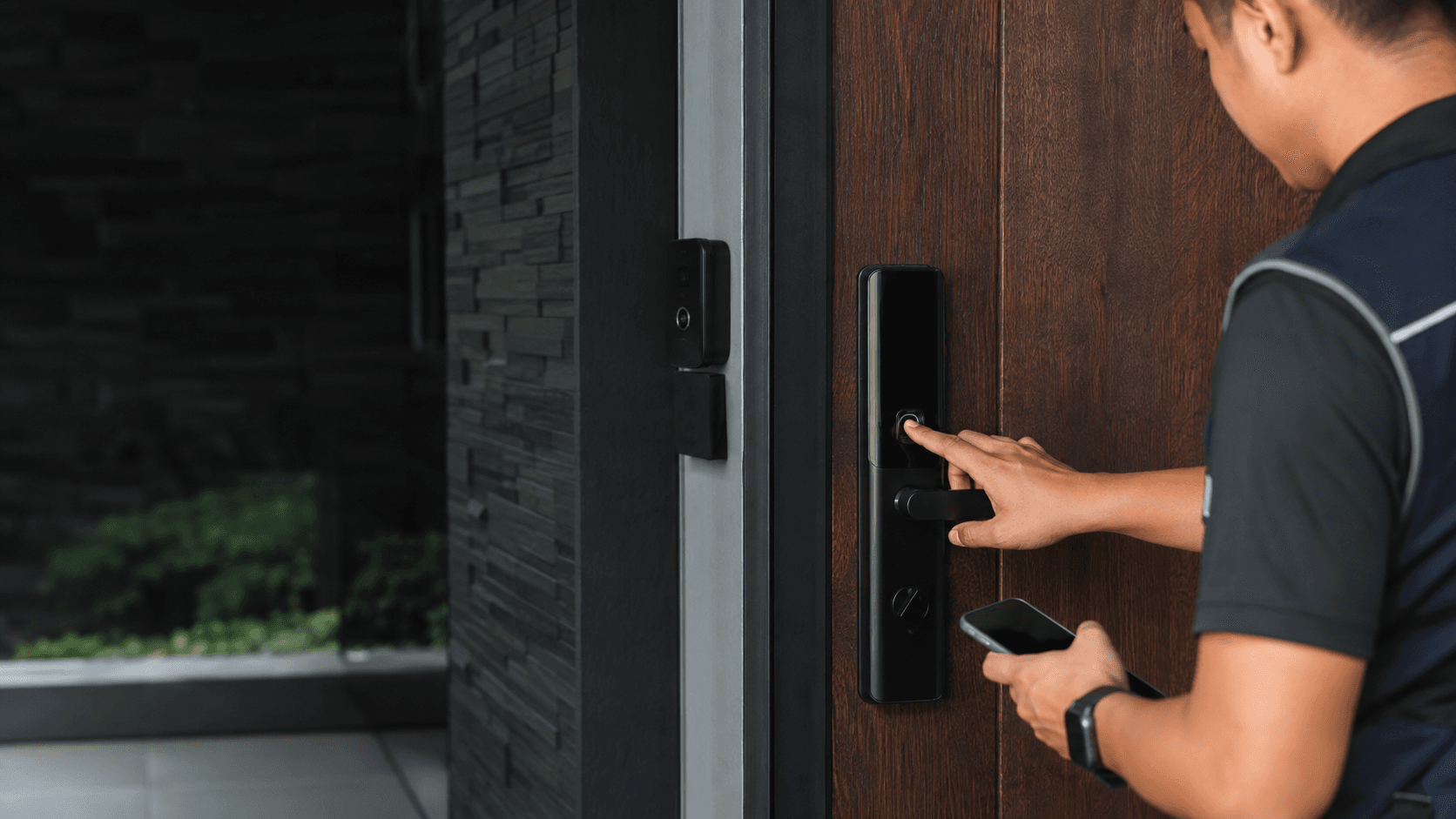
Most buyers arrive at this category after losing a key, renting out a room, or trying to stop family members from sharing one code. The hardware looks similar across listings, but the differences that matter sit in the unlock methods, the door preparation, and what happens when the battery dies.
- Confirm the door thickness and backset match the lock's stated range.
- Count how many people need daily entry, then check the user slot limit.
- Decide whether the lock must work offline or through an app.
- Verify a mechanical key or emergency power option exists.
- Check the finish and handing against the existing door.
Fingerprint Door Knob Lock. What Matters Before Choosing
A fingerprint door knob lock replaces the existing knob or deadbolt with a unit that reads a fingerprint, and usually also accepts a code, an app command, or a physical key. The category splits into two physical formats: knob-style handles that swap out a round doorknob, and deadbolt-style units that sit above a separate handle.
Knob-style units suit bedrooms, offices, and rental rooms where the existing hardware is already a knob. Deadbolt units suit main entrances where the door already has a separate handle and a deadbolt cutout. Choosing the wrong format means patching or re-boring the door, which is the most common reason a straightforward swap turns into a carpentry job.
Three practical constraints decide most purchases. Door thickness must fall inside the manufacturer's stated range, the backset must match the existing bore, and the door handing must suit the latch direction. A lock that meets all three installs with a screwdriver. A lock that misses one needs modification.
Choosing the Right Fingerprint Door Knob Lock
The decision sequence below follows the order that avoids returns. Each step removes a category of lock rather than ranking brands.
- Measure door thickness at the edge and the backset from the door edge to the centre of the bore.
- Identify whether the door currently uses a knob, a lever, or a deadbolt, and whether the cutout is round or rectangular.
- List every person who needs entry and how often, because user capacity and guest access differ sharply between models.
- Decide whether remote unlocking and entry logs are required, since app features depend on Bluetooth or Wi-Fi rather than the fingerprint reader itself.
- Confirm the backup method, whether that is a mechanical key, a USB emergency charge point, or both.
- Check the finish against the door and surrounding hardware before ordering.
Step four carries the most weight for anyone managing a rental or a small office. A lock that stores fingerprints locally still works when the internet drops, while a lock that depends on a cloud service may not. Local storage also means entry records stay on the device rather than in an account.
What Is a Fingerprint Door Knob Lock?
A fingerprint door knob lock is a door handle or deadbolt with a capacitive or optical sensor built into the exterior face. The sensor captures a fingerprint image, converts it to a template, and compares that template against stored prints. A match releases the latch motor.
Two sensor types dominate. Capacitive sensors read the ridge pattern through a thin surface and generally handle dry or slightly worn fingers better. Optical sensors photograph the print and can be more sensitive to residue on the surface. Neither type stores a photograph of a finger in the way a phone camera would; the stored data is a mathematical template.
Battery life varies with motor torque, sensor type, and how often the lock is used. Most units run on AA or AAA cells, and low-battery warnings appear well before the lock stops responding. The backup path matters more than the runtime figure, because a lock with a mechanical key or an external power contact never leaves anyone locked out.
Geeni Fingerprint Smart Door Lock, Keyless Entry
The Geeni Fingerprint Smart Door Lock is a keyless entry knob and handle unit that unlocks by fingerprint and supports app-based access management. It is battery powered and designed as a direct replacement for a standard knob handle.
Its fit is clearest for a homeowner or landlord who wants one app for entry management and does not need a wired access-control panel. The app handles access sharing, which suits households where a cleaner, a tenant, or a family member needs entry without a physical key.
Two limits are worth noting before ordering. App features depend on the lock's wireless connection, so a property with weak Wi-Fi at the door should confirm the connection method first. And because the unit is a knob-and-handle design, it suits doors already cut for a knob rather than a deadbolt-only door.
Practical Considerations for Fingerprint Door Knob Lock Installation
Installation is the point where most of the risk sits, and it is also where a supplier's site survey adds value. Eyonic's installation process runs through site survey, system proposal, installation, and handover, which is the same sequence that applies to door hardware: confirm the door, confirm the users, install, then test with the people who will actually use it.
Eyonic's smart lock guidance notes that smart locks work best when door condition, user roles, and backup method are reviewed before installation, and that for business use the choice between a standalone smart lock and an access-control panel should be checked first. That distinction matters in offices where dozens of staff need entry and an audit trail is expected.
For larger sites, the pattern Eyonic applied at the Kuching Immigration Office is instructive: the work focused on arrival flow, staff areas, visitor movement, and dependable daily operation. A door lock decision on a public or commercial site is really a flow decision, not a hardware decision.
Residential and small-office installations in Sarawak typically sit alongside other low-voltage work. Eyonic supplies and installs CCTV, alarm, autogate, keyphone intercom, and Starlink systems, with published packages at RM 1,599 for a Hikvision CCTV package, RM 1,599 for a Hikvision alarm system, and RM 1,599 for an autogate package. Door hardware is a separate scope from those packages.
Making an Informed Choice About Fingerprint Door Knob Lock
The right choice comes down to three questions: does the lock physically fit the door, does it support the number of people who need entry, and does it have a backup path that does not depend on the battery or the network.
For a single bedroom or rental room, a knob-style unit with local fingerprint storage and a mechanical key covers nearly every scenario. For a main entrance, a deadbolt-format unit with an app and an entry log is usually the better fit. For an office with staff turnover, the standalone-versus-panel question should be settled before any hardware is ordered.
Anyone comparing options in Malaysia can share the location, property type, and required system with Eyonic on WhatsApp at +60 11-5111 7959 for the next practical step.