
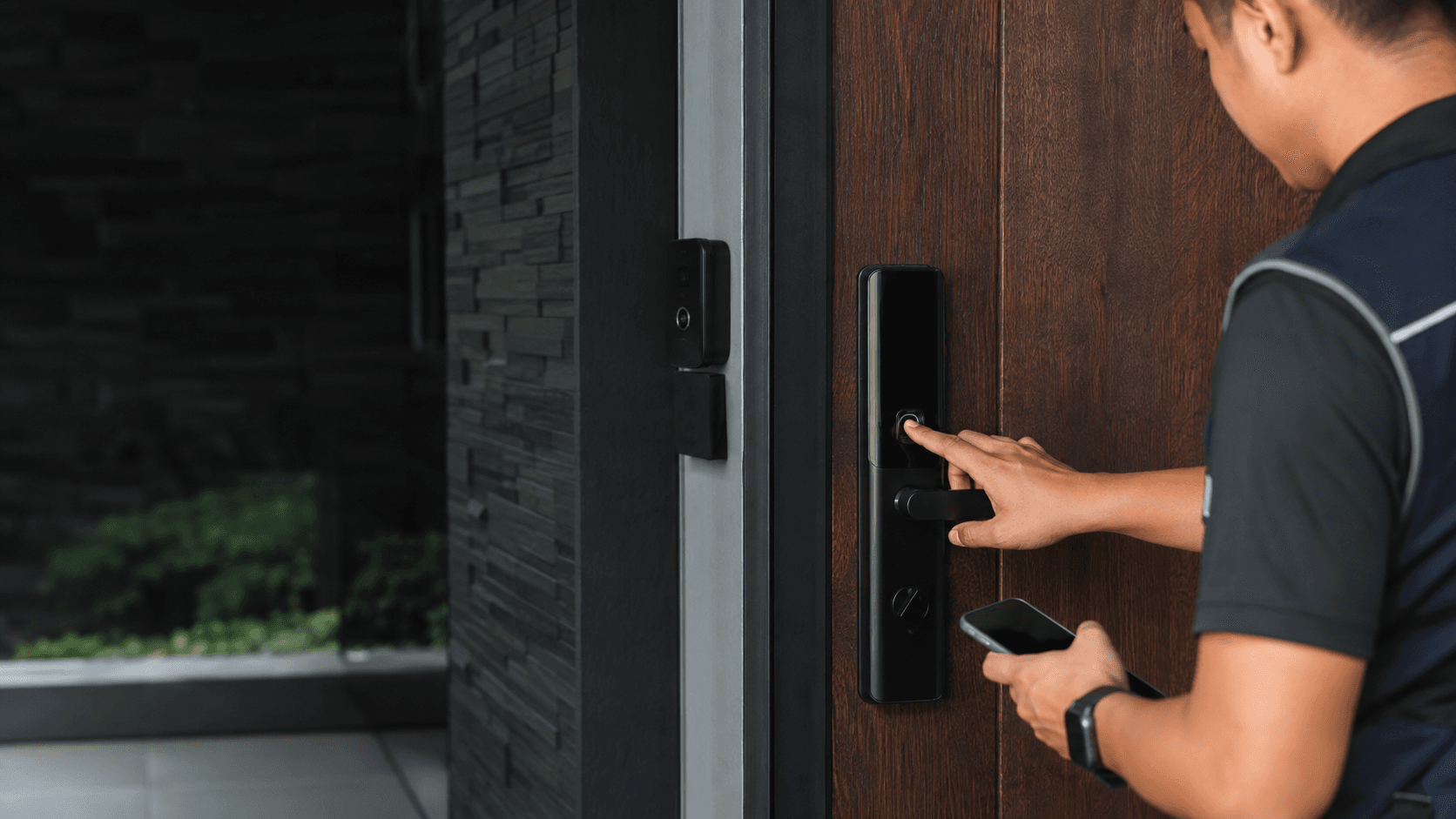
The term covers a narrow family of hardware. A sliding glass patio door does not take the same lock body as a hinged swing door, because the panel travels sideways along a track instead of swinging on hinges. That single difference drives almost every buying decision: how the lock mounts, where the bolt engages, and whether the frame has enough flat surface to carry the lock at all.
Across the pages that currently rank for this query, most are thin product or collection pages rather than full guides. The median word count in that set is 235 words and the median heading count is 3. None of the eight pages uses the complete query in its H1, and none records the query or the main entity in body copy. That leaves the topic effectively unclaimed in on-page text, which is why a fit-and-decision guide is more useful than another product listing.
Keypad Lock for Sliding Glass Door: What the Term Covers
A keypad lock for sliding glass door openings is a code-operated lock designed for a panel that slides. The code replaces a key as the everyday entry method, while the locking action still happens at the door edge or the frame.
Two mechanisms dominate the category. A mechanical keypad uses push buttons to set a combination and drives the bolt through internal levers, so it needs no power source. An electronic keypad uses a powered keypad and a motor or solenoid to move the bolt, and it usually adds user codes, temporary codes, or app and card access on top of the keypad.
The lock body itself is usually a surface mount lock, meaning it fixes to the visible face of the door or frame rather than sitting inside a routed pocket. Surface mounting matters on sliding doors because the panel edge and the frame face are often the only flat, accessible surfaces available.
Many sliding-door locks use a hook bolt rather than a straight deadbolt. A hook bolt reaches into a receiver and hooks behind it, which resists the panel being lifted or pried along the track. That is a different engagement method from a standard deadbolt and it is one reason sliding-door hardware is not interchangeable with swing-door hardware.
Mechanical Keypad Lock for Sliding Glass Door vs Electronic Keypad Entry
The choice between a mechanical keypad and electronic keypad entry comes down to power, control, and failure behaviour rather than security alone. Both can secure a slider; they fail in different ways and suit different users.
A mechanical keypad lock has no battery, no wiring, and no app. It cannot lose power, it cannot be locked out by a flat battery, and it does not need a network. The trade-off is control. changing the code is a physical procedure at the lock, there is no access log, and there is no way to issue a code that expires on its own.
An electronic keypad adds the things a mechanical lock cannot do. Multiple user codes, temporary codes for guests or staff, scheduled access, and in some cases app or card entry all become possible. The trade-off is dependency. the lock needs power, and when that power fails the door must still be openable through a planned backup method.
For a home slider used by a household, a mechanical keypad removes an entire category of maintenance. For a rental, an office, or a property where codes need to change between users, electronic keypad entry earns its complexity. Eyonic's own product guidance notes that smart locks work best when the door condition, user roles, and backup method are reviewed before installation, and that for business use the question is whether a standalone smart lock or an access-control panel is the better fit.
Door Frame, Glass Thickness and Handing Checks Before Purchase
Fit is the part that decides whether a purchase works. A keypad lock for sliding glass door panels is only compatible when the frame, the panel thickness, and the handing all match what the lock expects.
Door thickness is the first constraint. Locks are built for a stated thickness range, and a panel outside that range may not accept the lock body or the bolt receiver. Sliding glass patio door panels vary, and aluminium-framed sliders in particular can present a narrow face that limits which lock bodies will sit flush.
Handing is the second constraint. A sliding door has a direction of travel and a leading edge, and the lock must be fitted to the correct side so the bolt engages the receiver when the panel closes. Getting handing wrong usually means the lock cannot be installed on that panel without modification.
The mounting surface is the third constraint. A surface mount lock needs enough flat, sound material to fix into. A narrow aluminium frame, a rounded frame profile, or a frame already carrying a handle set can all reduce the available mounting area.
Before buying, work through these checks in order:
- Confirm the door type and frame material, and confirm the panel slides rather than swings.
- Measure the door thickness at the point where the lock body will sit.
- Confirm the handing, meaning which edge leads and which side the lock must mount on.
- Confirm the mounting surface is flat and wide enough for the lock body and its fixings.
- Confirm the backup entry method before committing, especially for any powered lock.
If any of those five checks cannot be answered from the door itself, the fit question is unresolved. A lock that is correct in principle can still be wrong for a specific opening.
Keypad Lock for Sliding Glass Door Installation and Daily Use
Installation on a slider is a fitting job, not a swap. The lock body, the bolt or hook, and the receiver all have to line up so the panel closes and locks in one motion.
On a mechanical lock, installation is largely mechanical: position the body, fix it to the mounting surface, align the bolt or hook with its receiver, and set the combination. On an electronic lock, the same physical work is followed by power, code setup, and a test of every entry method the lock supports.
Daily use is where the two types diverge most. A mechanical keypad is operated the same way every time and gives no feedback beyond the bolt moving. An electronic keypad gives feedback, may auto-relock after a set delay, and may report access events, but it also introduces a routine: codes to manage, batteries to watch, and a backup method to keep accessible.
Eyonic's installation process for its security work follows site survey, system proposal, installation, and handover. That sequence matters for door hardware too, because the survey is where frame condition, thickness, and handing get confirmed rather than assumed.
Backup Entry, Battery and Failure Planning
Every powered keypad lock needs a defined way in when the power side fails. That is the single most important planning decision for an electronic keypad on a sliding glass door.
Mechanical keypad locks sidestep the problem entirely, because there is no battery to fail and no motor to stop. The failure mode is limited to the lock mechanism itself.
Electronic keypad locks need a backup path. Depending on the model, that may be a keyed override, an external power point, or a second entry route through another door. The backup method should be confirmed before purchase, not after installation, and it should be tested while the lock is working rather than discovered when it is not.
Battery behaviour is the other planning item. A lock that warns before the battery is exhausted gives time to replace it; a lock that does not can leave a door unusable at an inconvenient moment. Because no verified battery-life figures are available for specific models here, the practical approach is to treat the manufacturer's stated battery type and replacement guidance as the reference, and to keep the backup method independent of the battery.
There is also a physical edge case worth planning for. If the panel is lifted or the track is obstructed, a hook bolt and its receiver can be forced out of alignment. Checking that the panel runs freely and sits correctly in its track is part of keeping the lock working, not a separate concern.
Cost, Supply and Installation Support in Sarawak
Cost for a keypad lock for sliding glass door use depends on the lock type, the door condition, and whether installation is included. No verified pricing is available here for keypad locks or for keypad lock installation in Malaysia, so any figure should come from a supplier or installer quoting the specific door.
Supply is the other variable. Not every keypad lock model is stocked and supported locally, and a model that is available online may have no local support path if a part or a replacement is needed. Confirming local availability before committing avoids a lock that cannot be serviced.
For readers in Sarawak, Eyonic Sdn Bhd is a security system supplier based in the state, working on planning, supply, and installation for homes, offices, shops, and industrial sites. Its completed work includes the Kuching Immigration Office project, which focused on arrival flow, staff areas, visitor movement, and dependable daily operation, and the KTA Sarawak Sdn Bhd project, which covered staff movement, visitor handling, and tidy cabling for an engineering consultancy office. Both are examples of the same underlying approach: confirm the site conditions first, then specify hardware that suits them.
Eyonic's published packages are priced at RM 1,599 for a Hikvision CCTV package, RM 1,599 for a Hikvision alarm system, and RM 1,599 for an autogate package. Those figures cover CCTV, alarm, and autogate work rather than door locks, so they are not a price for a keypad lock or for lock installation.
Where a door lock sits inside a wider access plan, the useful question is whether a standalone lock is enough or whether the door should tie into an access-control arrangement. Eyonic's guidance on smart lock door access is that it suits controlled convenience when user permissions and backup entry are planned properly, which is the same condition that applies to a single sliding door.
Share your location, property type and required system with Eyonic on WhatsApp at +60 11-5111 7959 for the next practical step.