
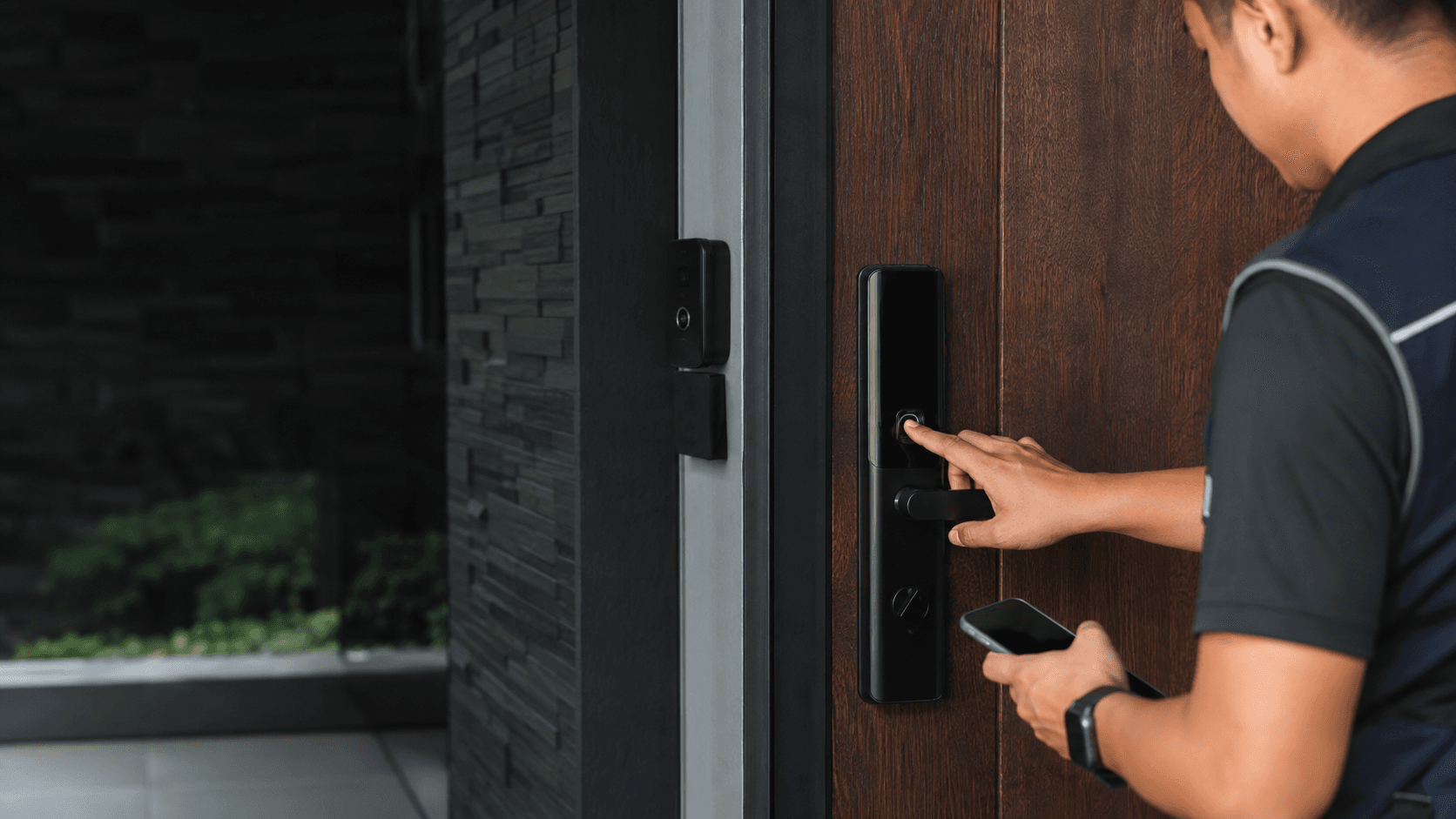
That review step matters because a lock that suits a landed property in Kuching may not suit a rented shop lot or a glass office door. The sections below cover how these locks work, how the entry methods differ, what to confirm before buying, and how installation and handover run in Sarawak.
Digital Entrance Door Locks. What They Are and How They Work
A digital entrance door lock is a locking mechanism that grants entry through an electronic credential instead of a cut key. The credential is usually a numeric code, a proximity card or tag, a fingerprint, or a command sent from a phone app. The lock body still performs the mechanical job of a conventional lock, so the door, frame and existing cutout determine whether a given unit fits at all.
Eyonic's own product review notes that smart locks work best when the door condition, user roles and backup method are reviewed before installation. For business use, the same review checks whether a standalone smart lock or an access-control panel is the more appropriate choice. That distinction is the practical fork in the road: a single entrance with a handful of regular users points one way, while a site with staff turnover, visitor traffic and multiple controlled doors points another.
Day-to-day operation is simple once the lock is commissioned. A user presents a credential, the lock verifies it against stored permissions, and the bolt retracts. The complexity sits in the setup: who holds which credential, how quickly a credential can be revoked when someone leaves, and what happens when the lock loses power or the network drops.
What the lock does not change
An electronic lock does not fix a door that already sits poorly in its frame, and it does not replace the need for a physical backup route. If the door binds, the strike plate is misaligned, or the frame has swollen, the lock will still struggle regardless of how the credential is presented. This is why a site survey comes before a model recommendation rather than after.
Keyless Entry Methods Compared
Keyless entry is the everyday benefit of digital entrance door locks, but the methods are not interchangeable. Each one shifts convenience, cost and risk in a different direction.
Numeric codes suit shared entrances because a code can be issued and changed without handing over hardware. The trade-off is that codes get shared informally, so a code that was meant for one person can end up known by several.
Cards and tags suit offices and shops where staff already carry an access card. They are quick to present and easy to cancel individually, but they add a physical item that can be lost or lent out.
Fingerprints remove the need to carry anything and cannot be passed to another person. They depend on a clean, dry finger and a reader that is kept free of dust and grease, which matters on an entrance exposed to weather or heavy handling.
App and remote control adds the ability to grant entry from elsewhere and to see a record of activity. It also introduces a dependency. if the phone, the network or the app service is unavailable, that route is unavailable too.
Most entrances end up combining two methods rather than relying on one. A code plus a card, or a fingerprint plus a mechanical key, gives a fallback when the primary method fails.
What to Check Before Choosing a Digital Entrance Door Lock
The pre-purchase checks below follow the sequence Eyonic uses when reviewing a smart lock installation. Working through them in order prevents the common outcome where a lock is bought first and the door turns out to be unsuitable.
- Confirm the door condition, including thickness, material, existing cutout and whether the frame closes squarely.
- List the user roles, separating regular users from occasional visitors and anyone who needs temporary access.
- Decide the backup entry method, such as a mechanical key, a second credential type or a separate entrance.
- Plan the power or battery arrangement, including who monitors it and what the lock does as power runs low.
- Assess the network or app dependency, and confirm the entrance still works if that dependency is unavailable.
Two of these checks carry more weight than the rest. Door condition decides whether an installation is straightforward or requires preparation work. Backup entry decides what happens on the day the primary method fails, which is the scenario most often overlooked at the point of purchase.
Door condition and fit
A solid timber door with an existing deadbolt cutout is the simplest case. A metal gate, a glass door or a door with a narrow stile usually needs a different approach, and sometimes a different product category entirely. Because verified compatibility details for specific models are not available here, the fit question is best answered by inspecting the actual door rather than by comparing specifications online.
User roles and permissions
For a home, the user list is short and stable. For an office or shop, the list changes: staff join and leave, contractors need short-term access, and visitors need to be let in without being given a permanent credential. A lock that handles temporary credentials well reduces the administrative work later. Where the user list is long or changes often, an access-control panel is often the better fit than a standalone lock.
Backup entry and power failure
Every digital entrance door lock needs a defined answer to two questions: how does a legitimate user get in when the battery is flat, and how does entry work when the network is down. A mechanical key override, a second credential type, or a separate entrance all serve as answers. The point is to choose one deliberately rather than discover the gap during a lockout.
for Homes Offices and Shops
The same product category serves very different sites, and the priorities shift with each one.
For a home, the priorities are convenience and a reliable backup. A household wants to stop carrying keys, let family members in without duplicating hardware, and still have a way in when something fails. The user list is small, so permission management is rarely a burden.
For an office, the priorities are control and record. Staff movement, visitor handling and the ability to revoke access quickly matter more than the entry method itself. Eyonic's work for the Kuching Immigration Office focused on arrival flow, staff areas, visitor movement and dependable daily operation, which is the same set of concerns an office entrance lock has to serve. The KTA Sarawak Sdn Bhd project addressed staff movement, visitor handling, tidy cabling and clearer daily site control for an engineering consultancy office in Kuching.
For a shop, the priorities are durability and simplicity. An entrance that is used constantly, sometimes by staff who are not the owner, needs a credential method that is fast and hard to misuse. A code or card usually fits better than a fingerprint reader on a busy retail entrance.
Across all three, the deciding factor is usually not the lock itself but the surrounding plan: who holds credentials, how they are revoked, and what the fallback is.
Installation Handover and Daily Support
Eyonic's installation process runs through site survey, system proposal, installation and handover. Applied to a lock, that sequence means the door is inspected before a model is proposed, the proposal reflects the actual entrance rather than a catalogue default, and the handover covers how credentials are issued and revoked.
Handover is where most of the long-term value sits. A lock that is installed but not explained tends to be used through a single credential that everyone shares, which defeats the purpose of individual permissions. A proper handover covers adding a user, removing a user, changing a code, and what to do when the lock reports a low battery or stops responding.
Support matters most in the months after installation, when staff change and credentials need updating. Because verified warranty terms and response times for lock installation are not available here, those details are best confirmed directly rather than assumed.
Eyonic Sdn Bhd is a security system supplier based in Sarawak, Malaysia, working on CCTV and ELV systems for homes, offices, shops and industrial sites. The founder, Eric Yong, has more than ten years in the industry and works on technical installation of digital security solutions for commercial businesses in Sarawak. Lock work sits alongside the wider security scope, which helps when an entrance lock needs to align with cameras, an intercom or an alarm.
Common Questions About
Do digital entrance door locks work without internet? The lock itself can operate offline, because credential verification happens at the lock. Internet access is only needed for remote control, app-based entry and activity records viewed from elsewhere. An entrance that must keep working during an outage should not depend on a network connection for its primary entry method.
What happens when the battery runs out? This depends on the model, and verified battery specifications are not available here. The practical safeguard is to confirm the backup method before installation, whether that is a mechanical key override, an external power point, or a second entrance.
Can a digital lock be fitted to an existing door? Often, but it depends on door thickness, material and the existing cutout. A door that already has a deadbolt is usually the simpler case. A glass door, a metal gate or a narrow stile often needs a different solution, which is why the door is inspected before a model is recommended.
Is a standalone lock or an access-control panel the better choice? Eyonic's review guidance draws the line at business use: a standalone smart lock suits a single entrance with a small, stable user group, while an access-control panel suits a site with multiple controlled doors, frequent staff changes or a need for central records.
How are credentials managed when someone leaves? The credential is removed from the lock or panel, and any shared code that person knew is changed. This is the main reason individual credentials beat a single shared code, even though a shared code is faster to set up.
For a specific entrance, the useful next step is to share the location, property type and required system with Eyonic on WhatsApp at +60 11-5111 7959, so the door condition and user roles can be reviewed against a real installation rather than a general recommendation.