
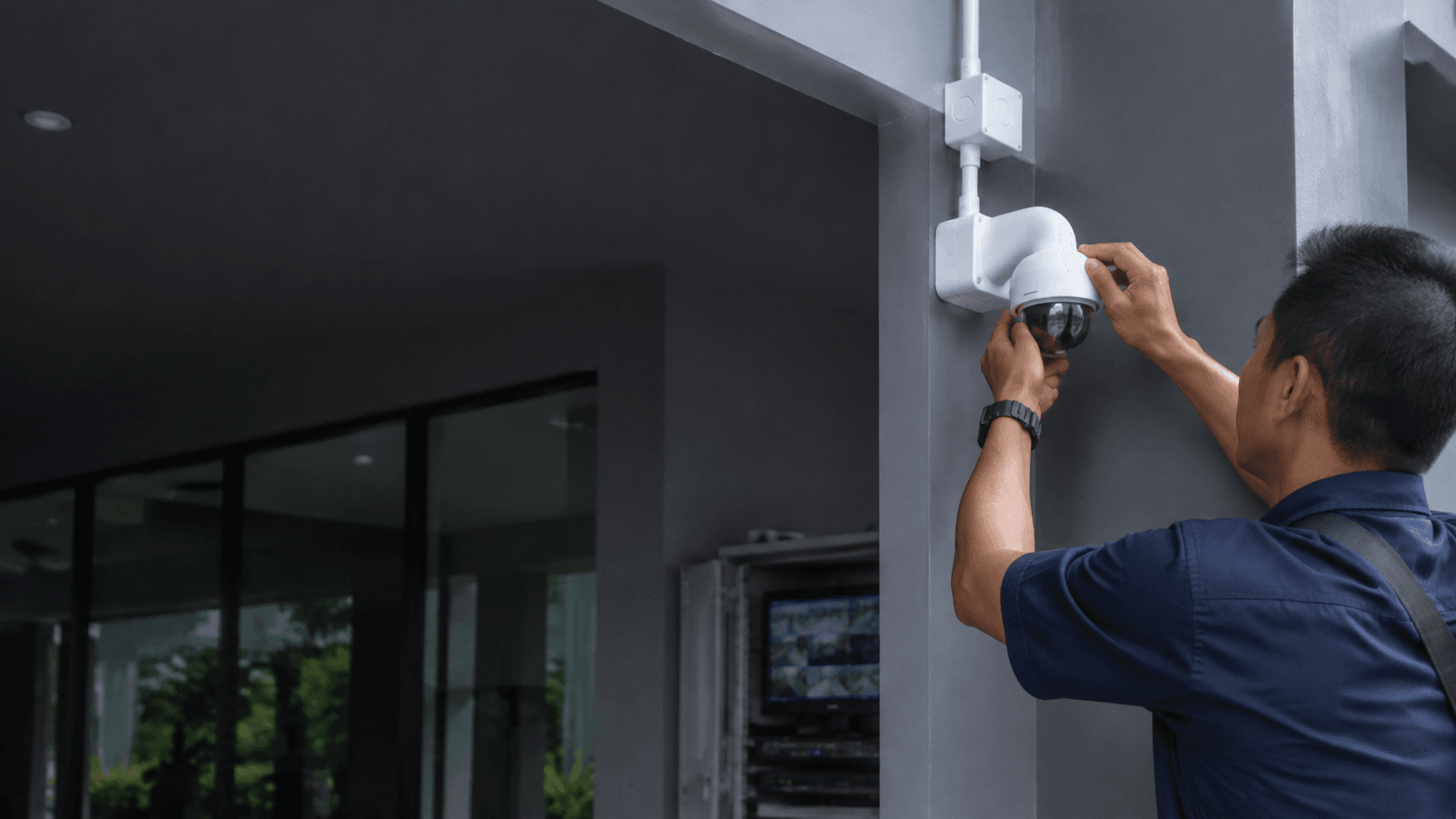
The exact-match query "outdoor camera system" describes more than a box of cameras. In Malaysian practice it covers the survey that decides where each camera points, the cabling and recorder that store the footage, the mobile viewing setup that lets an owner check the property remotely, and the handover that confirms the system works before the installer leaves.
Eyonic Sdn Bhd is a security system supplier in Sarawak that plans, supplies, and installs monitoring systems with camera placement, recording, and remote viewing. Its founder, Eric Yong, has worked in the industry for more than 10 years, with experience in technical installation of digital security solutions for commercial businesses in Sarawak.
What an outdoor camera system covers in Malaysia
A complete outdoor camera system has four working parts: cameras mounted at the perimeter, a recorder that stores footage, a network or cabling path that connects them, and a viewing method for checking live or recorded video away from the site. Eyonic lists site survey, camera placement, NVR setup, and remote viewing as the core elements of its CCTV security systems work.
Malaysian properties vary widely in what those four parts need to handle. A single-storey terrace house in Kuching has a different perimeter from a shophouse with a back lane, and both differ again from an industrial site with a long boundary and multiple entry points. The planning stage exists to match the hardware and cabling to the actual property rather than to a generic package.
Eyonic supplies and installs for homes, offices, shops, and industrial sites, so the same planning method is applied across property types. What changes is the number of cameras, the recorder capacity, and how much cabling and containment the site requires.
How an outdoor camera system is planned before installation
Planning starts with a site survey, not with a product list. Eyonic's CCTV installation process runs through four stages in order, and each stage depends on the one before it.
- Site survey — the property is reviewed to understand entry points, existing cabling, power availability, and where cameras can be mounted.
- System proposal — the survey findings are turned into a proposed camera layout, recorder position, and viewing setup.
- Installation — cameras, cabling, and the recorder are installed and configured on site.
- Handover — the system is checked with the user, including recording and mobile viewing.
The survey stage is where most of the practical decisions get made. Camera positions depend on what needs to be seen, where power and network points already exist, and whether cable runs can be kept tidy. A proposal built without a site visit tends to produce either too few cameras for the coverage needed or cameras placed where a wall, roof overhang, or tree blocks the view.
For businesses, the survey also captures how the site is actually used. The Kuching Immigration Office project focused on arrival flow, staff areas, visitor movement, and dependable daily operation. That framing shaped where cameras were needed, because a public office has different priorities from a warehouse or a retail shop.
The KTA Sarawak Sdn Bhd project followed a similar logic for an engineering consultancy office in Kuching, supporting staff movement, visitor handling, tidy cabling, and clearer daily site control. In both cases the camera layout followed the operational need rather than a fixed template.
Camera placement and lighting checks for an outdoor camera system
Placement decisions should be confirmed against real lighting conditions at the site, not against product descriptions alone. Eyonic recommends checking actual lighting conditions before confirming placement for ColorVu-style cameras, which are designed to produce usable images in low light.
That check matters because outdoor lighting changes through the day and across the year. A position that looks well lit at midday may sit in deep shadow by evening, and a camera aimed at a bright entrance can struggle when the background is much brighter than the subject. Reviewing the position at the times that matter — after dark, and during the hours when the property is most exposed — gives a more reliable answer than assuming a low-light camera removes the problem.
Practical placement questions during a survey usually include:
- Which entry points, gates, and vehicle paths need to be covered, and from which angle.
- Whether an existing wall, pillar, or roof edge gives a stable mounting point with a clear line of sight.
- Whether power and network or video cabling can reach the position without an exposed or untidy run.
- Whether the camera faces into a light source at night, which affects image quality.
- Whether the position is high enough to be out of easy reach but still close enough to identify faces or plates.
Coverage and identification pull in opposite directions. A wide view captures more of the perimeter but shows less detail on any one person or vehicle. A tighter view identifies better but leaves gaps. Most properties end up with a mix: wider views on open boundaries and tighter views on gates, doors, and cash or stock areas.
Recording, remote viewing, and handover for an outdoor camera system
Recording and viewing are configured after the cameras are mounted. Eyonic's scope includes NVR setup and remote viewing, which means the recorder is installed and configured, and mobile viewing is handed over to the user as part of the job.
The recorder is the part most often underestimated during planning. It needs a position with power, ventilation, and a cable path back to the cameras, and it needs enough storage for the number of cameras and the retention period the owner wants. Retention is a practical decision: keeping more days of footage requires more storage, and the right number depends on how quickly a problem would realistically be noticed.
Remote viewing depends on the network at the site. A stable connection at the recorder is what makes mobile viewing reliable, so the survey should confirm that a suitable connection point exists before installation rather than after. Handover is where this gets tested — the user should be able to open the app, view a live camera, and find recorded footage before the installer leaves.
Handover is also the point to confirm the practical details: which cameras cover which areas, how to review footage for a specific time, and who to contact if a camera goes offline. For multi-user sites such as offices, it helps to decide in advance who holds viewing access and whether different users need different permissions.
Budget ranges and project examples for an outdoor camera system
Budget depends on camera count, recorder capacity, cabling distance, and site complexity. Eyonic publishes a Hikvision CCTV Package at RM 1,599 covering camera supply and setup, basic recording configuration, and mobile viewing handover. That package suits a straightforward property where the coverage requirement is modest and cabling runs are short.
Larger or more complex sites sit in a different range. The Kuching Immigration Office project had an approximate budget of RM 12,000 to RM 28,000, reflecting a public office with arrival flow, staff areas, and visitor movement to cover. The KTA Sarawak Sdn Bhd office project had an approximate budget of RM 8,000 to RM 18,000, covering staff movement, visitor handling, and tidy cabling.
Those two figures show how far the range can move. A single office fit-out and a public building with heavier foot traffic both need more than a basic package, but they do not need the same amount of hardware or cabling. The site survey is what separates them, because it establishes how many cameras are needed and how much installation work the property requires.
For a home or small shop, the entry point is usually the package price. For a commercial or industrial site, the budget is better estimated after the survey, when camera count, recorder size, and cable routes are known. Quoting a commercial site from a package price alone tends to produce a figure that changes once the site is seen.
Common questions about an outdoor camera system
How many cameras does a property need? The count follows the number of entry points, vehicle paths, and areas that need coverage. A terrace house may need a small number covering the gate and front and rear entries, while a shop or office typically needs coverage of the entrance, counter or stock area, and any back access. The survey is what turns that into a number.
Can cameras be added later? Adding cameras later depends on whether the recorder and cabling can support them. Planning for a little spare capacity at the recorder and leaving room in cable routes makes later additions simpler than starting from a system sized exactly to day-one needs.
Does remote viewing need a subscription? Remote viewing depends on the recorder and network configuration at the site. Whether any ongoing service cost applies depends on the specific setup chosen, so it is worth confirming during the proposal stage rather than assuming either way.
What happens if a camera goes offline? The practical answer is to check power and network at the camera and at the recorder first, since most outages trace back to one of those two. Handover should include where the recorder sits and how to check camera status, so a simple fault can be identified without a site visit.
Is a site survey always necessary? For anything beyond a very simple single-camera setup, the survey is what prevents misplaced cameras and undersized recorders. It also produces the camera layout and cabling plan that the installation follows.
Eyonic's installation process — survey, proposal, installation, handover — applies across the property types it serves, from homes to industrial sites. Sharing the location, property type, and required system with Eyonic on WhatsApp at +60 11-5111 7959 is the next practical step toward a survey and proposal.