
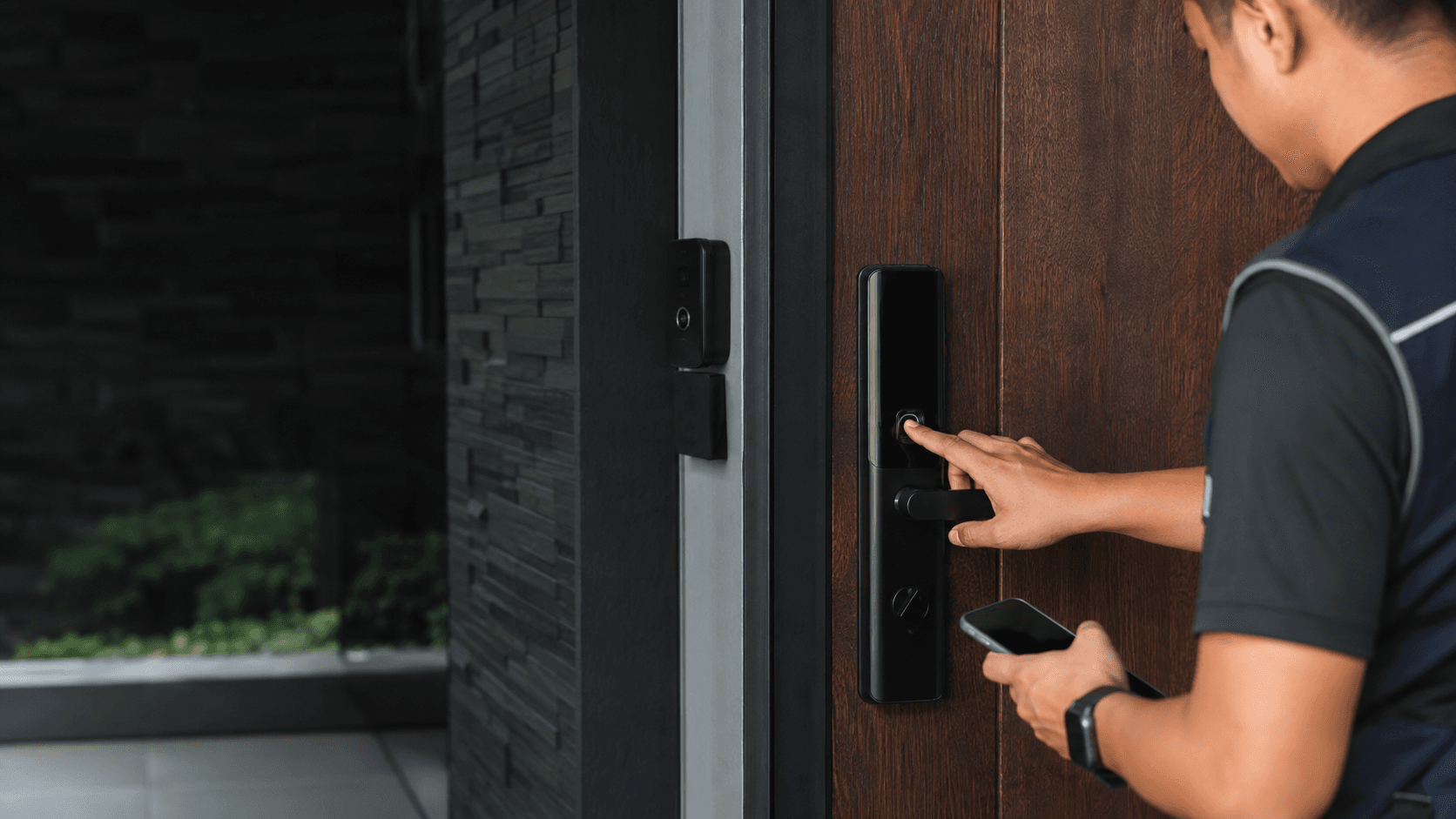
Most buyers in Malaysia start with a feature list and work backwards. The more reliable order is to start with the door itself, because the door decides which locks are even possible. Eyonic's own product review guidance makes the same point: smart locks work best when the door condition, user roles and backup method are reviewed before installation, and for business use the choice between a standalone smart lock and an access-control panel is checked first.
This page covers what buyers actually compare, how fit is confirmed, which access methods matter, what happens when power or network fails, and the checks worth completing before anyone drills into a main door.
Best Smart Lock For Main Door. What Buyers Compare
The comparison that matters is not brand against brand. It is lock type against door condition, and access method against the people who need to enter.
Review roundups in this category tend to sort locks into a few structural groups. Deadbolt replacement locks swap out the existing deadbolt entirely. Retrofit or adapter locks keep the existing deadbolt and motorise the thumb turn on the inside. Lever-handle and knob replacements change the handle rather than the deadbolt. Each group has a different relationship with the door, and that relationship drives cost, installation time, and how reversible the change is.
For a main door specifically, three trade-offs recur:
- Reversibility. A retrofit lock leaves the original deadbolt in place, so the door hardware is unchanged if the lock is removed. A full deadbolt replacement commits the door to that lock's footprint.
- Finish and hardware matching. A main door is visible. A replacement deadbolt or handle has to sit acceptably next to the existing handle set, grille, and gate hardware.
- Who needs entry. A household with domestic help, elderly parents, or regular short-stay guests needs temporary and revocable access. A single-occupant household may only need one reliable method.
Eyonic's product review listing describes smart lock door access as good for controlled convenience when user permissions and backup entry are planned properly. That phrasing is the useful summary: the lock itself is rarely the failure point. The planning around it is.
Why product rankings are a weak starting point
Large English-language roundups dominate search results for this query, and they are built around naming specific models with pros and cons. Those pages are useful for learning what features exist. They are less useful for a Malaysian main door, because the deciding variables are local: the door, the frame, the gate, the household, and who installs it.
A lock that ranks well in a review roundup can still be the wrong lock for a particular door. Fit is confirmed on site, not from a specification table.
Smart Lock For Main Door Fit. Door Type, Thickness and Existing Deadbolt
Fit is the first filter, and it eliminates more options than any feature comparison. A lock that does not physically suit the door cannot be rescued by better software.
Three physical facts decide most of it. The first is door type and construction: solid timber, hollow-core, metal, or a glass-and-frame arrangement each present different mounting and drilling conditions. The second is door thickness, because deadbolt and mortise hardware is designed around a thickness range, and a door outside that range needs different hardware or an adapter. The third is the existing deadbolt or handle configuration, including the backset and the position of the existing cutout.
There is also the question of what sits in front of the door. A main door behind a metal grille or a gate changes how a person approaches the lock, where a keypad can be reached, and whether a fingerprint reader is at a comfortable height. These are practical constraints, not preferences.
Retrofit versus full replacement on a main door
A retrofit lock is the lower-commitment option. It keeps the existing deadbolt and adds motorised control, which suits a door with sound existing hardware and a household that wants to test smart access before committing further.
A full deadbolt replacement gives a cleaner integrated result and typically a more complete feature set, but it changes the door permanently and depends on the door accepting that hardware.
The deciding question is usually whether the existing deadbolt is worth keeping. If it is in good condition and the door is otherwise sound, retrofit preserves options. If the existing hardware is worn or the door is being reworked anyway, replacement makes more sense.
Access Methods. Fingerprint, Keypad, Card, App and Physical Key
Access method is where most buying decisions are actually made, because it determines daily experience for everyone in the household.
Fingerprint access is fast for regular users and removes the need to carry anything, but it depends on enrolled prints being readable, which is less reliable for very dry, very wet, or worn skin. Keypad entry works for anyone who can remember or be given a code, which makes it the most practical method for visitors, contractors, and household staff. Card or tag access suits households that already carry a card for a condominium lift or office. App access covers remote unlocking and permission changes. A physical key remains the fallback that does not depend on electronics at all.
The useful pattern is to combine methods rather than rely on one. A main door that can only be opened by fingerprint creates a problem the first time a print will not read. A main door that can only be opened by app creates a problem when a phone is flat or a network is down.
Access permissions and who can revoke them
Permission management is the feature that separates a smart lock from a key. Codes and prints can be issued to a domestic helper, a family member, or a short-stay guest, and withdrawn later without changing the lock.
Two questions are worth settling before purchase. Who administers the lock, meaning who can add and remove users. And what happens when that person is unavailable. A lock administered by one person's phone is a single point of failure for the whole household.
Power Connectivity and Backup Entry When Things Fail
Every electronic lock has a failure mode, and the design question is what happens on the day it occurs.
Power is the most common one. Battery-powered locks depend on the battery, and a lock that gives no advance warning before it dies turns a convenience into a lockout. The practical safeguards are a low-battery warning that is actually noticed, and a backup entry method that does not depend on the lock's electronics.
Connectivity is the second. A lock that relies on Wi-Fi or a hub for remote features will lose those features when the network or power is out, even though local access methods such as keypad or key continue to work. That distinction matters. remote access and local access fail separately, and only one of them is needed to get through the door.
Backup entry is the third, and it is the one worth confirming in writing before installation. A physical key cylinder, an external power point for a temporary charge, or a mechanical override each solve the problem differently. The requirement is simply that at least one of them exists and that the household knows how to use it.
What happens during a power cut
A battery-powered lock is generally unaffected by a household power cut, because it is not drawing from mains electricity. A lock whose remote features depend on a router or hub will lose those features during an outage, while keypad, fingerprint, and key access continue to work locally.
This is why the backup method should be a physical or local one rather than another electronic path that shares the same failure.
Checks Before Installation
These checks are worth completing before confirming a lock or booking installation. Each one can change the recommendation.
- Confirm the door type and construction, since solid timber, hollow-core, metal, and glass-frame doors accept different hardware.
- Confirm the door thickness and the existing backset, because deadbolt hardware is designed around a thickness range.
- Confirm the existing deadbolt or handle configuration, including whether the hardware is worth keeping or replacing.
- Confirm which access methods the household actually needs, covering regular users, visitors, and household staff.
- Confirm the backup entry method and that everyone who needs it knows how to use it.
- Confirm power and connectivity expectations, including what still works when the network or mains power is down.
- Confirm who administers user permissions and who can revoke them.
Eyonic's installation process for its security systems follows site survey, system proposal, installation, and handover. The same sequence applies here. the survey is where door fit and access requirements are established, and the handover is where backup entry and permission management are explained to the household.
Where a site survey changes the answer
A survey resolves the questions that cannot be answered from a product page. It establishes the actual door thickness, the state of the existing deadbolt, whether a grille or gate affects access, and where a keypad or reader can be reached comfortably.
It also surfaces the household's real access pattern, which is often different from the assumed one. A door used mainly by two adults has different requirements from a door used by a family, a helper, and regular deliveries.
Practical Next Step With Eyonic
Eyonic Sdn Bhd is a security system supplier based in Sarawak, Malaysia, working across CCTV and ELV systems for homes, offices, shops, and industrial sites. Its product range includes Hikvision cameras and smart locks, and its project work includes the Kuching Immigration Office, where the focus was arrival flow, staff areas, visitor movement, and dependable daily operation.
For a main door, the practical starting point is the door itself rather than a model number. Sharing the door type, the existing deadbolt or handle setup, and who needs regular access gives enough to narrow the options before any hardware is confirmed.
Share your location, property type and required system with Eyonic on WhatsApp at +60 11-5111 7959 for the next practical step.