
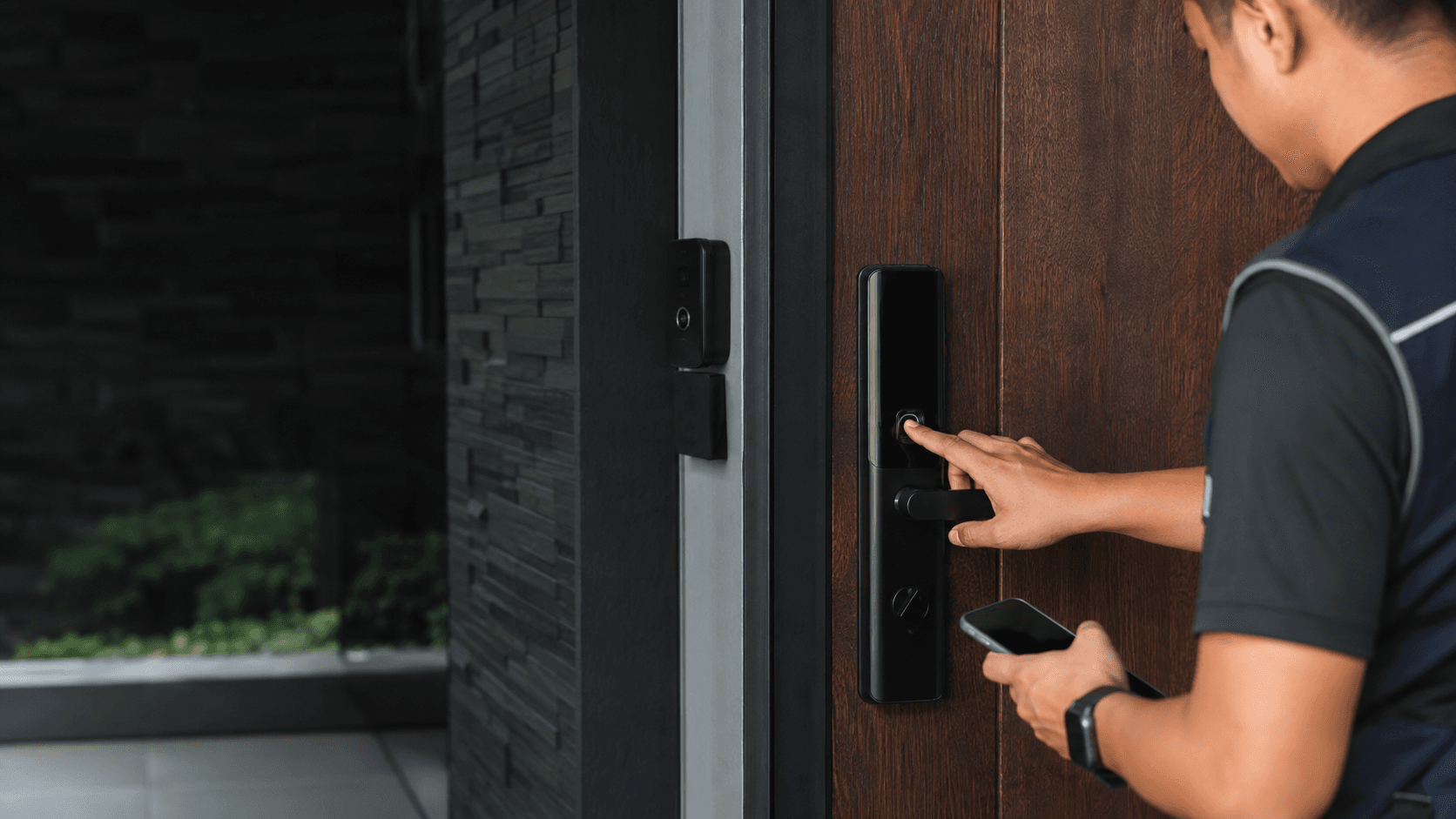
The exact-match query homekit compatible locks describes a small, specific category rather than a general smart-lock shelf. A lock earns that label only when Apple's ecosystem recognises it, and the practical work of choosing one in Malaysia starts with the door, not the product page.
Homekit Compatible Locks. What Compatibility Actually Means
Compatibility is a chain of three links: the lock itself, the hub that bridges it to Apple's Home app, and the network that carries the commands. Break any link and the lock still works as a standalone keypad or fingerprint lock, but it stops responding to Siri, automations, and remote status checks.
Apple's HomeKit framework lets a lock report its state and accept commands through the Home app. A hub is normally required for automations and remote access, because the lock communicates over Bluetooth, Thread, or Wi-Fi to a home hub rather than directly to a phone from another city.
Two features get confused constantly. HomeKit support means the lock appears in the Home app and responds to Siri. Apple Home Key is a narrower feature that stores a digital key in Apple Wallet so a compatible iPhone or Apple Watch can tap to unlock. A lock can support HomeKit without supporting Home Key, so the two should be checked separately against the manufacturer's own documentation.
Matter changes the picture again. A lock built on Matter can be added to multiple ecosystems, including Apple Home, which reduces the risk of buying into a dead end. Matter support is model-specific and firmware-dependent, so the only reliable check is the manufacturer's current compatibility statement for the exact model being considered.
HomeKit, Home Key and Matter: How the Pieces Fit Together
These three terms describe different layers, and treating them as one word is the most common buying mistake.
- Confirm the lock model is listed as HomeKit compatible by the manufacturer, not by a marketplace listing.
- Confirm whether the model also supports Apple Home Key, which is a separate feature from HomeKit itself.
- Confirm whether the model uses Matter or Thread, and whether that firmware is already shipping on units sold locally.
- Confirm a HomeKit hub is present in the home, such as an Apple TV or HomePod, since automations and remote access depend on it.
- Confirm the door's existing deadbolt or lever type matches what the lock is designed to replace or retrofit.
- Confirm the backup entry method, whether that is a physical key, a keypad code, or a second entry point.
- Confirm network coverage reaches the door, because a weak signal at the door produces unreliable status reporting.
Home Key is the feature most often marketed as the headline, but it only matters if household members carry a compatible iPhone or Apple Watch. In a household with mixed phone platforms, HomeKit support alone may be the more useful target, with keypad codes covering everyone else.
Where Matter fits
Matter is an interoperability standard rather than an Apple feature. A Matter lock can be commissioned into Apple Home and other ecosystems, which is useful for a home that may change platforms later. The constraint is that Matter support is not retroactive across every unit of a given model, so the firmware state of the actual unit matters as much as the model name.
Door and Lock Condition Before Any Smart Lock Decision
Smart locks fail in the field for mechanical reasons far more often than for software reasons. The door decides what is possible.
Door thickness, backset, bore diameter, and the position of the existing deadbolt determine whether a lock is a direct replacement, a retrofit over existing hardware, or a job that needs the door prepared differently. A retrofit design keeps the existing deadbolt and adds smart control, which suits rented or heritage doors where the original hardware should stay. A full replacement swaps the deadbolt assembly and usually gives a cleaner result on a door that is already being reworked.
Door alignment matters more than most buyers expect. A door that needs to be lifted or pushed to latch will fight a motorised deadbolt, and the lock will report jams or drain batteries faster. Checking the strike plate alignment and hinge condition before purchase avoids a lock that is technically compatible but practically unreliable.
Eyonic's own smart lock guidance notes that smart locks work best when door condition, user roles, and backup method are reviewed before installation, and that for business use the choice between a standalone smart lock and an access-control panel should be checked first. That is a mechanical and operational judgement, not a brand preference.
User Roles, Guest Access and Backup Entry Planning
A lock is only as good as the access rules around it. In a home, the questions are simple: who gets a permanent credential, who gets a temporary one, and what happens when a phone is lost or a battery dies.
HomeKit's Home app handles user invitations and access levels, which covers household members well. It is less suited to high-turnover guest access, where a dedicated access-control panel with scheduled credentials and an audit trail is often the more practical tool. For a small office, a shop, or a site with staff and visitors moving through the same door, that distinction decides the hardware category before any model is shortlisted.
Backup entry deserves a decision, not an assumption. A physical key cylinder, a keypad code, or a second door are the usual options. A lock with no mechanical override and no keypad leaves the property dependent on a working phone, a working hub, and a working battery at the same moment.
Eyonic's project work for the Kuching Immigration Office focused on arrival flow, staff areas, visitor movement, and dependable daily operation, and the KTA Sarawak Sdn Bhd project addressed staff movement, visitor handling, and clearer daily site control. Both illustrate the same principle: access hardware is planned around how people actually move through a building, not around a feature list.
Homekit Compatible Locks in Malaysian Homes and Offices
Malaysian buyers face a specific practical problem: the global model names discussed online are not always the units available locally, and local availability, warranty terms, and firmware state can differ from the international listing. That gap is the main reason a compatibility check should be done against the actual unit being supplied, not against a review written for another market.
For a landed home in Sarawak, the typical setup is a single main entrance door with a mix of household members and occasional domestic help or contractors. HomeKit support plus keypad codes covers that pattern well. For a shophouse or small office, the same door may serve staff, deliveries, and visitors across a working day, which pushes the decision toward scheduled credentials and an audit trail.
Network coverage is the quiet constraint. A door at the far end of a long house or behind a thick wall may sit at the edge of Wi-Fi range, which affects hub communication and remote status. Checking signal at the door before committing to a model is cheaper than discovering the problem after installation.
Where a property already has CCTV, alarm, or intercom systems, the lock should be planned as part of the same access picture rather than as an isolated purchase. Eyonic supplies and installs CCTV, alarm, autogate, keyphone intercom, and smart lock systems across Sarawak, which means the lock decision can be made alongside the rest of the entry setup instead of in isolation.
Installation Handover and Daily Operation
Installation is where compatibility claims meet the actual door. The process Eyonic follows for its installation work runs through site survey, system proposal, installation, and handover, and the same sequence applies to a smart lock: assess the door and the access pattern, propose the right category of hardware, install and configure it, then hand over with the household or staff trained on daily use.
Handover is not a formality. It is where user roles get set, guest codes get issued, the backup entry method gets demonstrated, and the person responsible for the system learns what to do when a battery warning appears or a phone is replaced. A lock that nobody knows how to administer reverts to a keypad lock within a month.
Daily operation then depends on three habits: keeping the hub powered and connected, replacing batteries before they fail rather than after, and reviewing who still holds access. The last one is the most commonly neglected, and it is the one that matters most in a property with staff turnover or short-term guests.
For readers comparing options, the useful next step is to describe the door, the property type, and the access pattern rather than the model name. Share the location, property type, and required system with Eyonic on WhatsApp at +60 11-5111 7959 for the next practical step.