
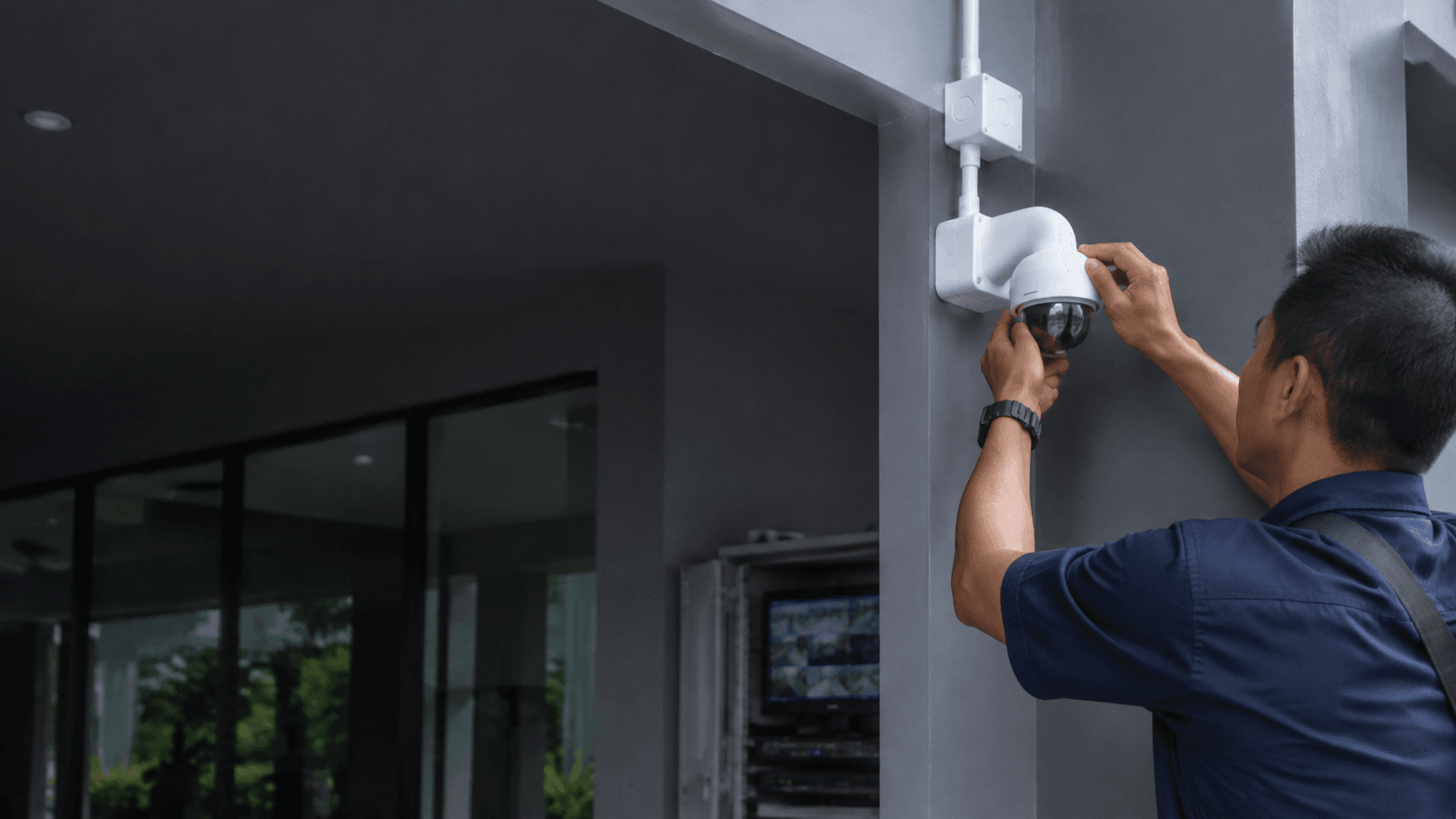
The channel count is the headline number, but it is not the whole decision. An eight-channel recorder is sized around how many camera positions a property actually needs, how long footage should stay available, and whether the person reviewing it can find the right clip without help. In Malaysia, the recorder is also the part of the system most likely to be installed once and then left running for years, which makes the survey and handover stages matter more than the specification sheet.
8ch dvr: what an eight-channel recorder does in a CCTV setup
A recorder takes the video feeds from the cameras, writes them to a storage drive, and serves them back for live viewing and playback. The "8ch" label describes how many camera channels the unit accepts. That single figure shapes the rest of the system: how many positions can be covered, how much footage can be retained, and how the recorder is wired back to the cameras.
In a small-to-mid setup, the recorder is usually the fixed point. Cameras can be added, repositioned, or swapped later, but the recorder determines the ceiling on how many feeds run at once. Choosing eight channels when the property needs six or seven leaves room to grow. Choosing eight when the property needs twelve means a second recorder or a replacement unit.
Recording is not the only job. The recorder also handles playback, search, and remote viewing. Those three functions decide whether the system is genuinely useful after an incident, because footage that cannot be found quickly has limited value.
How eight channels map to cameras, storage, and daily recording
Channel count and camera count are related but not identical. A property with eight camera positions can use all eight channels. A property with five positions uses five and leaves three spare. The spare channels are the reason an eight-channel recorder is often chosen over a four-channel unit even when the current camera count is low.
Storage is the other half of the equation. Continuous recording fills a drive faster than motion-triggered recording, and higher camera counts fill it faster still. The practical question is not "how big is the drive" but "how many days of footage should remain available before the oldest recording is overwritten". That answer depends on the number of cameras, the recording schedule, and the resolution in use.
Daily recording behaviour matters as much as capacity. A recorder set to record continuously gives complete coverage but shorter retention. A recorder set to record on motion gives longer retention but depends on the detection working reliably in the actual lighting conditions at each position. Eyonic advises checking real lighting conditions before confirming camera placement, because detection behaviour changes between a well-lit entrance and a dim back lane.
Remote viewing is the third daily function. Once the recorder is on the network, live and recorded footage can be reviewed from a phone or browser. The setup work happens at handover, when the viewing app is configured and tested rather than left for the property owner to work out later.
Camera compatibility and wiring decisions before purchase
Compatibility is where most recorder purchases go wrong. A recorder and its cameras need to speak the same video format, and the cabling between them needs to suit the distance and the building. These are decisions to settle before the unit is ordered, not after it arrives.
Three questions drive the choice:
- Site survey to confirm camera positions, lighting, cable routes, and recorder location.
- System proposal covering the recorder, cameras, storage, and viewing setup.
- Installation of cameras, cabling, recorder, and storage drive.
- Handover with live viewing, playback, and remote access tested on site.
The survey stage exists because cable routes and recorder placement are hard to change later. A recorder needs power, network access, and enough ventilation, and it is usually better placed somewhere secure than somewhere convenient. Camera positions need to be checked against actual lighting rather than assumed from a floor plan.
Existing wiring is worth assessing before assuming a full re-cable. Where suitable cable already runs to the right positions, it can sometimes be reused, which changes both the cost and the disruption. Where it does not, the survey should identify that early rather than mid-installation.
Where an eight-channel recorder fits homes, shops, and offices
An eight-channel recorder suits properties that need more coverage than a basic four-camera setup but do not justify a larger unit. That covers a range of common cases in Sarawak.
A home with a front gate, a car porch, a back door, and a side lane can use four to six channels and keep the rest spare. A shop with an entrance, a counter, a stockroom, and a rear loading area sits in a similar range, with the counter position often the one that matters most for disputes. An office with a reception, a corridor, a server room, and a staff entrance typically needs coverage of movement rather than of people at desks.
Eyonic's work for the Kuching Immigration Office focused on arrival flow, staff areas, visitor movement, and dependable daily operation. That is the shape of a public-facing site: coverage follows how people move through the building, and the system has to keep running without daily attention. A smaller commercial or residential property usually follows the same logic at a smaller scale.
The KTA Sarawak Sdn Bhd project covered a practical office setup in Kuching supporting staff movement, visitor handling, tidy cabling, and clearer daily site control. Tidy cabling is not a cosmetic point. Poor cable routing is one of the more common reasons a working system becomes unreliable, and it is far easier to get right during installation than to correct afterwards.
Where an eight-channel recorder does not fit is equally clear. A property needing more than eight camera positions, or one where footage must be retained for a long period across many cameras, will outgrow the unit. A single-camera setup does not need eight channels. The recorder should match the property, not the other way around.
Site survey, installation, and handover steps
The installation sequence Eyonic follows is site survey, system proposal, installation, and handover. Each stage produces something the next stage depends on, which is why skipping the survey tends to surface as problems during installation.
The survey establishes what the property actually needs. It covers camera positions, lighting at each position, cable routes, recorder location, and how the system will be used day to day. The proposal then sets out the recorder, cameras, storage, and viewing setup as a single package rather than a list of parts.
Installation covers mounting, cabling, recorder setup, and storage configuration. Handover is the stage that decides whether the system is usable: live viewing, playback, and remote access are tested on site, and the people who will use the system see it working before the installer leaves.
Handover is also where retention settings get confirmed. How many days of footage remain available, and what happens when the drive fills, are questions worth settling at handover rather than discovering later.
Practical next step for a Malaysia installation
For a property in Sarawak, the useful starting point is a survey rather than a product decision. Camera count, positions, and cable routes determine which recorder is appropriate, and those are site-specific.
Eyonic Sdn Bhd plans, supplies, and installs monitoring systems with camera placement, recording, and remote viewing for homes, offices, shops, and industrial sites. The founder, Eric Yong, has worked in the industry for more than ten years, with experience in technical installation of digital security solutions for commercial businesses in Sarawak.
Package pricing is published for related systems: a Hikvision CCTV package at RM 1,599 covering camera supply and setup, basic recording configuration, and mobile viewing handover; a Hikvision alarm system at RM 1,599; and an autogate package at RM 1,599. These are package prices for those systems, not a quoted price for an eight-channel recorder installation, which depends on the site.
Larger project work sits in a different range. The Kuching Immigration Office project carried an approximate budget of RM 12,000 to RM 28,000, and the KTA Sarawak Sdn Bhd project an approximate budget of RM 8,000 to RM 18,000. Those figures describe the scale of commercial project work rather than the cost of a single recorder.
Share your location, property type and required system with Eyonic on WhatsApp at +60 11-5111 7959 for the next practical step.