
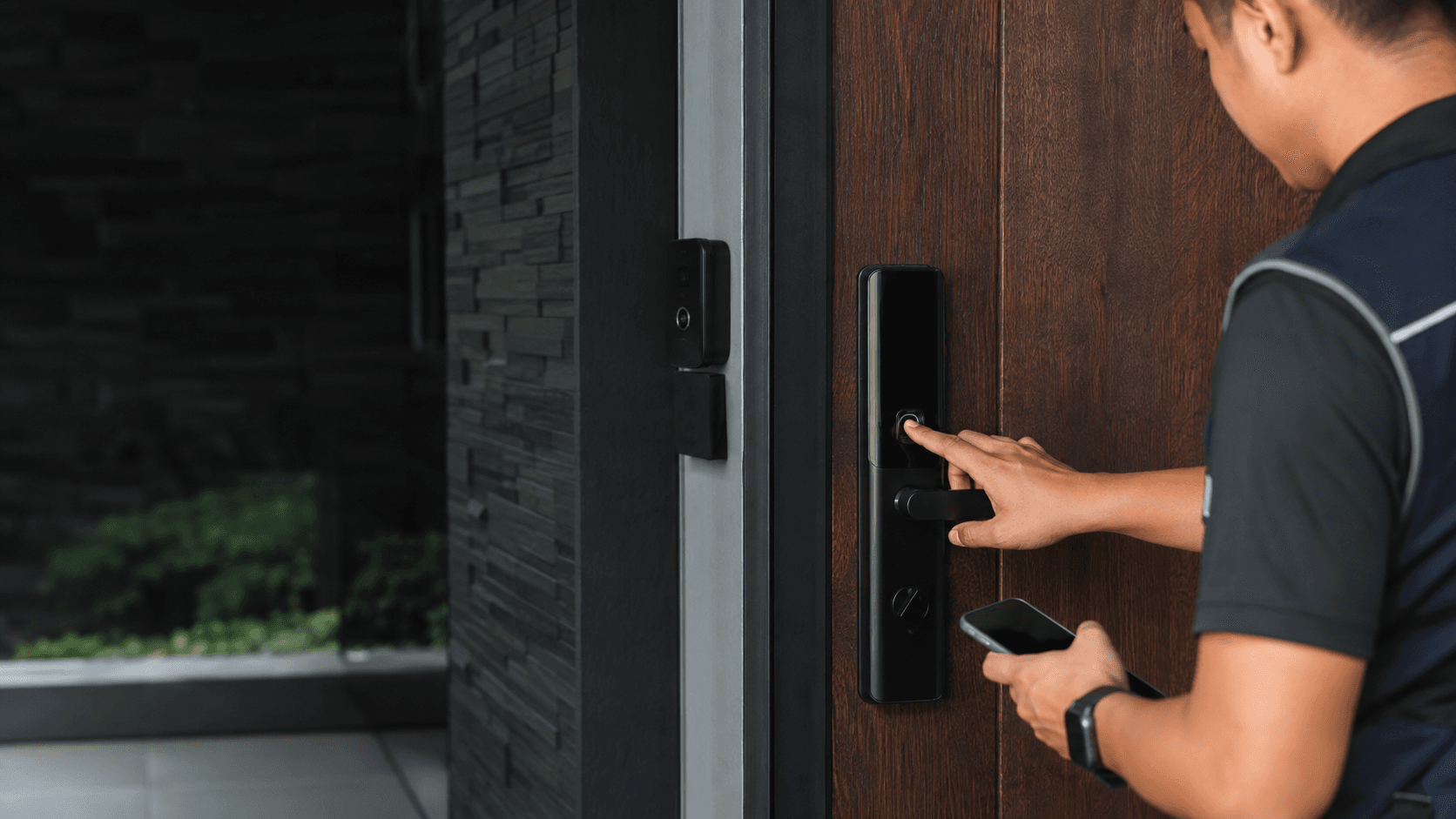
The category is broad, and the buying decision rarely turns on the lock alone. In Malaysia, the practical questions are whether the existing door can carry the hardware, how many people need daily entry, and what happens when the electronics fail or the battery runs flat. Eyonic Sdn Bhd, a security system supplier in Sarawak, treats smart lock door access as a planning exercise rather than a product swap, and the same logic applies whether the door serves a home, an office, a shop or a controlled-entry area.
Electronic Keyless Door Locks. What the Category Covers
Electronic keyless door locks are door-mounted locking devices that grant entry through a credential other than a cut key. The credential may be a numeric code, a proximity card or fob, a fingerprint, a smartphone app, or a combination of these. Some models retain a mechanical keyway as a fallback; others are key-free by design.
The category sits between two larger worlds. On one side is conventional door hardware, where the lock is a purely mechanical device. On the other is full access control, where a panel manages many doors, schedules and audit trails. Electronic keyless door locks occupy the middle ground: smarter than a keyed knob, simpler than a networked system.
That middle position explains why the category attracts so much comparison shopping. A buyer searching for electronic keyless door locks is usually trying to solve one door, not a building. The decision is therefore about fit, not about which product has the longest feature list.
Where the category stops
A standalone electronic keyless door lock controls one door. It does not coordinate with other doors, and it does not normally produce the kind of centralised reporting that a managed access control panel does. When a site needs several doors under one policy, the standalone lock becomes a component rather than the whole answer.
Eyonic's own product review notes that smart locks work best when the door condition, user roles and backup method are reviewed before installation, and that for business use the company usually checks whether a standalone smart lock or an access-control panel is more appropriate. That check is the dividing line between the two approaches.
Door Condition and User Roles Decide the Fit
Two doors can look identical and behave completely differently once hardware is fitted. Door condition is the first filter, and user roles are the second.
Door condition covers the physical realities: how the door is constructed, how it closes, whether the frame is sound, and whether the existing cut-outs suit the replacement hardware. A door that binds, drops, or relies on a loose strike plate will punish any lock fitted to it. Electronic hardware adds weight and a motor or solenoid action, so alignment matters more than it does with a simple latch.
User roles cover who needs in, how often, and with what level of accountability. A family home with four regular users has different needs from a shop where staff turn over, or an office where visitors need escorted entry. The number of distinct credentials, the need to revoke one without disturbing the others, and the desire for a record of entry all push the decision.
Pre-installation checks Eyonic applies to smart lock door access
- Review the door condition, including how it closes and whether the frame and existing cut-outs will accept the hardware.
- Map the user roles, so the number of credentials and the need to add or revoke access is known before a model is chosen.
- Confirm the backup method, so entry is still possible if the primary credential fails, the battery drains, or the electronics stop responding.
Those three checks come before any product discussion. Skipping them is the most common reason a lock that reviews well elsewhere disappoints on the actual door.
Electronic Keyless Door Locks Compared by Access Method
Access method is the most visible difference between models, and it shapes daily behaviour more than any other feature.
Keypad entry suits doors used by people who should not carry anything extra. A shared code is easy to issue and easy to change, which makes it practical for a shop counter or a staff entrance. The trade-off is that a shared code is only as private as the people who know it, and changing it disrupts everyone who used the old one.
Card and fob entry suits sites where credentials need to be issued and withdrawn individually. A lost fob can be cancelled without affecting anyone else. The trade-off is that users must carry the credential, and the lock must be compatible with the card technology in use.
Fingerprint entry removes the carried credential entirely and ties entry to a person. It suits doors where a small number of regular users need fast, hands-free access. The trade-off is enrolment effort and the reality that some users' fingerprints read less reliably than others.
App and smartphone entry suits households and small offices where remote control and temporary access matter. It depends on the phone, the app and, in many cases, a network connection. The trade-off is that the lock's usefulness is tied to a device that can be lost, replaced or run out of charge.
Most electronic keyless door locks combine two or more of these methods. The combination matters more than any single method, because the second method is usually the one that keeps the door usable when the first one fails.
How Eyonic Plans a Keyless Door Lock Installation
Eyonic's installation work follows a documented sequence used across its security system projects in Sarawak: site survey, system proposal, installation, and handover. The same four stages apply to a keyless door lock installation, scaled to the size of the job.
- Site survey, where the door, frame, closing behaviour and existing hardware are examined on site.
- System proposal, where the recommended approach is set out, including whether a standalone lock or a panel-based arrangement fits better.
- Installation, where the hardware is fitted and the credentials, permissions and backup method are configured.
- Handover, where the people who will use the door daily are shown how it works and how to handle the common failure cases.
The survey stage is where most problems are caught. A lock specified from a photograph or a measurement alone can fail on a door that does not close cleanly, and the cost of discovering that after installation is higher than the cost of checking first.
Eyonic's project history in Kuching includes work for the Kuching Immigration Office, focused on arrival flow, staff areas, visitor movement and dependable daily operation, and for KTA Sarawak Sdn Bhd, an engineering consultancy office where staff movement, visitor handling and tidy cabling were the priorities. Both projects share the same underlying concern: the system has to work every day, for the people who actually use the entrance.
What handover should cover
Handover is not a demonstration of features. It is the point where the people who use the door learn how to add a user, remove a user, and get in when the primary method fails. A lock that nobody on site can administer becomes a support call waiting to happen.
For a business, handover should also establish who holds the administrative credential. If that responsibility is unclear, access tends to accumulate rather than get cleaned up.
Backup Entry and Daily Operation
Every electronic keyless door lock needs a plan for the day the electronics do not cooperate. Battery depletion is the most common cause, but failed readers, damaged keypads and network outages all produce the same result: a door that will not open on the usual credential.
The backup method should be decided before installation, not after the first lockout. A mechanical keyway is the simplest fallback, provided the key is stored somewhere other than behind the door it opens. A second credential method, such as a keypad behind a fingerprint lock, covers reader failure but not a dead battery. An external power point covers some battery failures but not a damaged reader.
Daily operation matters just as much as the failure case. A lock that requires a phone to be unlocked, an app to be opened and a connection to be available will slow down every entry. A lock that opens on a code in under two seconds will not. The right choice depends on how the door is used at peak times, not on how it is used when someone is demonstrating it.
For sites with several doors or a need to review who entered and when, the standalone lock reaches its limit. That is the point at which a panel-based access control approach becomes the more practical answer, because it centralises the policy instead of repeating it at each door.
Questions Buyers Ask
Can an electronic keyless door lock be fitted to an existing door? Often, but it depends on the door's construction, how it closes, and whether the existing cut-outs match the replacement hardware. A site survey answers this more reliably than a product listing.
How many users can one lock support? The practical limit is set by the model and by how the credentials are managed. The more important question is how easily a single user can be removed without disturbing the others.
What happens when the battery runs out? It depends on the backup method chosen at planning stage. A mechanical keyway, a second credential type, or an external power point each cover different failure modes, and none covers all of them.
Is a standalone lock enough for a business? For one controlled door with a small, stable user group, often yes. For multiple doors, frequent staff changes, or a need for entry records, a panel-based approach is usually the better fit.
Does the lock need a network connection? Only if remote access or app-based control is part of the requirement. A keypad or card lock can operate without any network at all, which removes a dependency rather than adding one.
Eyonic supplies and installs security systems across Sarawak, including CCTV, alarm, autogate, keyphone intercom and smart lock door access, with published packages for CCTV, alarm and autogate at RM 1,599 each. Keyless door lock supply and installation is quoted per site because the door, the user count and the backup requirement vary too much for a fixed package. Share the location, property type and required system with Eyonic on WhatsApp at +60 11-5111 7959 for the next practical step.