
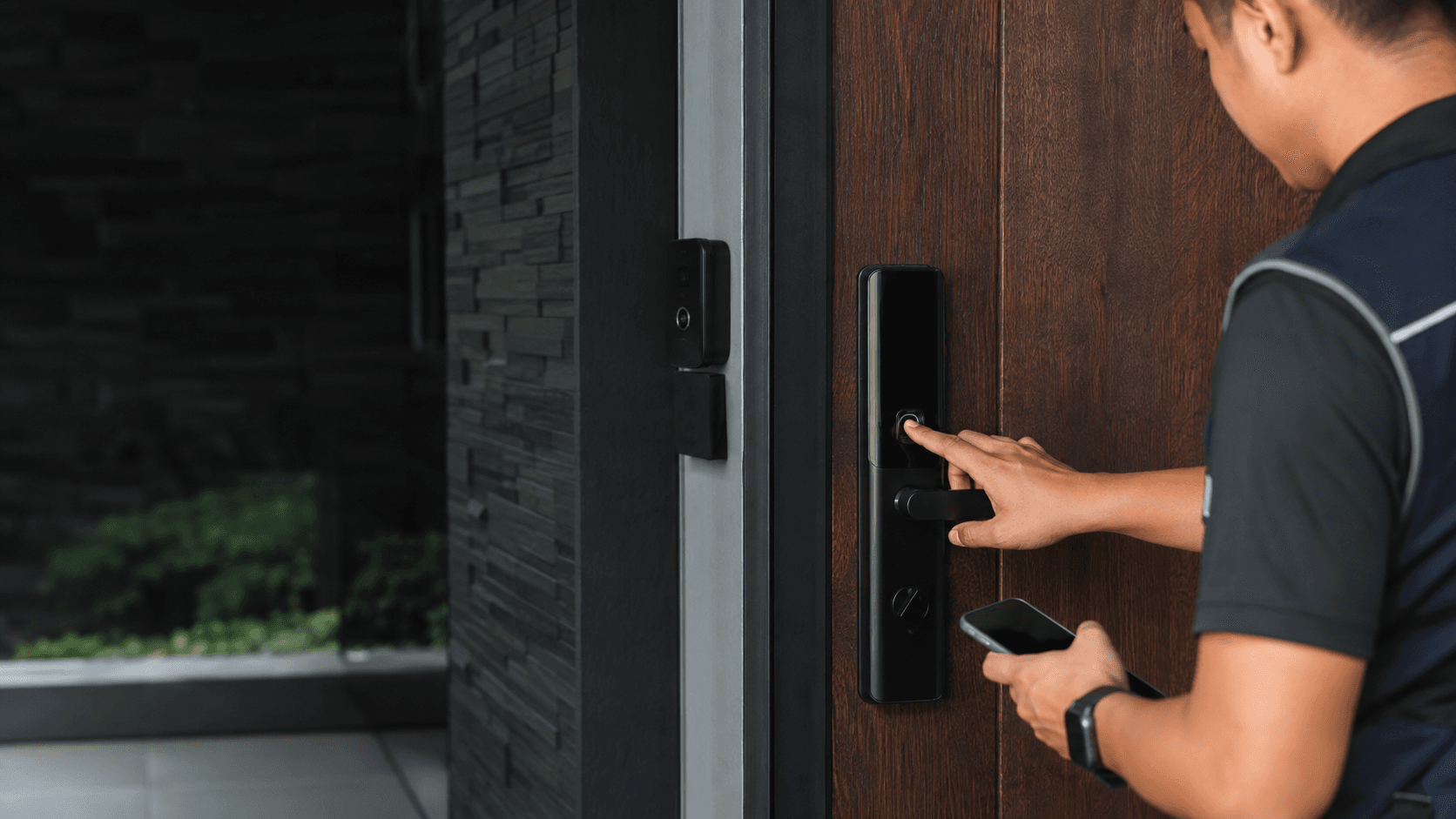
That retrofit approach is the reason the category exists. Instead of removing a working deadbolt and cutting or re-drilling anything, the smart unit attaches to the interior side of the door and turns the existing thumbturn. The outside of the door looks the same as it did before, and the original key still works.
Eyonic Sdn Bhd, a security system supplier in Sarawak, Malaysia, treats smart lock door access as a controlled-convenience product rather than a straight swap. The company's own product review guidance states that smart locks work best when door condition, user roles and backup method are reviewed before installation, and that for business use the choice between a standalone smart lock and an access-control panel is usually checked first.
Smart Lock That Fits Over Existing Deadbolt: What Matters Before You Choose
A retrofit unit leaves the deadbolt body, the latch, the strike plate and the exterior key cylinder in place. Nothing is removed from the door slab, so there is no exposed bore hole and no patching afterwards.
Three things stay usable after the smart unit is mounted:
- The original key, because the exterior cylinder is unchanged.
- The existing deadbolt throw, because the smart unit drives the same thumbturn the hand already used.
- The door's finish and hardware style, because no new exterior trim is fitted.
This is also why retrofit units suit rented property and heritage or solid-timber doors where drilling a second hole is undesirable. A full replacement lock, by contrast, swaps the whole assembly and normally requires the existing bore to match the new lock's backset and bore diameter.
The trade-off is mechanical. A retrofit unit has to grip and rotate a thumbturn that was designed for fingers, so the smoothness of that thumbturn decides how reliably the motor can drive it. A stiff or gritty deadbolt that a person can still force by hand may stall a retrofit motor.
Door and deadbolt conditions that decide fit
Fit is decided by the door and the deadbolt, not by the smart lock's marketing. Four conditions carry most of the weight.
- Door condition. The slab must be solid enough at the mounting point, and the door must close and latch cleanly without being lifted or pushed. A door that already needs a shoulder to shut will not improve with a motor attached.
- Deadbolt operation. The thumbturn should rotate smoothly through its full travel by hand. Binding, grinding or a bolt that needs a nudge to seat means the mechanical side needs attention before any smart hardware is considered.
- User roles. Who needs entry, how often, and whether access must be revoked matters more than the lock model. A household with three regular users and a cleaner is a different problem from an office with staff, contractors and visitors.
- Backup method. There must be a way in when the battery is flat, the app is unavailable or the phone is lost. On a retrofit unit the original key is normally that method, which is one of the strongest arguments for the retrofit route.
Alignment between the deadbolt and the strike plate is the most common hidden problem. If the bolt does not drop freely into the strike, the motor is fighting the frame on every cycle, and the failure will show up as intermittent locking rather than a clean fault.
Where retrofit stops being the right answer
A retrofit unit is a poor fit when the door has no deadbolt at all, when the existing deadbolt is damaged or seized, or when the site needs audit trails, time-and-attendance records or integration with a wider access-control system. In those cases a standalone smart lock or an access-control panel is the more honest recommendation, and Eyonic's own review guidance points business users toward that comparison rather than assuming a retrofit unit will do.
Entry methods, permissions and backup access
Once the unit is mounted, entry is normally handled through a phone app, a keypad, a shared code or the original key. Which of those are available depends on the specific model, and no model-level capability should be assumed before the unit is confirmed.
Permissions are the part that gets under-planned. A retrofit lock that works perfectly for a family can become a liability in a workplace if every user holds the same code and nobody can tell who entered when. Planning user roles before installation means deciding who gets permanent access, who gets time-limited access, and who can revoke it.
Backup entry deserves the same planning. The original key covers a dead battery, but only if the key is stored somewhere reachable and not locked inside the property. A keypad covers a lost phone, but only if its code is managed. Two independent backup paths are more robust than one.
How Eyonic reviews a smart lock before installation
Eyonic's published review guidance sets out the sequence the company follows: check door condition, check user roles, check the backup method, then decide whether a standalone smart lock or an access-control panel suits the site. That order matters because the first three checks can rule out the fourth.
The company's wider installation process runs site survey, system proposal, installation and handover, which is the same shape applied to its CCTV work in Sarawak. A site survey is where door condition and deadbolt travel get confirmed in person rather than assumed from a photograph.
Eyonic's project record includes the Kuching Immigration Office, where the work focused on arrival flow, staff areas, visitor movement and dependable daily operation, and KTA Sarawak Sdn Bhd, an engineering consultancy office in Kuching that needed staff movement, visitor handling and clearer daily site control. Both are examples of the same underlying question a smart lock raises: who moves through a door, and how is that movement managed.
Eric Yong, founder of Eyonic Security Systems, has worked in the industry for more than ten years and is experienced in technical installation of digital security solutions for commercial businesses in Sarawak.
Practical limits and open questions
Several things cannot be settled from a web page, and pretending otherwise would be misleading.
Model-level compatibility is the biggest one. Whether a specific retrofit unit will drive a specific deadbolt depends on the geometry of that deadbolt and the door, and that is a physical check. No compatibility claim should be treated as confirmed until the door has been looked at.
Battery life, wireless protocol, remote access and platform integration all vary by model and are not fixed properties of the retrofit category. A buyer comparing units should read the manufacturer's own documentation for the model in question rather than relying on category-level descriptions.
Price is also model and site dependent. Eyonic publishes RM 1,599 package pricing for its Hikvision CCTV package, Hikvision alarm system and autogate package, but no equivalent published figure exists for smart lock supply or installation, so no smart lock price should be quoted from this page.
The honest summary is that a smart lock that fits over existing deadbolt hardware is a good answer when the door is sound, the deadbolt moves freely, the user roles are clear and a backup entry path exists. When any of those four is unresolved, the retrofit unit is not the constraint — the door is.
Share your location, property type and required system with Eyonic on WhatsApp at +60 11-5111 7959 for the next practical step.