
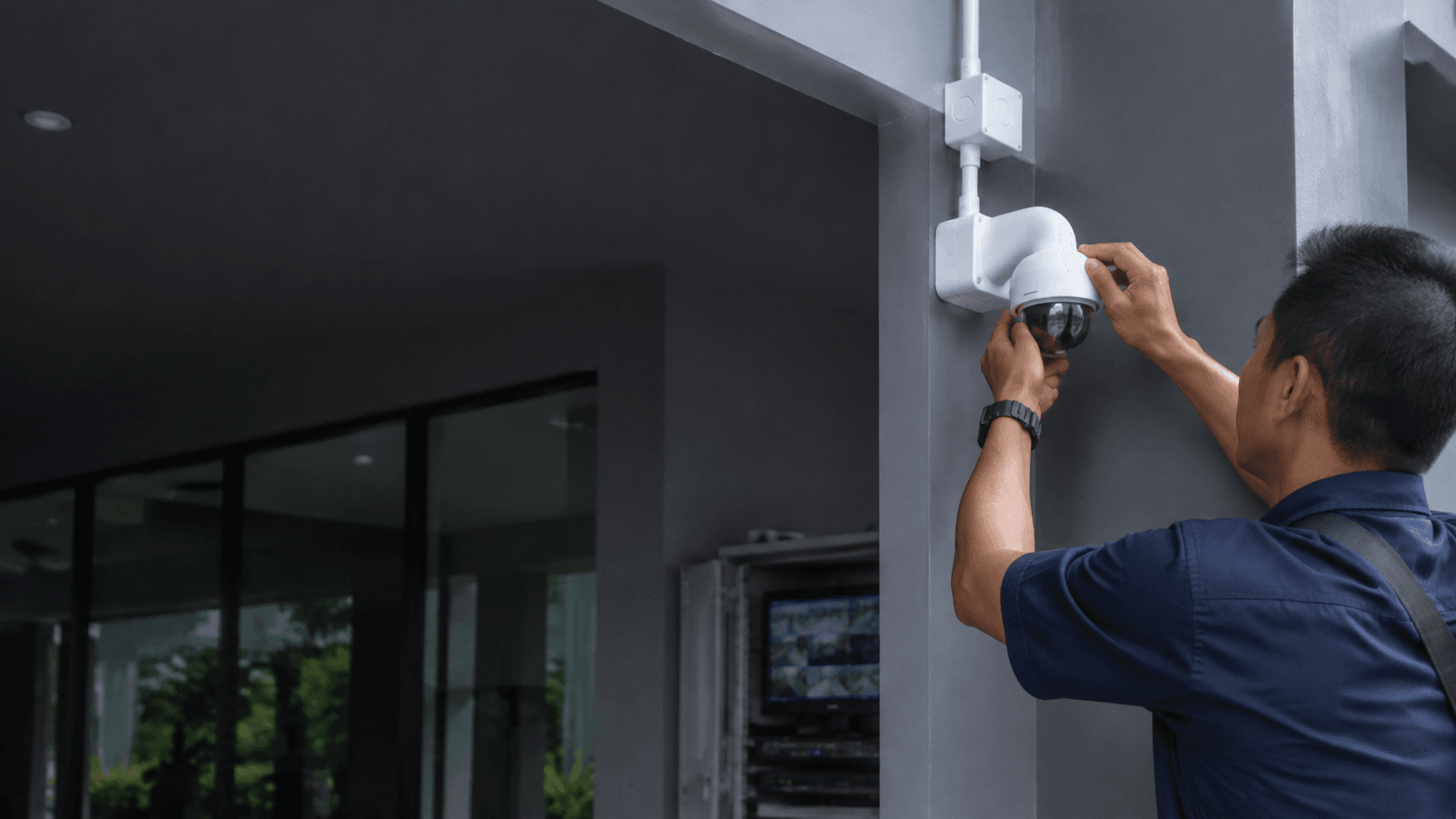
The exact-match query here is cctv camera for home, and the useful question is not which brand wins a specification contest. It is what a household in Kuching or elsewhere in Sarawak is actually buying: where cameras go, how footage is stored, how the feed reaches a phone, and who carries the work from first visit to final walkthrough.
Eyonic Sdn Bhd plans, supplies, and installs monitoring systems with camera placement, recording, and remote viewing for homes, offices, shops, and industrial sites. The company is based in Sarawak and works across residential and commercial properties, so the same planning discipline applied to a public office also shapes how a cctv camera for home setup is scoped.
Cctv Camera For Home. What the Setup Actually Involves
A home CCTV installation is a sequence, not a single purchase. Eyonic's published installation process runs through four stages, and each one produces something the household can review before the next begins.
- Site survey. The property is assessed on location, covering entry points, sightlines, existing wiring, and lighting conditions at the positions under consideration.
- System proposal. The survey findings become a proposed system: which cameras, where they mount, how recording is handled, and how remote viewing will work.
- Installation. Cameras, cabling, and the recorder are installed and configured according to the agreed proposal.
- Handover. The system is explained and demonstrated so the household knows how to view footage and operate the setup day to day.
That order matters because it front-loads the decisions that are expensive to change later. Moving a camera after cabling is run costs more than placing it correctly the first time, and a recorder sized for the wrong number of cameras is a replacement rather than an adjustment.
Why the survey comes before any equipment list
A survey exists to answer questions that cannot be settled from a floor plan alone. Where does the afternoon sun land? Which corner already has a power source? Does the front gate line of sight clear the neighbour's wall? These are physical facts about the property, and they determine placement more than any product comparison does.
Eyonic recommends checking actual lighting conditions before confirming placement for ColorVu-style cameras. That is a specific example of a general principle: a camera chosen for low-light performance still needs its position verified against the light that actually falls there, not the light assumed from a product description.
Camera placement decisions that shape the whole system
Placement is the decision that constrains everything downstream. It sets how many cameras are needed, how much cable is run, where the recorder can sit, and whether the resulting coverage has gaps that only become obvious after installation.
For a home, the practical starting points are the routes a person would use to approach or leave: the main gate, the car porch, the front door, and any side or rear access that is not overlooked. A camera pointed at a gate records the approach. A camera pointed at a door records the moment of entry. Those are different jobs and often need different positions.
Two constraints tend to surface during planning. The first is lighting. A position that looks ideal on a site plan may face directly into a strong light source for part of the day, which affects what the camera can usefully record. The second is cabling. Every camera position needs a route back to the recorder, and the tidiest route is usually decided before installation rather than improvised during it.
Eyonic's work for KTA Sarawak Sdn Bhd, an engineering consultancy office in Kuching, included tidy cabling as part of the brief alongside staff movement and visitor handling. The same expectation applies at home: cabling that is planned looks deliberate, and cabling that is improvised does not.
Recording, storage and remote viewing in daily use
Once cameras are placed, three things determine what the system is like to live with: where footage is stored, how long it is kept, and how it is viewed.
Eyonic's service description covers recording and remote viewing as core parts of a monitoring system, and the RM 1,599 Hikvision CCTV Package lists camera supply and setup, basic recording configuration, and mobile viewing handover. That package structure shows the intended shape of a handover: the household should finish the process able to open the feed on a phone, not merely in possession of installed hardware.
Storage is the part most often left vague in conversation. A recorder holds footage for a period determined by how many cameras feed it, how much storage it has, and how the recording is triggered. Those specifics depend on the system proposed for the property, so the retention period is a question to settle during the proposal stage rather than assume afterwards.
What remote viewing actually requires
Remote viewing depends on the recorder being reachable over the network and the viewing app being configured on the household's devices. That configuration is part of handover, which is why the handover stage is not a formality. A system that records correctly but cannot be viewed remotely has not delivered what was asked for.
Households should also decide who holds access. A single shared login is simpler to manage; separate logins per adult are easier to revoke if a device is lost. Either approach works, but the choice is easier to make before handover than after.
What a cctv camera for home package costs in Malaysia
Eyonic publishes a Hikvision CCTV Package at RM 1,599 covering camera supply and setup, basic recording configuration, and mobile viewing handover. That figure is the clearest published starting point for a home-scale package.
Larger or more complex work sits in a different range. Eyonic's Kuching Immigration Office project, a public office covering arrival flow, staff areas, and visitor movement, carried an approximate budget of RM 12,000 to RM 28,000. The KTA Sarawak Sdn Bhd office project carried an approximate budget of RM 8,000 to RM 18,000.
Those two project figures describe commercial and institutional scopes, not homes, and they should be read that way. They are useful because they show how far a budget can move once camera count, building size, and cabling complexity increase. A single-storey house and a multi-level property with outbuildings are not the same job even when both are described as a cctv camera for home installation.
What the published figures do not include is equally worth noting. No warranty terms, subscription fees, or monitoring plan details are published, so any assumption about ongoing costs should be confirmed directly rather than inferred from the package price.
A public office project that shows the planning approach
Eyonic's Kuching Immigration Office project is a useful reference because the brief was about movement rather than equipment. The work focused on arrival flow, staff areas, visitor movement, and dependable daily operation.
That framing translates directly to a home. Arrival flow becomes the gate and porch. Staff areas become the interior spaces a household wants covered. Visitor movement becomes the path from gate to door. Dependable daily operation becomes the requirement that the system still works on an ordinary Tuesday, not just on the day it was installed.
The project also shows why a public building and a private house can share a method. Both start with how people move through the space, then place cameras to match that movement. Neither starts with a product list.
Questions worth settling before installation day
Most dissatisfaction with a home CCTV system traces back to a question that was never asked during planning. Settling these before installation avoids rework.
How many cameras, and covering what? The answer should follow from the survey, not from a package default. A proposal that names each position and what it covers is easier to judge than one that names a camera count.
Where does the recorder live, and who can reach it? The recorder needs power, a network connection, and a location that is not trivially accessible to anyone who should not have it.
How long is footage kept? Retention depends on the proposed system. Ask for the figure rather than assuming a default.
What happens during a power cut? This is a legitimate planning question for any property, and the answer depends on the equipment proposed.
Who is contacted if something stops working? Knowing this before handover is more useful than discovering it afterwards.
Eric Yong founded Eyonic Security Systems and has worked in the industry for more than ten years, with experience in technical installation of digital security solutions for commercial businesses in Sarawak. That background is relevant to a home project mainly because the planning habits carry over: survey first, proposal second, installation third, handover last.
For households ready to move from reading to planning, sharing the property location, property type, and the system required with Eyonic on WhatsApp at +60 11-5111 7959 is the practical next step.