
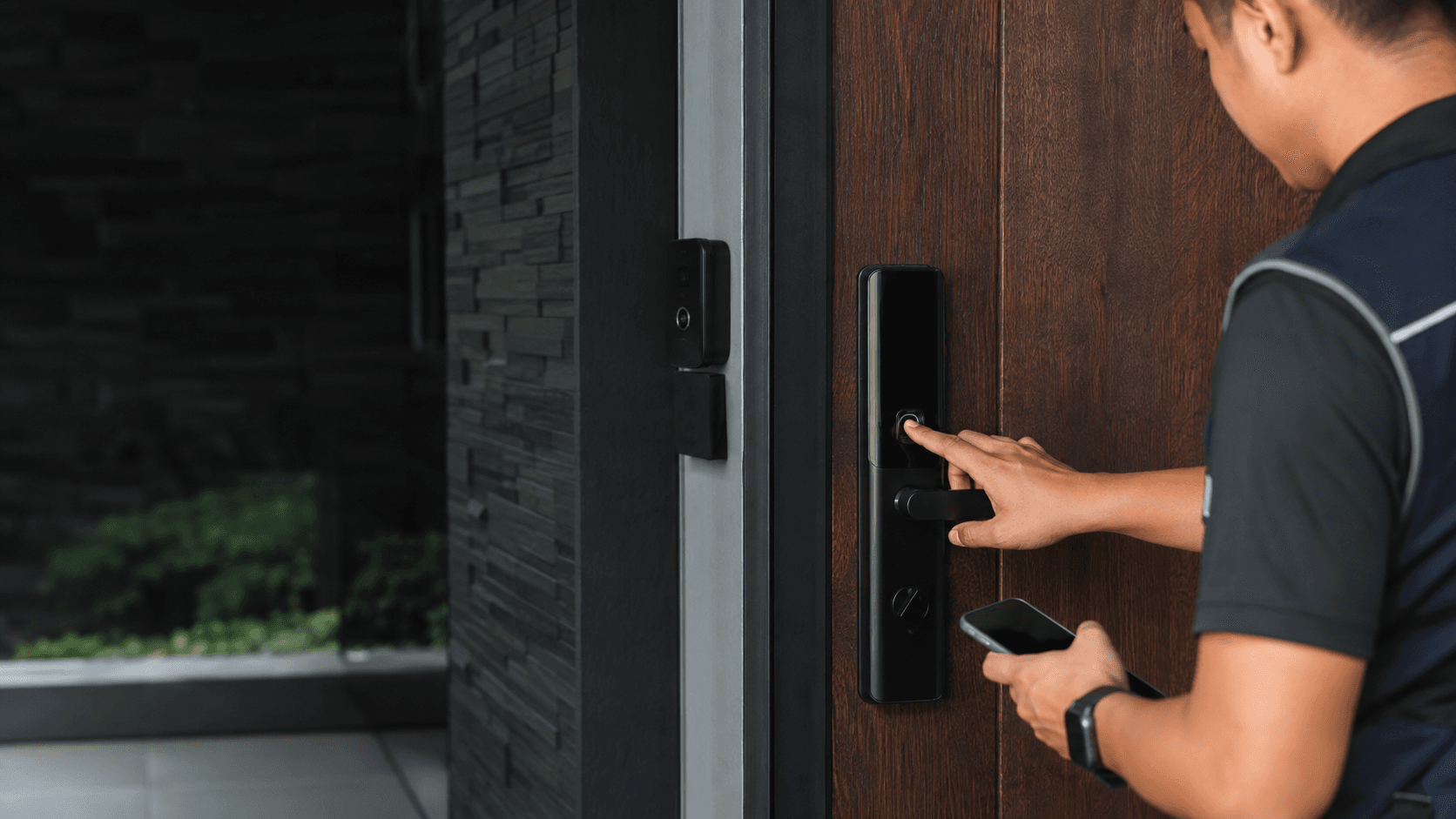
The exact-match query yale automatic door lock describes a category rather than one fixed product. Yale builds several electronic locks, and the automatic part usually refers to auto-lock: the bolt extends by itself after a chosen interval instead of waiting for someone to turn a thumbturn or press a button. That single behaviour changes how a door is used day to day, because the lock stops depending on the last person out remembering to secure it.
For properties in Malaysia, the practical questions are narrower than the marketing pages suggest. Will the lock fit the existing door and frame? Who needs entry, and who should be excluded? What happens when the battery runs down or the network drops? Those three questions decide more about satisfaction than any feature list.
Yale Automatic Door Lock. What It Does and When It Fits
Auto-lock is the defining function. A Yale automatic door lock can be set to relock after a delay, so a door that is pulled shut does not stay open to the corridor or the street. Yale's own support documentation describes auto-lock as a feature that locks the door automatically after a predetermined time, with the delay configurable up to 30 minutes. That range matters. a short delay suits a busy office entrance, while a longer delay suits a home where people move between rooms with their hands full.
The feature fits best where the door is used predictably. A main entrance with steady traffic, a staff door that closes at a fixed hour, or a rental unit where guests come and go without a key handover all suit automatic relocking. It fits poorly where the door is propped open for long stretches, because the lock will keep trying to secure a door that is not actually closed.
Two named things shape the decision before any model is chosen. The first is the door itself, including its thickness, material and how the existing deadbolt sits in the frame. The second is the access method, whether that is a keypad code, a fingerprint, a card, or an app. Yale's regional product pages group their smart door locks around exactly these entry options: fingerprint, RFID card, PIN code and mobile app.
One limit is worth stating plainly. Automatic relocking is a convenience and a discipline tool, not a substitute for a door that closes properly. If the door swells in humidity or the strike plate is misaligned, the motorised bolt may not seat, and the lock will report or behave in ways that frustrate users.
Door Condition and User Roles Decide the Model
Eyonic's own product review guidance on smart lock door access puts it directly: smart locks work best when the door condition, user roles and backup method are reviewed before installation. The same review notes that for business use, the choice between a standalone smart lock and an access-control panel should be checked rather than assumed.
Door condition covers more than appearance. The relevant checks are whether the door is hollow or solid, whether the frame has enough material for the lock body and strike, whether an existing bore hole matches the new hardware, and whether the door closes squarely without lifting or dragging. A door that needs a shoulder to shut will fight an automatic lock every day.
User roles decide how the lock is configured. A household needs a handful of codes and a way to add a cleaner or a relative temporarily. A shop needs staff codes that can be removed when someone leaves. An office may need time-restricted access so that a code works during working hours only. These are configuration decisions, and they are easier to make before installation than after.
Where roles become complex, a standalone lock can reach its limit. Multiple doors, audit trails, integration with an existing alarm or CCTV system, and centralised permission changes usually point toward an access-control panel instead. That is a design decision, not a product failure.
Auto-Lock Timing, Access Codes and Backup Entry
Auto-lock timing is the setting most likely to need adjustment after handover. A delay that is too short locks people out mid-task; a delay that is too long removes most of the security benefit. The right value depends on how far the door is from the nearest person and how often hands are full.
Access codes need a plan for removal, not just creation. Every temporary code should have an owner and an end date. In shared buildings, a code that is never deleted becomes a permanent key that nobody tracks.
Backup entry is the part that gets skipped and then matters most. There should be a mechanical key or a second entry method available, stored somewhere that is not inside the property the lock protects. If the only way in is a code or a phone, a flat battery becomes a lockout rather than an inconvenience.
Eyonic's smart lock review guidance frames this as planning user permissions and backup entry properly, which is the same principle that applies to any controlled-access door.
Power, Connectivity and Daily Reliability
Battery behaviour is the most common source of complaints about any electronic lock, and it is also the hardest thing to predict from a specification sheet. Battery life depends on how often the motor runs, how much the bolt has to push against the strike, and how much the wireless radio is used. A door that needs force to close will drain a lock faster than a door that swings freely.
Connectivity adds a second layer. A lock that works over Bluetooth alone needs someone nearby with a phone. Remote access, notifications and code changes from elsewhere generally require a bridge or a Wi-Fi connection, and that connection has to be stable where the door is. In Malaysia, that means checking signal at the door itself rather than at the router.
Reliability also depends on what happens during an outage. If the lock depends on a network for entry, a dropped connection should not become a locked door. The safe design keeps local entry working when the network does not.
These are the questions a site survey answers. Eyonic's installation process includes a site survey, a system proposal, installation and handover, and the survey stage is where door condition, power and connectivity are checked against the actual property rather than assumed from a product page.
Installation and Handover in Sarawak and Malaysia
Installation quality decides whether an automatic lock feels effortless or irritating. The lock body has to sit square in the door, the strike has to align with the bolt, and the door has to close without being pushed. Small alignment errors show up as failed locking attempts and shortened battery life.
Eyonic is a security system supplier based in Sarawak, working on CCTV and ELV systems for homes, offices, shops and industrial sites. Completed work includes the Kuching Immigration Office, where the focus was arrival flow, staff areas, visitor movement and dependable daily operation, and KTA Sarawak Sdn Bhd, an engineering consultancy office in Kuching that needed support for staff movement, visitor handling and tidy cabling. Both projects show the same pattern: access and movement are planned around how people actually use the building.
Handover is where the value is confirmed. Users should leave with working codes, a tested backup method, and a clear understanding of what to do when the battery warning appears. A lock that is installed but not explained tends to be trusted less than a mechanical key.
The checks below reflect the sequence Eyonic follows on installation work, applied to a door lock.
- Site survey at the property, including the door, frame and surrounding power or network points.
- Door and frame condition review to confirm the lock body, strike and bore will fit and align.
- User role and permission planning, covering who gets entry, for how long, and how codes are removed.
- Backup entry method agreed and stored outside the protected space.
- Installation of the lock and any bridge, keypad or power connection.
- Testing of auto-lock timing, every entry method and the backup route.
- Handover with user codes set, battery and network behaviour explained, and a contact for support.
Costs, Questions and the Next Practical Step
Pricing for a Yale automatic door lock in Malaysia is not something this page can state, because verified local pricing, warranty terms and stock availability were not available at the time of writing. Anyone quoting a firm figure without checking the specific model and door is guessing.
What can be stated is the shape of the cost. A lock supply and installation job is priced on the lock itself, the door preparation needed, any additional keypad or bridge, and the labour to fit and test it. Eyonic's published package pricing for other security work sits at RM 1,599 for a Hikvision CCTV package, RM 1,599 for a Hikvision alarm system, and RM 1,599 for an autogate package, each including supply, setup and handover. Those figures cover different systems and are not a quote for a door lock, but they show how the company structures package work.
Larger access projects scale differently. Eyonic's Kuching Immigration Office project carried an approximate budget of RM 12,000 to RM 28,000, and the KTA Sarawak Sdn Bhd project an approximate budget of RM 8,000 to RM 18,000. Those ranges reflect multi-point access and movement planning rather than a single door.
Several questions come up repeatedly, and they are worth answering directly.
Does an automatic lock replace the existing deadbolt? Usually it replaces the existing lock hardware rather than sitting alongside it. Whether the existing bore and door thickness suit the new lock is a survey question.
Can it be used on a metal or glass door? Door material changes the preparation work and sometimes the hardware. It should be confirmed against the actual door rather than assumed.
What happens when the battery dies? A mechanical key or second entry method should exist, and it should be stored outside the property. This is the single most important backup decision.
Is a standalone lock enough for a business? For one door with simple roles, often yes. For multiple doors, audit needs or integration with existing systems, an access-control panel is usually the better fit.
Does Eyonic supply and install Yale locks specifically? That has not been confirmed in the available material, so it should be asked directly rather than assumed. Eyonic's product review section covers smart lock door access across multiple brands and notes that the standalone-versus-panel decision is checked per site.
The practical next step is to describe the property. Location, property type and the required system are the three details that let a supplier confirm whether an automatic lock suits the door and what the installation involves. Eyonic can be reached on WhatsApp at +60 11-5111 7959 with those details.