
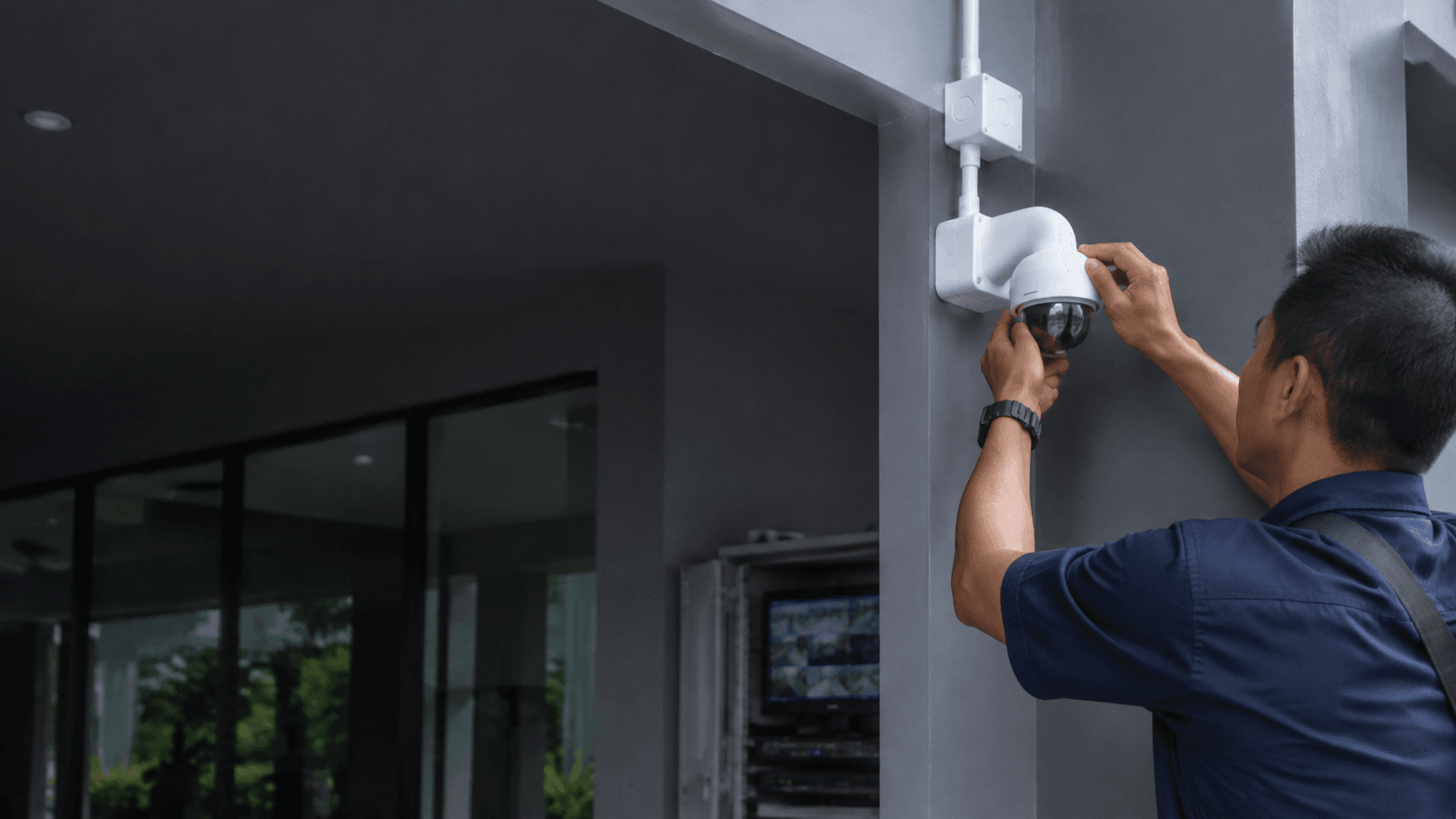
The exact-match phrase cellular security camera verizon describes a camera that reaches the internet over a mobile network rather than a fixed broadband line. Verizon's own support pages cover connected-device plans for non-phone devices, and its security camera plan page describes an unlimited data plan for cameras. That is the carrier side of the arrangement.
The practical question for a Malaysian property is different. Verizon is a United States carrier, and no supplied evidence states that Verizon service is available in Malaysia or that a Verizon SIM works in a camera installed here. The connectivity model still matters, because the same design logic applies to any local data-only SIM: the camera talks to the network on its own, and the site does not need a working Wi-Fi network to record and send footage.
Cellular Security Camera Verizon: What the Setup Actually Involves
A cellular camera carries its own radio module and its own SIM. It does not join a Wi-Fi network, and it does not depend on a router being powered, in range, or working. The camera sends video and alerts over the mobile network to a cloud service or app, and the viewer opens that app from anywhere with an internet connection.
Verizon's connected-device documentation treats a security camera as a non-phone device on a data plan, separate from a phone line. Verizon's security camera plan page describes an unlimited data plan for cameras and frames the pitch around not counting on Wi-Fi. Those two pages are the clearest carrier-side description of how the arrangement is sold in the United States.
Verizon Business also announced connectivity for a Tactacam cellular camera on the Verizon LTE network, which shows the same pattern at the hardware level: the camera ships with cellular connectivity built in, and the carrier supplies the data path.
Eyonic's own installation process runs through four stages, and the same sequence applies to a cellular camera job.
- Site survey to confirm the coverage area, mounting points, and power or solar options.
- System proposal covering camera choice, recording configuration, and remote viewing setup.
- Installation of the camera, its power source, and its network connection.
- Handover with mobile viewing configured and tested on the user's device.
Eyonic documents this four-stage process on its CCTV installation services page for Sarawak. The company plans, supplies, and installs monitoring systems with camera placement, recording, and remote viewing for homes, offices, shops, and industrial sites.
Why a Cellular Security Camera Verizon Arrangement Suits Sites Without Wi-Fi
The value of cellular connectivity is not speed. It is independence from a network the site may not have, may not trust, or may not be able to extend to the camera position.
A shop lot with a single shared router, a construction site with no fixed line, a farm or store far from the nearest fibre cabinet, and a temporary site that will be dismantled in a few months all share the same problem. Running cable or extending Wi-Fi to the camera point is expensive or impossible, and the camera still needs to send footage somewhere.
A cellular camera removes that dependency. The camera connects to the mobile network directly, so the recording and remote viewing path does not pass through the site's own internet service at all.
The trade-off is a recurring data cost and a dependence on mobile coverage at the camera position. A camera mounted in a basement, inside a metal container, or behind a thick concrete wall may see weak signal even when the surrounding area has good coverage. That is a survey question, not a specification question, and it is best answered on site before any mounting decision is made.
Power is the second constraint. A cellular camera that is not wired to mains power needs a battery, a solar panel, or both, and the panel needs meaningful daylight. A shaded mounting point changes the power plan.
Cellular Security Camera Verizon Connectivity, SIM, and Data Plan Questions
Verizon's connected-device plan pages describe how a camera is added to a mobile account in the United States. The camera is treated as a connected device, the plan carries a monthly cost, and the customer can bring an existing device or buy one through the carrier.
None of that establishes what happens in Malaysia. No supplied evidence states which Verizon data plans, prices, or activation terms apply to a security camera, and no supplied evidence states whether Verizon service is available in Malaysia at all. A reader in Kuching or elsewhere in Sarawak should treat the Verizon material as a description of how the model works, not as a purchasing route.
The local equivalent is a data-only SIM from a Malaysian carrier, paired with a camera whose radio module supports that carrier's bands. Whether a specific camera and a specific SIM work together is a compatibility question that has to be checked against the camera's own documentation and the carrier's plan terms. No supplied evidence confirms which cellular camera models Eyonic supplies, stocks, or supports, so that check belongs in the survey and proposal stage rather than in an assumption made beforehand.
Data consumption is the other unknown. A camera that records continuously and streams constantly uses far more data than one that records on motion events and uploads short clips. No supplied evidence gives cellular camera specifications such as resolution, battery life, solar capacity, or weatherproof rating, so a data estimate cannot be stated here with any confidence. The honest position is that the recording configuration drives the data requirement, and the configuration should be agreed before the SIM plan is chosen.
Does a cellular camera need a router or broadband line?
No. The camera reaches the network through its own cellular module, so a router and a fixed broadband line are not part of the path. A site with no internet service at all can still run a cellular camera, provided mobile coverage reaches the mounting position.
Can a Verizon SIM be used in a camera installed in Malaysia?
No supplied evidence supports that. Verizon is a United States carrier, and nothing in the available material states that its service or its SIMs operate in Malaysia. The connectivity model transfers; the specific carrier arrangement does not.
Camera Placement and Lighting Checks Before Installation
Placement decides whether the footage is useful. A camera aimed at a blank wall or a dark corner records nothing of value, and a camera mounted too high loses facial detail even when it covers more ground.
Eyonic recommends checking actual lighting conditions before confirming placement for ColorVu-style cameras. That advice applies directly to a cellular camera, because the same scene conditions govern whether the image is usable at night. A position that looks well lit during a daytime survey can be almost black after dark.
Signal strength belongs in the same check. A mounting point that gives the best view may sit behind a wall that blocks mobile reception, and moving the camera a short distance can change both the view and the connection quality. The two constraints have to be balanced on site rather than decided from a floor plan.
Power and cable routing complete the picture. A wired camera needs a supply run to the mounting point, and a battery or solar camera needs a position with enough daylight and reasonable access for maintenance. A camera that cannot be reached safely for a battery change or a cleaning is a camera that will eventually stop working properly.
Before installation is confirmed, four checks are worth completing.
- Lighting conditions at the exact mounting position, checked after dark as well as during the day.
- Camera placement that covers the intended area without losing the detail needed to identify a person or vehicle.
- Recording configuration, including whether the camera records continuously or on motion events, and where footage is stored.
- Remote viewing handover, with the app installed, the account signed in, and live view confirmed on the user's own device.
Planning Steps for Malaysian Properties
A cellular camera project in Sarawak follows the same shape as any other monitoring installation, with two extra decisions: which network the camera will use, and how the camera is powered.
The network decision starts with coverage at the site. A data-only SIM from a Malaysian carrier is the realistic route, and the camera's supported bands have to match that carrier. The power decision starts with whether mains supply can reach the mounting point; if it cannot, the choice is between a battery camera and a solar-assisted one, and the available daylight at the position determines which is workable.
Eyonic's documented process for CCTV work in Sarawak runs from site survey through system proposal, installation, and handover. The same sequence gives a cellular camera job a clear structure and a clear point at which the user takes over the system.
Budget expectations should be set carefully. Eyonic's published packages are RM 1,599 for a Hikvision CCTV package, RM 1,599 for a Hikvision alarm system, and RM 1,599 for an autogate package. No supplied evidence gives a price for a cellular camera installation, so a cellular camera job should be scoped and quoted on its own terms rather than assumed to match a package figure.
Larger projects give a sense of scale. Eyonic's Kuching Immigration Office project, which covered arrival flow, staff areas, visitor movement, and dependable daily operation, carried an approximate budget of RM 12,000 to RM 28,000. A KTA Sarawak Sdn Bhd office project in Kuching, covering staff movement, visitor handling, tidy cabling, and clearer daily site control, carried an approximate budget of RM 8,000 to RM 18,000. Those figures describe office-scale work, not a single cellular camera, and they are useful only as a reference for how project scope drives cost.
What Eyonic Can Confirm Before Any Cellular Camera Work Begins
Eyonic Sdn Bhd is a security system supplier in Sarawak, Malaysia, working on CCTV and ELV systems for homes, offices, shops, and industrial sites. Eric Yong, the founder, has been in the industry for more than ten years and works on technical installation of digital security solutions for commercial businesses in Sarawak.
What Eyonic can confirm at the survey stage is the site-specific part: where a camera can be mounted, what lighting conditions apply at that position, whether mobile coverage reaches it, how the camera will be powered, and how remote viewing will be handed over. Those are the questions that decide whether a cellular camera is the right choice for a particular property.
What Eyonic cannot confirm from the available material is which cellular camera models it supplies or supports, whether a Verizon SIM or any specific carrier SIM works with cameras installed in Malaysia, or what a cellular camera installation would cost. Those points need a direct answer rather than an assumption, and they are best raised before any commitment is made.
For a property in Sarawak with no dependable Wi-Fi at the camera position, the sensible first step is a survey that tests coverage, lighting, and power at the intended mounting point. Share the location, property type, and required system with Eyonic on WhatsApp at +60 11-5111 7959 to arrange that next practical step.