
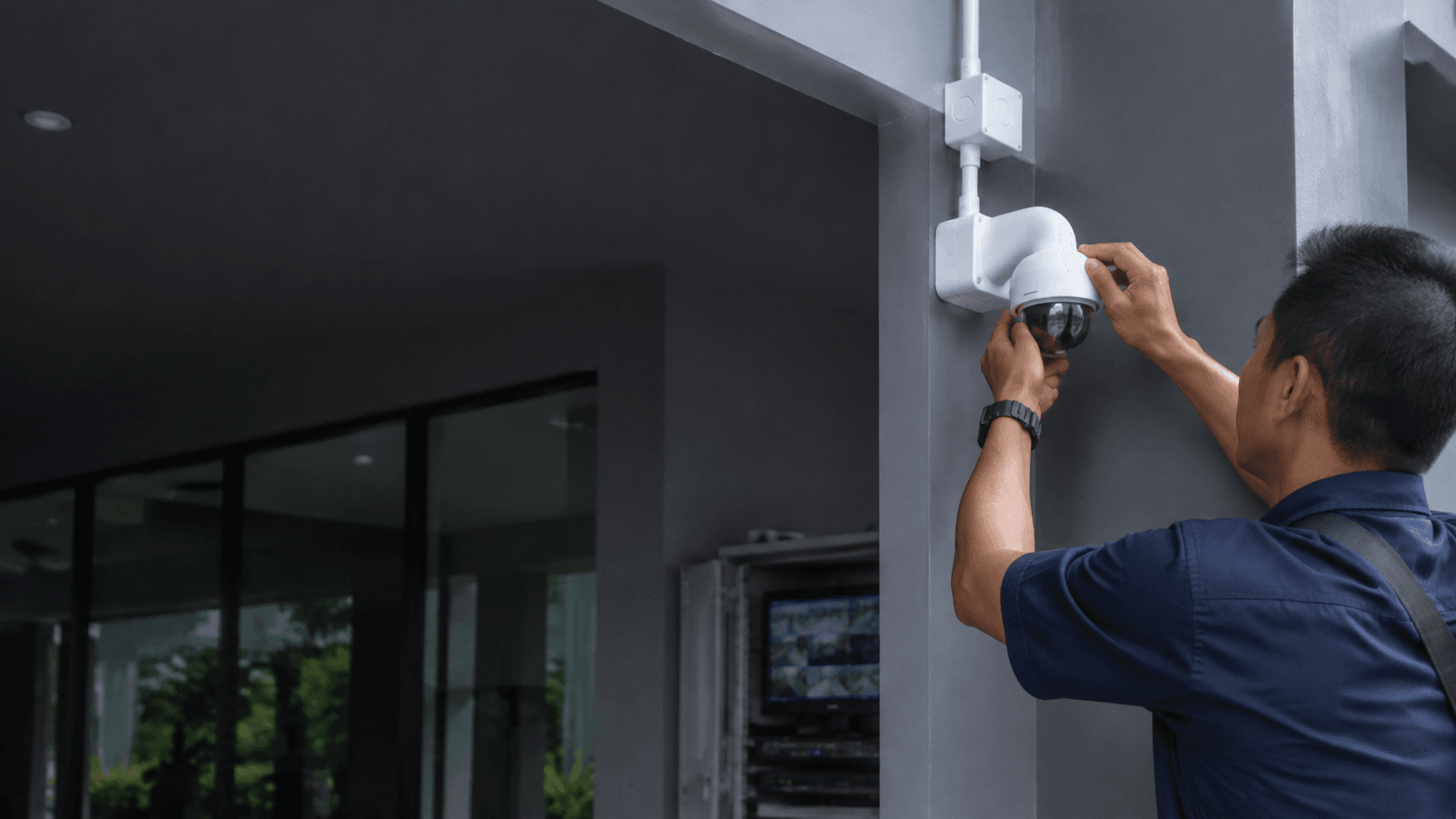
The exact-match query security camera monitoring service describes a package of work, not a single boxed product. It covers where cameras point, how footage is stored, who can open the live view, and what happens when something needs attention. In Malaysia, that work is shaped by building type, power and network routes, and how much of the day a site sits unattended.
Eyonic Sdn Bhd plans, supplies, and installs monitoring systems with camera placement, recording, and remote viewing for homes, offices, shops, and industrial sites in Sarawak. The company's founder, Eric Yong, has worked in the industry for more than 10 years, with a focus on technical installation of digital security solutions for commercial businesses in Sarawak.
Security Camera Monitoring Service: What It Covers
A security camera monitoring service is the layer that turns a set of cameras into something a person can act on. Three parts usually sit inside it.
The first is capture. Cameras are chosen and aimed so that the important movement on a property is actually visible, not just technically recorded. The second is recording, handled by a recorder such as an NVR that stores footage locally. The third is remote viewing, which lets an owner or manager open a live or stored view from a phone or computer.
Recording-only CCTV stops at the first two parts. Footage exists, but nobody sees an event while it is happening. Adding monitoring changes the timing: the value shifts from proving what happened to noticing what is happening.
That distinction matters most where a site is empty for long stretches. A shop after closing hours, a warehouse yard at night, or an office over a weekend all produce long periods with no one present. Monitoring is what closes that gap.
Where monitoring stops and other systems begin
Cameras do not open gates, unlock doors, or sound a siren on their own. Those jobs belong to separate systems. Eyonic also installs alarm systems, autogate packages, keyphone intercoms, and Starlink internet in Sarawak, which matters because a monitoring setup often depends on the network and power arrangements around it.
An alarm system can trigger attention. An autogate controls vehicle entry. A keyphone intercom handles internal and door communication. Cameras record and, with remote viewing, let someone look. Treating these as one product leads to gaps, because each has its own wiring, its own failure points, and its own handover checks.
How Remote Viewing and Recording Fit Together
Remote viewing and recording are two different jobs that share the same cameras. Recording keeps a copy on site. Remote viewing sends a live or stored picture out to a phone or computer over the internet.
Because they are separate, one can work while the other fails. A recorder can keep writing footage to disk while the internet link is down, which means the recording survives but the live view does not. The reverse also happens. a live view can open on a phone while the recorder has stopped writing, which is the more dangerous case because the footage a dispute depends on may not exist.
This is why NVR setup is treated as its own task rather than a by-product of mounting cameras. The recorder needs a defined storage location, a stable power source, and a check that it is actually writing. Remote viewing then needs a working internet connection at the site and a viewing app configured on the owner's device before handover.
What remote viewing does not replace
Remote viewing gives access, not attention. A person still has to open the app and look. That is a real constraint for anyone who cannot check a phone during working hours, and it is the honest limit of a self-managed remote viewing setup.
Where continuous attention is needed, the practical answer is usually a combination: recording for the record, remote viewing for quick checks, and an alarm system for events that should not wait for someone to open an app. Each part covers a different failure mode.
What a Site Survey Confirms Before Installation
A site survey is the step that decides whether a proposed camera layout will actually work on a given property. It happens before installation, and its findings shape the system proposal.
Eyonic's CCTV installation process runs through site survey, system proposal, installation, and handover. The survey is where placement, cabling routes, power availability, and network conditions are checked against the real building rather than a floor plan.
Several things are settled at this stage. Camera positions are confirmed against the areas that matter, such as entrances, counters, staff areas, and vehicle routes. Cable paths are identified, including where drilling or trunking is needed. The recorder location is chosen for power and access. The internet connection at the site is checked, because remote viewing depends on it.
Lighting is part of the same survey. Eyonic recommends checking actual lighting conditions before confirming placement for ColorVu-style cameras, because a position that looks adequate in daylight can behave differently at night. A survey done in the afternoon may miss what the same corner looks like at 8pm.
Why the survey changes the proposal
Two properties of the same size can need different systems. A shop with a bright frontage and a dark back lane has two different lighting problems. An office with a suspended ceiling has easier cable routes than a building with solid concrete slabs. A site with no fixed internet needs a different remote viewing plan than one with fibre already installed.
The survey is also where scope gets bounded. It is better to confirm that a specific area cannot be covered well from a single position than to discover it after installation, when moving a camera means re-running cable.
Planning Checklist
The practical sequence below reflects how Eyonic structures CCTV installation work in Sarawak, from first visit to handover.
- Site survey. Confirm camera positions, cable routes, power points, recorder location, and the internet connection available at the property.
- System proposal. Set out the camera and recorder arrangement, the areas covered, and the scope of work before anything is installed.
- Installation. Mount cameras, run cabling, install the recorder, and configure recording and remote viewing.
- Handover. Test the system, confirm the live view works on the owner's device, and walk through how to check footage.
Before the survey, a few checks shorten the process. Note the areas that matter most, such as an entrance, a cash counter, a store room, or a parking bay. Note whether the property has a working internet connection and where the router sits. Note whether lighting changes significantly between day and night in the areas of concern. Note who will need access to the live view, because that affects how the viewing app is set up at handover.
Budget expectations are easier to set with a reference point. Eyonic's Hikvision CCTV package is priced at RM 1,599 and covers camera supply and setup, basic recording configuration, and mobile viewing handover. Larger or more complex sites sit well above that. A completed project for the Kuching Immigration Office, covering arrival flow, staff areas, visitor movement, and dependable daily operation, had an approximate budget of RM 12,000 to RM 28,000. A practical office setup for KTA Sarawak Sdn Bhd in Kuching, supporting staff movement, visitor handling, tidy cabling, and clearer daily site control, had an approximate budget of RM 8,000 to RM 18,000.
Those figures describe one-off installation work. They are not a monitoring subscription, and no recurring monitoring fee is evidenced here.
Lighting Placement and Camera Choice
Placement decides more about final image quality than the camera model does. A well-chosen camera in the wrong position produces a worse result than a modest camera in the right one.
Three placement rules hold in most Malaysian properties. Aim cameras to capture faces and vehicle plates at the point where people must pass, such as a gate or doorway, rather than across a wide open area. Avoid pointing directly into a strong light source, because backlight washes out the subject. Keep the camera out of easy reach where it can be turned or covered.
Lighting is the variable most often underestimated. A position that reads clearly at midday can be almost unusable at night if the only light comes from a distant street lamp. This is why the ColorVu-style check matters: the actual lighting at the actual hour should be confirmed before placement is locked in.
Camera choice follows the survey rather than leading it. The areas that need coverage, the lighting at those points, and the distance involved determine what is appropriate. Choosing a model first and then finding positions for it tends to produce coverage gaps.
Recording and storage decisions
The recorder is where footage lives, and its location matters for both security and service access. A recorder placed in an open office is easy to reach but also easy to interfere with. A recorder locked in a store room is safer but needs enough ventilation and a power point that is not switched off at night.
Retention length, resolution, and storage capacity are linked, and specific figures are not evidenced here. The practical approach is to decide how far back footage needs to be available, then size the storage to match, rather than choosing a storage figure first and discovering the retention window is shorter than expected.
Working With a Sarawak Based Installer
Local presence changes the practical experience of a security camera monitoring service. A Sarawak-based installer can attend a site in Kuching or elsewhere in the state for the survey, return for installation, and handle adjustments after handover without long travel delays.
Eyonic Sdn Bhd is a security system supplier in Sarawak specialising in CCTV and ELV systems, with planning, supply, and installation for homes, offices, shops, and industrial sites. The company has completed projects for government and engineering consultancy clients, including the Kuching Immigration Office and KTA Sarawak Sdn Bhd.
When comparing installers, the useful questions are about process rather than product lists. Does the installer survey the site before proposing a system? Is the proposal specific about which areas are covered? Is remote viewing tested on the owner's own device at handover? Is there a clear point of contact after installation?
One practical next step is to share the property location, the type of property, and the system required with Eyonic on WhatsApp at +60 11-5111 7959. That gives enough context for a site survey to be arranged and for placement to be confirmed against the actual building rather than a generic package.