
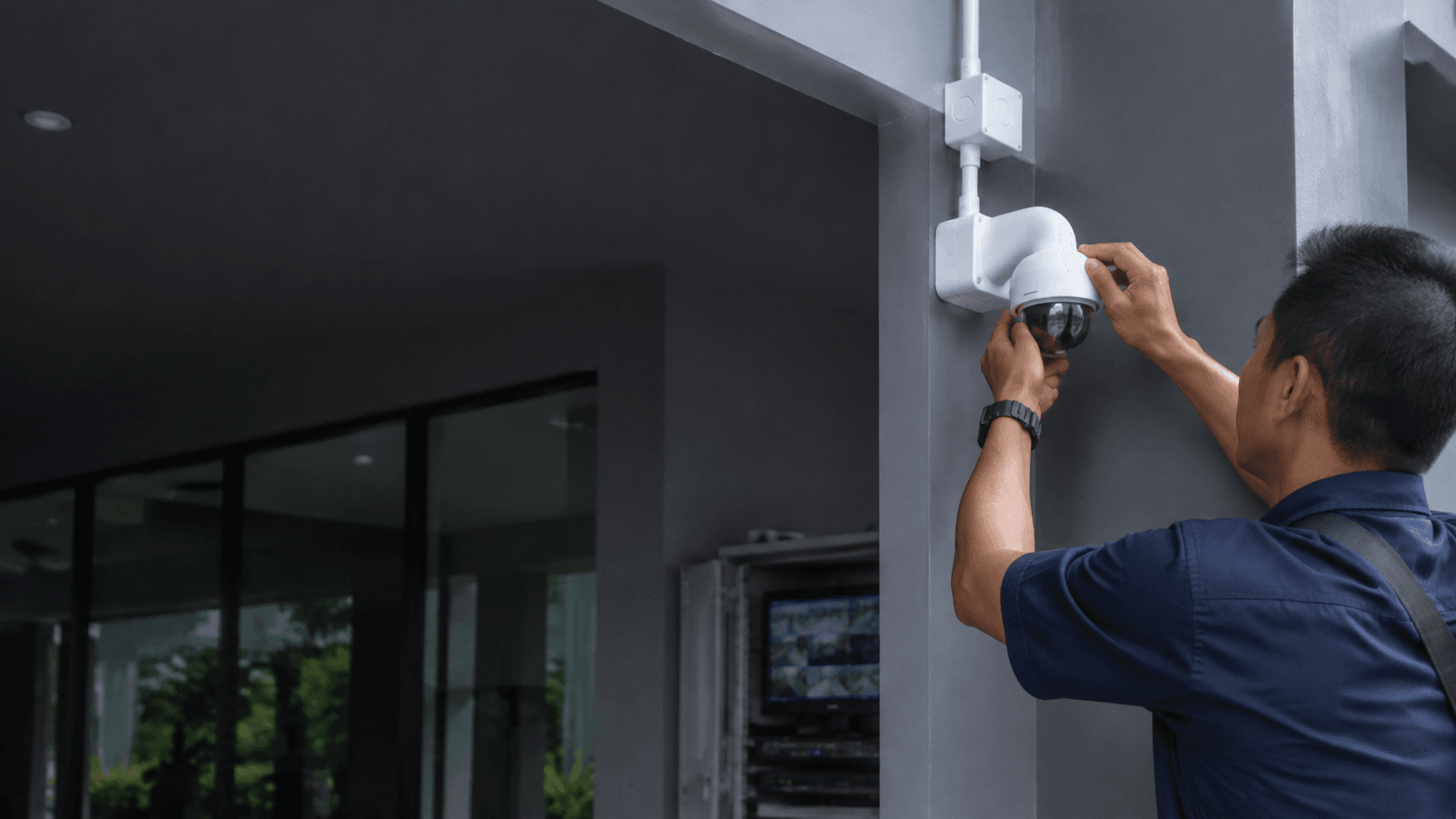
The phrase covers more ground than a single product type. A camera sold as wireless may run on a rechargeable battery, plug into a wall socket, or connect to a recorder over Wi-Fi instead of a video cable. Each version changes where the camera can go, how often it needs attention, and what happens when the power or network drops.
Malaysian houses add their own conditions. Reinforced concrete walls, tiled roofs, gate pillars and multi-storey layouts all affect signal reach and mounting options. A camera that performs well in a product video may behave differently on a link house in Kuching once the router sits two rooms away.
Wireless House Cameras. What the Term Covers in a Malaysian Home
Wireless house cameras usually means one of three arrangements. The first is a fully battery-powered camera that records to internal storage or a cloud plan. The second is a plug-in Wi-Fi camera that needs a power point but no video cable. The third is a Wi-Fi camera paired with a recorder, where video travels over the network and the recorder stores it.
The distinction matters because "wireless" rarely means cable-free in every sense. A plug-in camera still needs power. A battery camera still needs a network connection for remote viewing. A Wi-Fi camera linked to a recorder still needs that recorder powered and connected.
For a Malaysian terrace house, the practical question is not whether a camera is wireless but whether the chosen power and network arrangement survives daily use. A camera above a car porch needs a stable signal through at least one wall. A camera at a back gate needs either a nearby power point or a battery that can be recharged without a ladder every few weeks.
Where Wireless House Cameras Usually Go in a Terrace, Apartment or Shop Lot
Placement follows the entry points that matter most, not the corners that look tidy. Most residential setups in Sarawak start with the front gate or car porch, then the main door, then any side or rear access.
A terrace house typically needs coverage of the porch, the front door and the back lane or rear gate. An apartment or condominium unit usually focuses on the entrance door and any balcony access, since common areas fall under building management. A shop lot combines a street-facing entrance with a back door used for deliveries, and both need to be visible.
Height and angle decide whether footage is useful. A camera mounted too high captures the tops of heads. A camera aimed straight at a gate captures glare from headlights at night. Angling slightly downward and keeping the subject within a few metres of the lens produces footage that can actually identify a person or vehicle.
Overlapping coverage is worth planning at the start. Two cameras that share a small section of the same path close the gap that a single camera leaves when someone walks close to the wall.
Power, Wi-Fi and Recording Choices Behind Wireless House Cameras
Power is the first constraint. Battery cameras suit positions where running a cable is impractical, such as a gate pillar or a rented property where drilling is limited. Plug-in cameras suit positions near an existing power point, such as under a porch light or inside a car porch ceiling.
Wi-Fi is the second constraint. Cameras placed far from the router, or separated by thick walls, may drop frames or lose connection during heavy rain. A recorder connected to the network can reduce the load on the home Wi-Fi by handling recording locally, while remote viewing still depends on the internet connection.
Recording is the third constraint. Local recording keeps footage on a recorder or memory card and does not depend on a subscription. Cloud recording keeps footage off-site but usually carries a recurring cost and depends on upload speed. Many households run local recording as the primary store and use remote viewing for live checks.
Remote viewing is what most households actually use day to day. Checking a phone during a lunch break or while travelling only works if the camera, the network and the viewing app are all configured correctly at handover.
Lighting and Placement Checks Before Fixing Wireless House Cameras
Lighting decides how much detail a camera can capture after dark. Eyonic recommends checking actual lighting conditions before confirming placement for ColorVu-style cameras, because a position that looks well lit during the day may be almost black at night.
A porch light, a street lamp or a neighbour's security light can change the result. A camera facing a bright light source may produce glare, while a camera in a genuinely dark corner may need a model built for low-light recording. Walking the property after sunset, with the existing lights on, shows what the camera will actually see.
Placement checks also cover the practical side. A camera needs a mounting surface that can hold its weight, a route for power if it is plug-in, and enough clearance for maintenance. A position that requires a ladder and a helper every time the camera needs attention is a position that will be neglected.
Privacy boundaries matter too. A camera aimed at a neighbour's window or a shared corridor creates problems that are easier to avoid at the planning stage than to fix afterwards.
How Eyonic Plans and Installs Wireless House Cameras in Sarawak
Eyonic Sdn Bhd plans, supplies and installs monitoring systems with camera placement, recording and remote viewing for homes, offices, shops and industrial sites. The founder, Eric Yong, has more than ten years in technical installation of digital security solutions for commercial businesses in Sarawak.
The installation sequence follows four stages:
- Site survey to review the property layout, entry points, existing power and network conditions.
- System proposal covering camera positions, recording method and remote viewing setup.
- Installation of cameras, recorder and network configuration.
- Handover with user testing and mobile viewing setup.
The Kuching Immigration Office project shows how that process scales beyond a home. The work focused on arrival flow, staff areas, visitor movement and dependable daily operation for a public office. A residential job is smaller, but the same logic applies: coverage follows movement through the property, and the system has to keep working every day without constant attention.
Eyonic's published packages start at RM 1,599 for a Hikvision CCTV Package covering camera supply and setup, basic recording configuration and mobile viewing handover. The Hikvision Alarm System and Autogate Package are also listed at RM 1,599 each. These are package starting points rather than a quotation for a specific property, since camera count, cabling and recorder size change with the layout.
Larger projects give a sense of range. The Kuching Immigration Office work carried an approximate budget of RM 12,000 to RM 28,000, and the KTA Sarawak Sdn Bhd office project carried an approximate budget of RM 8,000 to RM 18,000. Both were commercial sites with wider coverage needs than a typical house.
Wireless House Cameras. Practical Next Step
The most useful preparation is a clear picture of the property. Knowing the number of entry points, whether power is available near each camera position, and how far the router sits from the furthest camera gives an installer enough to work with.
Share the location, property type and required system with Eyonic on WhatsApp at +60 11-5111 7959 for the next practical step. A short conversation about the layout usually settles whether a battery, plug-in or recorder-based arrangement fits the house.