
The jump from a basic 2MP or 4MP camera to a 5MP unit changes what a recording can actually prove after an incident. More pixels across the same scene means a face, a plate or a hand movement survives zooming and cropping better than a lower-resolution frame. That matters most where identification is the point, not just detection.
Resolution alone does not deliver that result. A 5MP camera pointed at the wrong angle, mounted too high, or fed into an undersized recorder produces files no more useful than a cheaper unit. The practical question is not whether 5MP is better on paper, but whether the whole chain — camera, lens, lighting, recorder and cabling — supports it.
Cctv Hikvision 5mp: what the resolution changes on site
Five megapixels describes the sensor's pixel count, not the sharpness of the final image. Sharpness depends on how many pixels land on the subject. A wide-angle 5MP camera covering an entire car park spreads those pixels thinly, so a person at the far end may occupy fewer pixels than a narrower 2MP camera covering the same spot.
This is why placement decisions usually matter more than the megapixel figure. A 5MP camera covering a gate, a doorway or a counter at a moderate distance puts far more pixels on the subject than the same camera covering a whole compound. Buyers comparing 5MP against 4MP should expect a modest gain in detail, not a transformation, and the gain shrinks further in poor light.
Low light is the real constraint. More pixels on a small sensor can mean each pixel collects less light, which can make night footage noisier unless the camera has strong low-light processing or supplemental illumination. A 5MP camera with good lighting will usually outperform a 4MP camera in the same spot; a 5MP camera in near darkness may not.
Where 5MP Hikvision cameras fit in a Sarawak property
Sarawak properties vary widely, and the right resolution depends on what needs to be identified rather than on a single specification. The table below sets out where 5MP earns its place and where it does not.
Shops and offices in Kuching often need counter-level detail: who handled a transaction, who entered a restricted room, whether a document changed hands. These are close-range identification tasks, and 5MP cameras positioned at those points perform well. Eyonic's work for the Kuching Immigration Office centred on arrival flow, staff areas, visitor movement and dependable daily operation, which is the same pattern of coverage a commercial premises needs.
Residential compounds are a different case. A house with a long driveway, a gate and a perimeter wall needs detection first and identification second. Mixing resolutions is often the sensible answer: wider coverage at the boundary, tighter 5MP coverage at the gate and main entrance where identification matters.
Industrial and warehouse sites in Sarawak bring their own constraints. Long distances, dust, heat and rain exposure all affect what a camera can deliver. Tidy cabling and clear daily site control were central to Eyonic's work for KTA Sarawak Sdn Bhd, an engineering consultancy, and those same priorities apply to any site where equipment has to keep working without constant attention.
What a complete installed setup includes
A working system is more than cameras. The recorder determines how many channels run, how long footage is kept and whether remote viewing performs reliably. Cabling determines whether the installation survives heat, rain and rodents. Power and network design determine whether the system stays online.
Eyonic's CCTV installation process follows four stages:
- Site survey — reviewing the property, entry points, lighting and existing infrastructure before any hardware is specified.
- System proposal — setting out camera positions, recorder configuration and coverage priorities for the site.
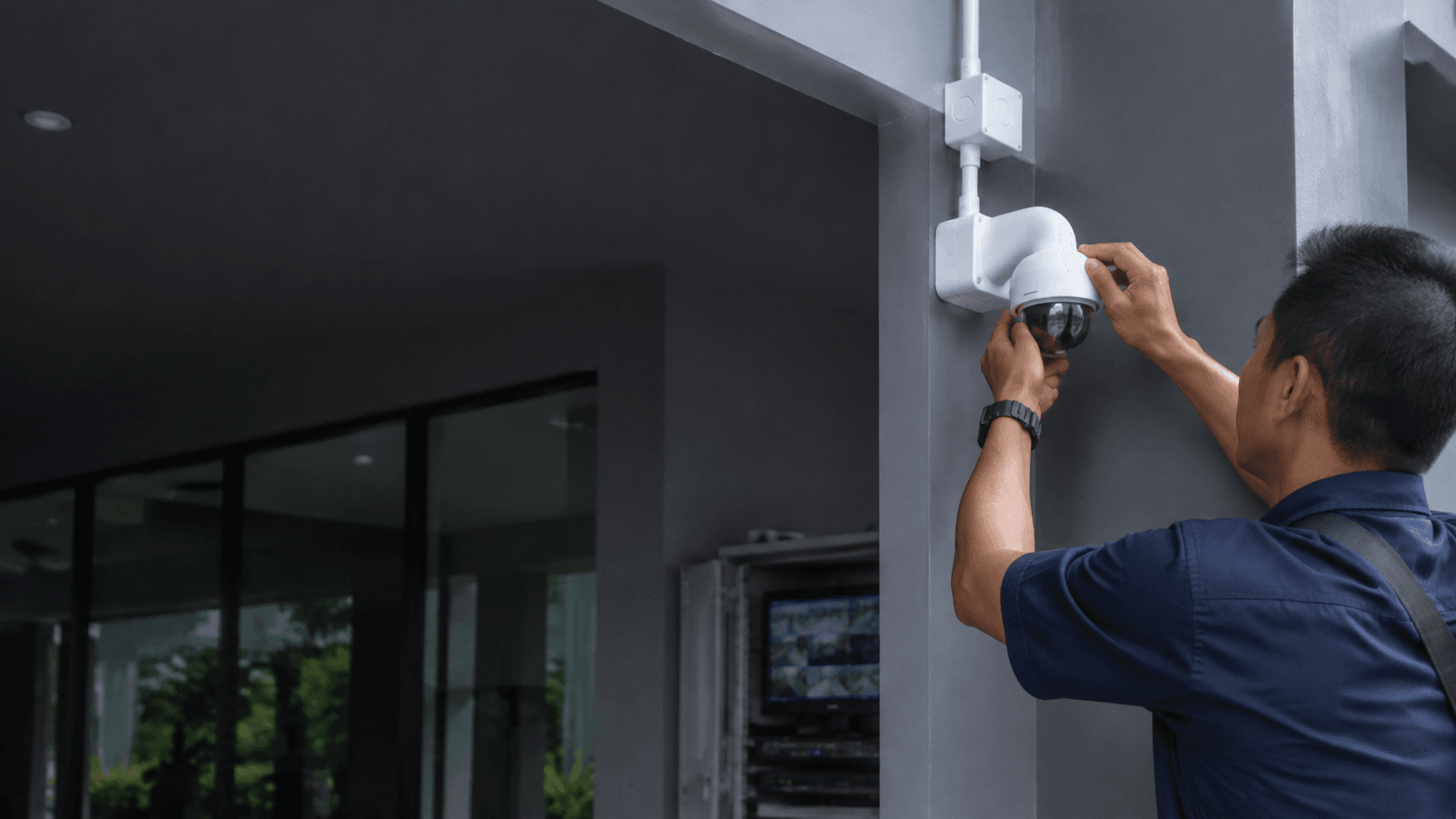
- Installation — mounting cameras, running cabling, configuring the NVR and connecting remote viewing.
- Handover — confirming recording works, walking through mobile access and leaving the system in a usable state.
The survey stage is where most problems are prevented. Camera placement decided on site, with the actual lighting and sightlines visible, avoids the common outcome of a camera that covers the right area but cannot identify anyone in it.
Lighting, placement and recording decisions that matter
Eyonic recommends checking actual lighting conditions before confirming placement for ColorVu-style cameras. A position that looks adequate during a daytime survey can behave very differently after dark, and the difference between usable and unusable night footage is usually decided before installation rather than after.
Before confirming camera positions, these checks are worth completing:
- Walk the property after dark and note where light actually falls, not where fixtures are installed.
- Identify the specific points that need identification — gates, counters, entrances — rather than covering open space.
- Confirm mounting height keeps faces in frame rather than the tops of heads.
- Check that the recorder has capacity for the channels and retention period the site needs.
- Verify network and power routes before cabling is run.
Recording decisions follow from the same logic. Higher resolution generates larger files, so retention period and channel count have to be planned together with the recorder's storage. A system specified for 5MP across many channels needs storage sized for that load, and that calculation belongs in the proposal stage rather than after installation.
Remote viewing is the other decision that affects daily use. Mobile access is only useful if it works reliably on the network available at the property, and handover should confirm that access works before the installer leaves.
How Eyonic plans, supplies and installs the system
Eyonic Sdn Bhd is a security system supplier based in Sarawak, working on CCTV and ELV systems for homes, offices, shops and industrial sites. The company plans, supplies and installs monitoring systems with camera placement, recording and remote viewing. Eric Yong, the founder, has worked in the industry for more than ten years, with experience in technical installation of digital security solutions for commercial businesses in Sarawak.
Because planning, supply and installation sit with one party, the camera specification, recorder capacity and cabling are decided together rather than assembled from separate purchases. That matters for 5MP systems, where a mismatch between camera resolution and recorder capability is a common and avoidable failure.
The documented Hikvision CCTV Package is priced at RM 1,599 and covers camera supply and setup, basic recording configuration and mobile viewing handover. That package is not a 5MP-specific quotation, and the final specification depends on the property, the number of cameras and the coverage required. Larger commercial work sits in a different range: Eyonic's Kuching Immigration Office project carried an approximate budget of RM 12,000 to RM 28,000, and the KTA Sarawak Sdn Bhd project an approximate budget of RM 8,000 to RM 18,000.
Costs, handover and the next practical step
Cost for a 5MP Hikvision system depends on camera count, recorder channels, storage, cabling distance and the difficulty of the installation. A single-camera addition to an existing recorder is a different job from a full multi-camera system with new cabling and a new NVR.
Handover is where the system either becomes useful or becomes a source of frustration. A proper handover confirms that recording runs, that footage can be found and exported, that mobile viewing works on the owner's device, and that someone on site knows how to check the system without calling an installer.
For a property in Sarawak, the practical starting point is a site survey rather than a product list. Coverage priorities, lighting conditions and existing infrastructure determine which cameras and which recorder make sense, and those answers come from the property itself.
Share the location, property type and required system with Eyonic on WhatsApp at +60 11-5111 7959 for the next practical step.