
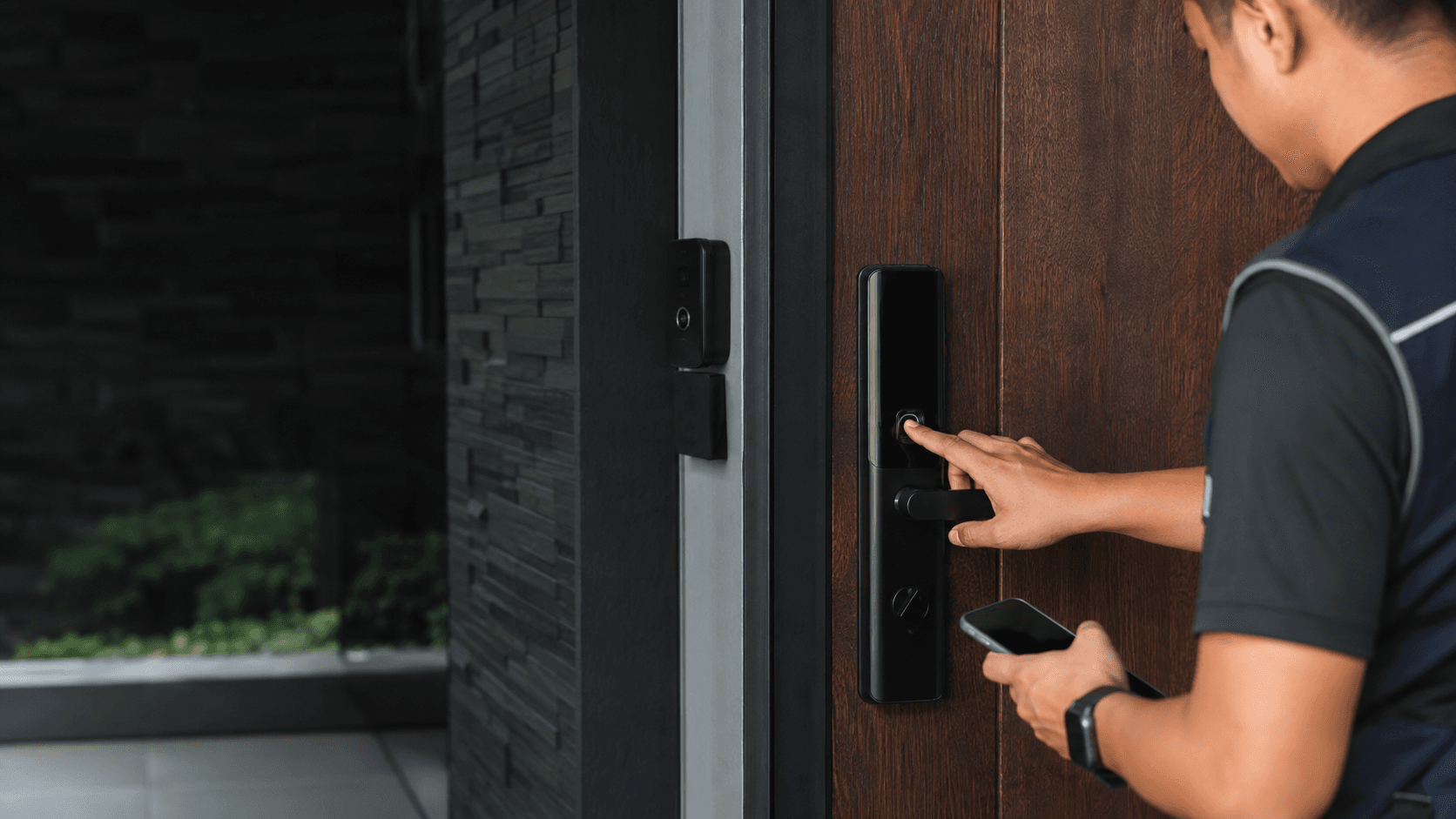
The exact-match query "home assistant door lock" describes a specific integration problem rather than a single product. Home Assistant is an open-source home automation platform, and its Lock integration defines how lock devices appear as entities with states such as locked, unlocked, open, and jammed. A door lock becomes part of that system only when a supported radio or bridge exposes it. The practical question is therefore not which lock is best in the abstract, but which lock fits an existing door, an existing network, and an existing automation plan.
Community discussion around this topic clusters on a few recurring concerns: local control without cloud dependency, protocol choice among Z-Wave, Zigbee, Matter over Thread, and Wi-Fi, battery behaviour, and whether a lock reports its true state after manual use. Those concerns shape the decision sequence below.
Home Assistant Door Lock. What Matters Before You Choose
Three constraints decide most outcomes before brand enters the conversation. The first is the door itself. deadbolt bore diameter, backset, door thickness, and whether the existing cylinder can be replaced or must be retained. Retrofit locks that sit over an existing deadbolt on the interior side avoid cylinder changes; full replacements require the door to accept a new mechanism. The second constraint is the radio environment. A lock that speaks Z-Wave needs a Z-Wave controller and a mesh path to the door. A Zigbee lock needs a coordinator and a stable route. A Matter-over-Thread lock needs a Thread border router. A Wi-Fi lock needs reliable coverage at the door and usually depends on a vendor cloud. The third constraint is power. Battery locks trade convenience for maintenance intervals, and a lock that loses power mid-operation can leave a door in an unexpected state.
Home Assistant's Lock integration models each lock as an entity with a state and a set of available actions. The documented states include locked, unlocked, open, opening, closing, locking, unlocking, and jammed. That state model matters because automations trigger on it. A lock that only reports "locked" and "unlocked" without a jammed state gives less to work with than one that reports jams and open positions.
What is home assistant door lock?
In Home Assistant terms, a door lock is a lock entity provided by an integration. The integration might be a native one for a hub, a Z-Wave JS connection, a Zigbee coordinator through Zigbee2MQTT or ZHA, a Matter integration, or a vendor-specific cloud integration. Once the entity exists, it can be locked, unlocked, or opened through services, and its state can be used as a trigger or condition in automations. The Lock integration documentation lists triggers, conditions, and actions for lock entities, including examples such as turning on a hallway light when a front door unlocks, or sending a reminder if a door is still unlocked at bedtime.
This is the mechanism that separates a smart lock from a Home Assistant door lock. A lock with its own app is a standalone product. A lock exposed as a Home Assistant entity becomes part of a wider system that can coordinate lighting, alarms, cameras, and notifications.
Choosing the Right Home Assistant Door Lock
The decision sequence below reflects the order in which constraints tend to eliminate options. Working through it in order avoids buying a lock that cannot be paired, cannot be mounted, or cannot report state usefully.
- Confirm the door hardware. measure the bore diameter, backset, door thickness, and whether the existing deadbolt can stay in place.
- Confirm the radio path. identify which controller or border router is already present, and whether the door position has a reliable mesh route.
- Confirm the integration. check that the lock's protocol is supported by a Home Assistant integration that exposes lock entities.
- Confirm state reporting. verify whether the lock reports locked, unlocked, open, and jammed states, or only a subset.
- Confirm power and backup. decide between battery and mains power, and plan a mechanical or keyed entry method for outages.
- Confirm user management. decide whether codes, schedules, and per-user access are needed, and whether the lock or Home Assistant manages them.
- Confirm the automation plan. list the triggers and conditions the lock must support before committing to hardware.
Protocol choice carries the largest trade-off. Z-Wave and Zigbee locks generally operate locally once paired, which keeps automations working when the internet is down, but they depend on a healthy mesh and can be slower to respond. Matter over Thread is a newer path with local operation and growing support, though border router availability and device maturity vary. Wi-Fi locks are simple to connect but often route commands through a vendor cloud, which introduces a dependency that local-first users try to avoid. Bluetooth-only locks typically need a bridge or a nearby device to reach Home Assistant.
R/homeassistant On Reddit. Locally Hosted Smart Lock Recommendations
Community threads on locally hosted lock recommendations repeatedly raise the same criteria: no cloud dependency, reliable state reporting, and a mechanical fallback. Named locks that appear in those discussions include Nuki models, Yale Linus, and Tedee, alongside Matter and Thread as connectivity options. Those threads are useful as a map of what people actually run, but they are anecdotal. A lock that works well on one door and one mesh may behave differently on another.
The Home Assistant community forum carries parallel threads on smart locks in 2025 and on locks compatible with Home Assistant, plus a thread on outdoor IP65-rated locks for gates and exterior doors. The outdoor thread is a reminder that weather exposure changes the requirement set entirely: an interior deadbolt replacement is not suitable for a gate, and an outdoor lock needs a rated enclosure or a purpose-built unit.
Practical Considerations for Home Assistant Door Lock
State reporting is the most underrated factor. A lock that can be commanded but does not report its true state creates automations that fire on assumptions. If a door is unlocked manually with a key, does the entity update? If the bolt jams, does the entity show jammed? Home Assistant's lock state model supports these distinctions, but only if the underlying integration receives them.
Battery behaviour is the second practical factor. Battery life depends on motor torque, how often the lock is cycled, and whether the radio stays connected continuously or sleeps. A lock on a weak mesh route may retry transmissions and drain faster. Planning a replacement schedule and monitoring battery level as an entity avoids a lock that fails at an inconvenient moment.
Access management is the third. Some locks store user codes internally and can be managed through Home Assistant services; others require the vendor app. For households with cleaners, contractors, or short-term guests, time-limited codes are useful, but the mechanism for creating and revoking them differs by model. A lock that only supports app-based code management adds a step to every access change.
Physical security is the fourth. A smart lock is still a lock. The cylinder, the strike plate, and the door frame determine resistance to forced entry far more than the radio protocol does. A retrofit lock over a weak existing deadbolt does not improve the door's physical strength.
Making an Informed Choice About Home Assistant Door Lock
The right choice follows from the constraints, not from a ranking. A renter who cannot modify the door benefits from a retrofit lock that keeps the existing cylinder. A homeowner replacing a deadbolt can choose a full replacement with a keypad and internal code storage. A property with a gate needs an outdoor-rated unit rather than an interior lock. A household already running Z-Wave benefits from staying on Z-Wave rather than adding a second mesh.
For readers in Sarawak, Malaysia, the practical layer is installation and support. Eyonic Sdn Bhd plans, supplies, and installs security and ELV systems for homes, offices, shops, and industrial sites, and its product reviews cover smart lock door access alongside access control. Eyonic's published guidance notes that smart locks work best when door condition, user roles, and backup method are reviewed before installation, and that for business use the choice between a standalone smart lock and an access-control panel should be checked first. That matches the constraint sequence above: door, roles, backup, then hardware.
Eyonic's project work includes the Kuching Immigration Office, focused on arrival flow, staff areas, visitor movement, and dependable daily operation, and KTA Sarawak Sdn Bhd, an engineering consultancy office setup supporting staff movement, visitor handling, and tidy cabling. Both illustrate that access decisions sit inside a wider movement and control plan rather than standing alone.
Where a lock is part of a larger security setup, the surrounding systems matter as much as the lock. Eyonic's installation process for CCTV runs through site survey, system proposal, installation, and handover, and the same sequence applies to access hardware: confirm the site, propose the system, install, then hand over with the user trained. Published package pricing for related systems sits at RM 1,599 for a Hikvision CCTV package, RM 1,599 for a Hikvision alarm system, and RM 1,599 for an autogate package, each covering supply, setup, and handover. Those figures describe adjacent systems rather than the lock itself, and they are useful mainly as a sense of scale for a small installed system.
One constraint worth stating plainly: Home Assistant door lock integration is a technical project, not a plug-in accessory. It requires a controller, a supported lock, a working mesh or border router, and time spent on automations. Where that effort is not wanted, a standalone smart lock with its own app delivers most of the convenience without the integration work. Where local control, cross-system automation, and unified state are the goal, the integration path is the one that delivers them.
Share your location, property type and required system with Eyonic on WhatsApp at +60 11-5111 7959 for the next practical step.