
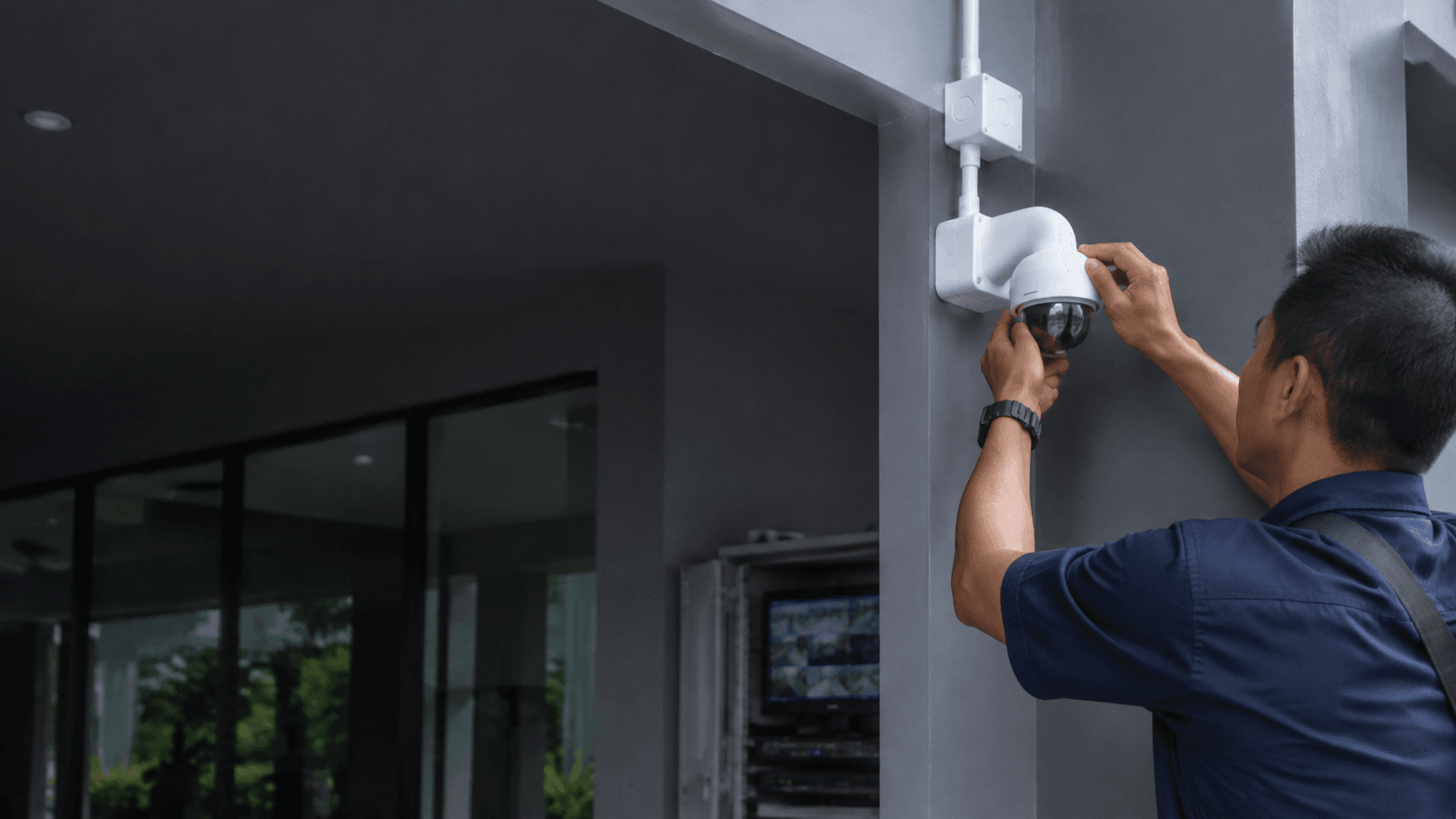
Concealment is the easy part. What decides whether the camera is still useful six months later is whether the position it hides in can also see, connect, and stay powered. That is why the practical question is not which model is smallest, but which position survives real home conditions.
Hidden CCTV camera for home with mobile connectivity: what has to line up
Four conditions have to hold at the same time, and a weak link in any one of them breaks the whole setup.
- Site survey — the position is checked for field of view, light level, WiFi reach and a power route before anything is fixed.
- System proposal — the camera, recorder and viewing method are matched to that position rather than to a catalogue page.
- Installation — the camera is mounted, cabled or powered, and connected to the recording and network path.
- Handover — recording and mobile viewing are tested with the user, so the phone view is confirmed working rather than assumed.
Eyonic's CCTV installation process follows those four stages: site survey, system proposal, installation, and handover. The order matters because a concealed position that fails the survey usually cannot be rescued later by changing settings.
Why concealment and coverage pull against each other
A camera hidden inside an object or behind a grille sees through a smaller opening than a surface-mounted camera. That opening narrows the field of view and can clip the edges of a doorway or corridor. Moving the camera to widen the view often means moving it somewhere more visible, or accepting a partial view of the entry point.
The trade-off is real and has no universal answer. A position that covers a full doorway usually needs a wider opening; a position that hides completely usually covers less. Deciding which matters more is a household decision, not a technical one.
Placement, lighting and WiFi reach decide whether the view holds
Lighting is the first thing to check on site. Eyonic recommends checking actual lighting conditions before confirming placement for ColorVu-style cameras, because a position that looks adequately lit during a daytime visit can behave differently once the room's normal evening lighting is in use. A concealed opening also blocks some of the light reaching the lens, which compounds the problem.
WiFi reach is the second constraint. A concealed camera is often placed inside a cabinet, behind a wall panel, or in a corner where signal is weakest. Enclosure materials matter. metal housings and foil-backed insulation attenuate signal far more than timber or plasterboard. The only reliable test is measuring signal at the intended position, not at the router or in the middle of the room.
What to check before fixing a position
Three checks are worth doing before any drilling. First, confirm the camera can see the target area through the concealment opening at the angles that matter. Second, confirm the WiFi signal at that exact spot is stable enough for live viewing, not just for recording. Third, confirm a power route exists that does not require running cable across a finished surface.
If any of the three fails, the position changes. That is cheaper than discovering the problem after installation.
Power, recording and phone access as one chain
Mobile connectivity is not a single feature. It is the last link in a chain that starts with power and passes through recording.
Power comes first. A camera with no reliable supply either stops recording or stops responding, and a concealed camera is harder to reach for a battery change than a visible one. Where mains power is available, a concealed position near an existing outlet or a lighting circuit is usually simpler than a battery-only position.
Recording comes second. Footage has to land somewhere — a recorder on the premises, a memory card in the camera, or a cloud service — before a phone can retrieve it. The choice affects what happens during an internet outage: local recording continues, while remote viewing does not.
Phone access comes last. The camera or recorder must be reachable over the home network and then over the internet, and the viewing app has to be set up on the user's device. This is the step that most often gets skipped, which is why handover testing matters.
What mobile connectivity actually requires
Live viewing from a phone needs three things working together: a stable connection between camera and router, an internet connection at the home, and an app configured with the correct account and permissions. If the home internet drops, local recording can continue while the phone view goes dark. If the router is fine but the camera's signal is marginal, the phone view may load slowly or drop frames rather than fail outright.
Remote viewing is a standard part of Eyonic's CCTV scope, alongside camera placement and NVR setup, for homes, offices, shops and industrial sites. The specific app, account steps and storage arrangement are confirmed at handover rather than assumed in advance.
What Eyonic checks before confirming a home setup
Eyonic Sdn Bhd plans, supplies and installs monitoring systems in Sarawak, covering camera placement, recording and remote viewing. The company's founder, Eric Yong, has worked in the industry for more than ten years, with experience in technical installation of digital security solutions for commercial businesses in Sarawak.
For a concealed home position, the survey answers the questions that cannot be answered from a product listing: where the camera can see from, whether the signal reaches, where power comes from, and how the phone view will be tested before handover.
Eyonic's completed work includes the Kuching Immigration Office project, which focused on arrival flow, staff areas, visitor movement and dependable daily operation. That project is a public-office installation rather than a concealed home setup, so it demonstrates the survey-led approach rather than a residential concealment result.
The published package pricing covers a Hikvision CCTV Package at RM 1,599, which includes camera supply and setup, basic recording configuration and mobile viewing handover. A concealed home installation is not the same scope as that package, and no price for a concealed camera installation is published.
Where the evidence stops and a site survey starts
Several things cannot be confirmed without inspecting the property, and it is worth being direct about which ones.
No published information states which specific concealed camera models are supplied, or their resolutions, lens sizes and night-vision ranges. No published information confirms which app is used for mobile viewing, or whether cloud storage is included. No published figures cover WiFi range, bandwidth or router requirements for remote viewing in Malaysian homes. No published figures cover battery life, recording duration or storage capacity for concealed cameras.
Malaysian legal and privacy requirements for concealed recording in a residential property are also outside what the published material covers. Anyone planning to record areas where other people have a reasonable expectation of privacy should confirm the position with a qualified source before installation.
What remains is the part a survey can settle: whether the chosen position sees what it needs to see, whether the signal reaches it, whether power can get there, and whether the phone view works at handover. Those four answers decide whether a concealed position is viable at all.
Sharing the property location, property type and the areas to be covered gives Eyonic enough to work from on WhatsApp at +60 11-5111 7959.