
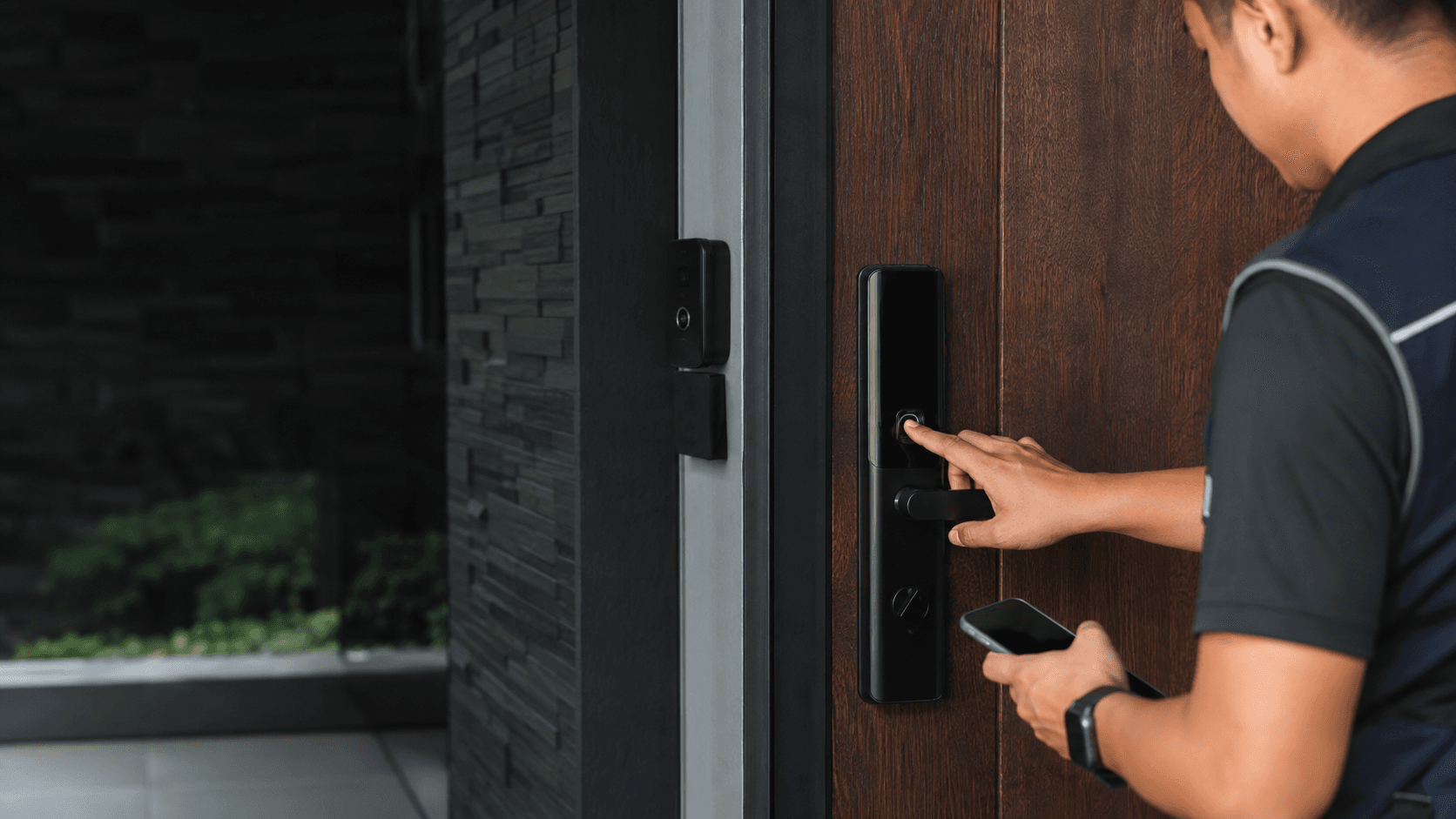
The term describes a lock that joins a wider security and automation system rather than working alone. Alarm.com documents lock and unlock control through its app and customer website, and its hardware pages list locks and access-control readers as separate categories. That distinction matters in Malaysia, where the practical question is rarely the lock itself but whether the door, the panel, and the people who use it can support a connected lock day to day.
Alarm Com Door Locks. what the term covers
Alarm.com is a connected security and automation platform. A door lock becomes part of that platform when it is added to an account and appears alongside cameras, sensors, and automation rules. Alarm.com's own hardware listing separates locks from access control, which places readers, keypads, and door controllers in a different product family.
That split is useful when reading product pages. A residential-style smart lock is normally a single door device with a keypad or app control. Access control is a broader arrangement covering multiple doors, credentials, and often a controller. Alarm Com Door Locks sit in the first group, but they inherit behaviour from the second when a site needs scheduled access, per-person codes, or an audit trail of who entered.
Alarm.com's lock and garage page describes lock status notifications, digital lock codes, arrival alerts, and automation scenes such as an Away Scene. Those features come from the account, not from the lock alone. A lock with no account behind it still opens and closes, but the notifications, codes, and scenes do not exist.
How Alarm.com door locks are locked and unlocked
Alarm.com's support documentation states that door locks can be locked and unlocked from the website and the app. The documented flow is short. sign in to the Alarm.com app or the Alarm.com customer website, open the locks list, select the lock, then use the lock or unlock control to set the desired state.
Three control paths usually exist on a working installation:
- Confirm the door itself is suitable, including its thickness, existing cutout, and whether the frame can take the lock body without weakening the door.
- Decide who needs access and in what form, because user codes, schedules, and temporary access are managed at account level rather than on the lock.
- Agree a backup entry method before installation, so a flat battery, a network outage, or a failed pairing does not leave a door that cannot be opened.
- Verify the panel or hub that will carry the lock, since the lock must be recognised by the system that reports it to the account.
- Confirm who supports the system after handover, including who replaces batteries, re-pairs the lock, and adjusts codes when staff or tenants change.
Physical entry still matters. A keypad code, a key, or a mechanical override remains the fallback when the app is unreachable. Alarm.com's own guidance assumes a signed-in account, so any plan that depends only on an app leaves no path when connectivity or credentials fail.
What the app and website actually control
The app and the customer website expose the same core action: lock or unlock a selected door. Around that action sit the account features that make a connected lock worth having. Lock status notifications tell an account holder whether a door is secured. Arrival alerts and digital codes support household or staff movement. Automation scenes can tie locking to arming or to a scheduled time.
None of this replaces the lock's own electronics. If the lock loses power or drops off the network, the account shows a stale or unavailable state, and the door must be handled physically.
What to check before choosing Alarm.com door locks
Eyonic's own product review guidance on smart lock door access states that smart locks work best when the door condition, user roles, and backup method are reviewed before installation. The same three checks apply to any lock intended for an Alarm.com account.
Door condition decides whether a lock fits at all. A door that is warped, too thin, or fitted with an unusual mortise may need a different model or additional carpentry. User roles decide the access model: a family home needs a handful of codes, while a shop or office needs codes that can be added and removed as people join and leave. Backup entry decides what happens on the worst day, and it should be agreed before the lock is mounted rather than after.
For business premises, Eyonic's review notes that the usual question is whether a standalone smart lock or an access-control panel is more appropriate. A single entrance with light traffic suits a standalone lock. Multiple doors, staff turnover, and a need for records point toward access control instead.
Panel, hub, and compatibility limits
A lock only appears in an Alarm.com account if the system that carries it recognises the device. Compatibility depends on the panel or hub in place and on the lock's own radio or connection type. Because approved evidence here does not include a verified list of compatible lock models, protocols, or panel pairings, the safe step is to confirm the exact lock and the exact panel together before purchase. A lock bought on the strength of its brand name alone may not pair with the system already installed.
Alarm.com door locks and local installation support
Alarm.com publishes hardware and support documentation, but it does not install locks in Malaysia. Local work falls to a supplier or installer who can survey the door, advise on the lock type, and hand over a working system.
Eyonic Sdn Bhd is a security system supplier in Sarawak that plans, supplies, and installs CCTV and ELV systems for homes, offices, shops, and industrial sites. Its published process runs through site survey, system proposal, installation, and handover. The company's product review section covers smart lock door access as a multi-brand category, and its review notes that door condition, user roles, and backup method are checked before installation.
Two completed projects show the kind of site where access and movement matter. The Kuching Immigration Office project covered arrival flow, staff areas, visitor movement, and dependable daily operation. The KTA Sarawak Sdn Bhd project covered staff movement, visitor handling, tidy cabling, and clearer daily site control. Both are office environments rather than lock-specific installations, so they indicate experience with controlled movement rather than a claim about Alarm.com hardware.
Approved evidence does not confirm that Eyonic supplies, installs, or supports Alarm.com door locks specifically, and no local pricing, warranty, or after-sales terms for those locks are verified here. A buyer should confirm scope directly before assuming a supplier covers this product line.
Alarm.com door locks compared with standalone smart locks
A standalone smart lock works on its own. It is fitted to a door, programmed locally or through its own app, and managed by whoever holds the admin credentials. There is no account-level view of other doors, no shared automation with cameras or sensors, and no central record unless the lock's own app provides one.
A lock connected to an Alarm.com account behaves differently. Lock and unlock actions sit inside the same app and website as the rest of the system. Codes, notifications, and scenes are managed at account level. The trade-off is dependency. the lock's useful features assume a working account, a reachable network, and a panel that recognises the device.
Cost and complexity follow the same split. A standalone lock is a single purchase and a single installation. A connected lock pulls in the account, the panel, and whoever maintains them. For one door in a home, the standalone route is often enough. For a site where several people need different access and someone needs to review who entered, the connected route earns its overhead.
Alarm.com door locks questions buyers ask
Can a lock be opened without the app? Yes, in most cases. A keypad code, a physical key, or a mechanical override provides entry when the app is unavailable. The backup method should be chosen before installation, not after a failure.
What happens when the battery runs down? The lock stops responding to remote commands and the account shows an unavailable or stale state. Battery replacement is a routine task, and someone at the site needs to own it.
Does a lock need the panel to work? The lock's own keypad and key still function. Remote control, codes, notifications, and scenes depend on the system that connects the lock to the account.
Is a connected lock the right choice for a shop or office? It depends on door count and staff turnover. One entrance with stable staffing suits a standalone lock. Several doors, changing users, and a need for records point toward access control.
What should be confirmed before buying? The door's condition and dimensions, the panel or hub already installed, the exact lock model and its compatibility, the backup entry method, and who will support the system afterwards.
For a site in Sarawak, the practical next step is a survey of the door and the existing system. Eyonic can be reached on WhatsApp at +60 11-5111 7959 with the location, property type, and required system.