
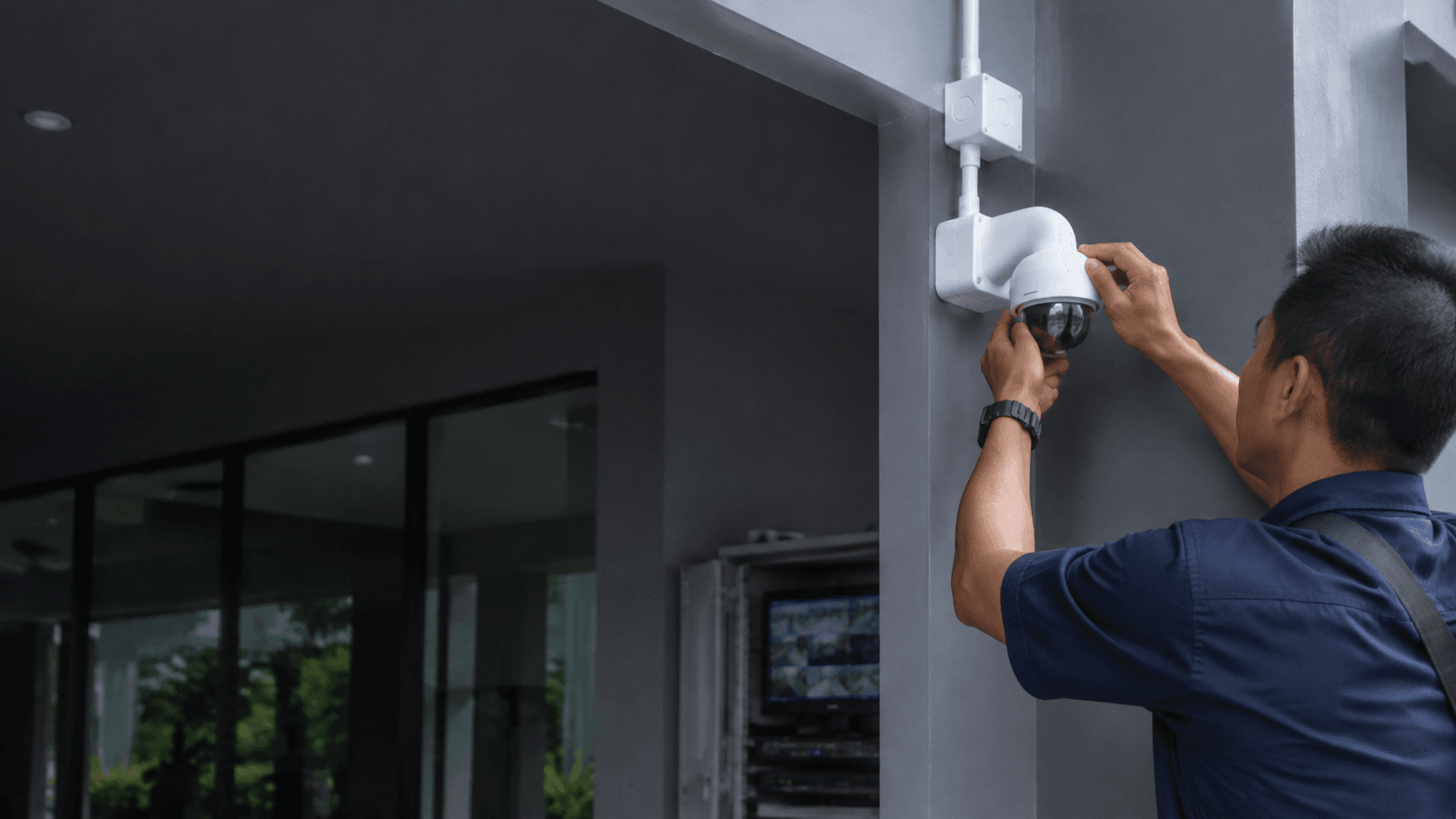
The term covers more than a camera that connects to a phone. It describes a monitoring setup where cameras, recording and remote viewing work together, and where placement is decided by what actually happens on site rather than by a product box.
Eyonic Sdn Bhd is a security system supplier in Sarawak that handles planning, supply and installation, with Hikvision cameras among the products it works with. The company's founder, Eric Yong, has been in the industry for more than 10 years and is experienced in technical installation of digital security solutions for commercial businesses in Sarawak.
Smart Cctv. What the Term Covers in Malaysia
In Malaysian homes, shops, offices and industrial sites, smart cctv usually means three things working as one system: cameras that capture usable images, a recorder that stores them, and a viewing method that reaches a phone or screen away from the property.
The word "smart" is often attached to features such as motion alerts, person or vehicle detection, and colour images at night. Those features only help when the camera can see the area that matters. A detection alert on a camera pointed at a blank wall is noise, not security.
Malaysia's building mix also shapes what works. A shop lot with a covered five-foot way, an office with a glass frontage, and a factory with a large open yard each present different lighting and coverage problems. The same camera model can perform well in one and poorly in another.
Because of that, the useful question is not which camera is smartest. It is whether a proposed system will produce clear, reviewable footage of the entrances, walkways and assets that matter at a specific address.
What Makes a Camera System Smart
A camera system earns the label when it reduces the work of watching. That happens through a small number of practical functions rather than a long feature list.
Remote viewing lets someone check a live or recorded view from outside the property. Recording configuration decides how far back footage can be reviewed. Camera placement decides whether faces, plates or movement are captured at a usable angle. Detection features decide which events generate an alert.
Each of these depends on the others. Remote viewing is only useful if the recorder is set up correctly and the network reaches it. Detection is only useful if the camera covers the right zone. Placement is only useful if the lighting at that spot supports the image the camera can produce.
Eyonic's own guidance on ColorVu-style cameras makes this point directly: actual lighting conditions should be checked before placement is confirmed. A position that looks correct on a floor plan can fail once the real light at that spot is measured.
Where smart features help most
Detection and alerts matter most where staff cannot watch a screen continuously. A shop counter, a back entrance, a loading bay or a visitor reception area can all benefit from an alert that fires only when something relevant happens.
They matter least where the scene is constantly busy. A camera facing a public walkway with continuous foot traffic will generate alerts all day unless the detection zone is narrowed to the specific area of interest.
Smart Cctv Checks Before Confirming Placement
Placement is the decision that most often determines whether a smart cctv installation delivers useful footage. It should be confirmed on site, in the actual light, before brackets are fixed.
- Walk the site at the times of day that matter, including after dark, and note where light falls and where it does not.
- Identify the specific points that need coverage, such as entrances, counters, walkways, gates and storage areas, rather than aiming for general coverage.
- Check what the camera will actually see from each proposed position, including obstructions, glare sources and areas that fall outside the frame.
- Confirm where the recorder, cabling and power will sit, and whether that route is practical in the building.
- Agree how footage will be reviewed and who will hold access to the live and recorded views.
Two of these checks are commonly skipped. The first is the after-dark walk, which is the only reliable way to judge how a position performs when lighting changes. The second is the review question, which decides whether the system is usable months later when someone needs to find a specific event.
For sites with multiple buildings or long perimeters, the checks also need to cover how the camera positions relate to each other. Overlapping coverage at a gate or a corridor junction is often more valuable than an extra camera pointed at open space.
How Eyonic Plans a Smart Cctv Installation
Eyonic's CCTV installation process runs through four stages: site survey, system proposal, installation, and handover. Each stage produces something the next stage depends on.
- Site survey, where the property is reviewed and the coverage requirements are established.
- System proposal, where the camera placement, recording and remote viewing approach is set out.
- Installation, where cameras, cabling and the recorder are fitted and configured.
- Handover, where the system is explained and the viewing setup is passed to the user.
The survey stage is where the lighting and placement checks belong. The proposal stage is where the number of cameras, the recording approach and the viewing method are agreed. Installation turns that plan into hardware, and handover is where the user learns how to reach the live and recorded views.
Eyonic's project work shows how the same process adapts to different sites. For the Kuching Immigration Office, the focus was arrival flow, staff areas, visitor movement and dependable daily operation. For KTA Sarawak Sdn Bhd, an engineering consultancy, the requirement was a practical office setup in Kuching supporting staff movement, visitor handling, tidy cabling and clearer daily site control.
Those two projects point to a pattern. Public-facing sites need coverage of movement through entrances and waiting areas. Office sites need coverage that supports day-to-day control without leaving cabling untidy. Neither requirement is solved by camera count alone.
What changes the scope of work
Several site conditions change how much work an installation involves. Cable routes through finished ceilings or across open yards take longer than routes through accessible service areas. Sites without a suitable network path to the recorder need additional work before remote viewing functions. Very large or multi-building sites need more survey time to confirm coverage between camera positions.
These are the conditions worth raising early, because they affect both the plan and the timeline rather than the camera choice alone.
Costs and Package Ranges in Malaysia
Cost depends on how many cameras a site needs, how far cabling must run, and how the recording and viewing setup is arranged. Eyonic publishes a Hikvision CCTV package at RM 1,599 that covers camera supply and setup, basic recording configuration, and mobile viewing handover.
That package suits a straightforward single-property requirement. Larger or more complex sites sit well above it. Eyonic's completed project budgets give a sense of the range: the Kuching Immigration Office project carried an approximate budget of RM 12,000 to RM 28,000, and the KTA Sarawak Sdn Bhd project carried an approximate budget of RM 8,000 to RM 18,000.
The gap between RM 1,599 and those project figures reflects scope rather than camera quality alone. More cameras, longer cable runs, multiple buildings, and coverage of busy public areas all add work. A site that needs coverage of a single entrance and a small interior area sits at the lower end. A site that needs coverage of arrival flow, staff areas and visitor movement across a public building sits at the upper end.
Eyonic also publishes a Hikvision alarm system package and an autogate package, each at RM 1,599. These are separate systems from CCTV, and a site that needs both monitoring and alarm coverage should treat them as separate scopes when comparing costs.
Questions Buyers Ask Before Installation
Most pre-installation questions come down to whether a proposed system will work at a specific site. The answers depend on the property, but the questions themselves are consistent.
How many cameras does a property need
The number follows from the coverage points identified during the site survey, not from a standard figure. A small shop may need coverage of the entrance, the counter and a storage area. A public office may need coverage of arrival flow, staff areas and visitor movement. Each of those is a coverage point, and the camera count follows from how many points need their own view.
Can the system be viewed from a phone
Remote viewing is part of Eyonic's CCTV service, and mobile viewing handover is included in the RM 1,599 Hikvision CCTV package. The practical requirement is a working network path from the recorder to the internet, which is confirmed during the survey and installation stages.
What happens if lighting is poor at night
This is decided during the survey. Eyonic's guidance on ColorVu-style cameras is to check actual lighting conditions before confirming placement, because a position that performs well in daylight may not perform as expected after dark. Where lighting is genuinely poor, placement or supplementary lighting becomes part of the plan rather than an afterthought.
Who handles installation and setup
Eyonic plans, supplies and installs the systems it provides, covering camera placement, recording and remote viewing. The installation stage includes fitting and configuring the equipment, and handover covers explaining the system and the viewing setup.
What should be prepared before the survey
A clear idea of what needs to be watched and when helps most. That includes the entrances and areas that matter, the times of day when coverage is most important, and who will need access to the live and recorded views. Sharing the location, property type and required system with Eyonic on WhatsApp at +60 11-5111 7959 gives the survey a starting point.
The checks that matter most are the ones done on site: lighting at the actual position, the specific points that need coverage, and how footage will be reviewed later. A smart cctv system that passes those checks will keep producing useful footage long after installation, while one that skips them tends to disappoint regardless of the features on the box.