
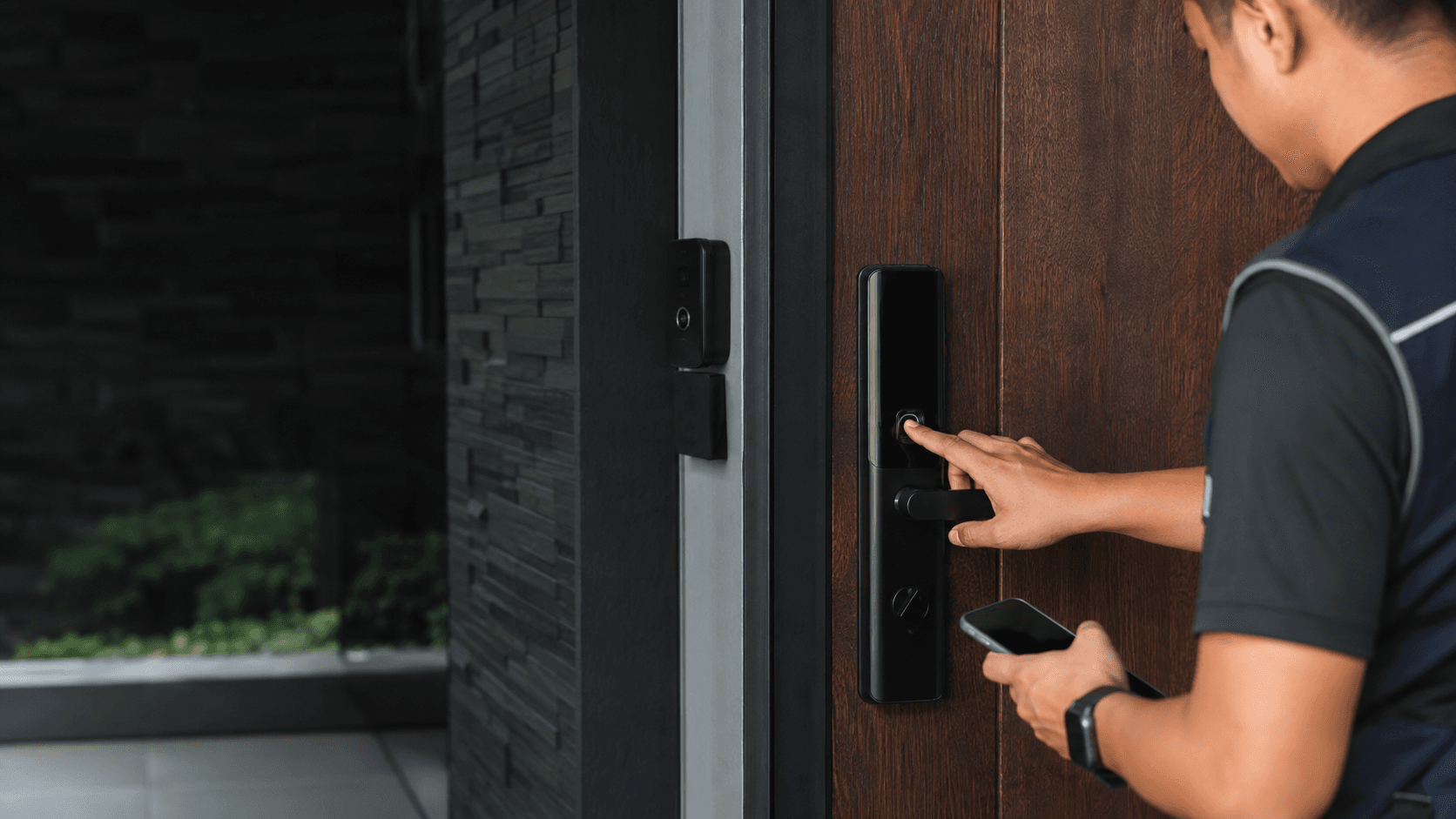
Alarm.com is a smart security and automation platform. A door lock does not connect to Alarm.com directly. It connects to a control panel or hub, and that panel passes lock status, user codes and lock or unlock commands to the Alarm.com app. That two-part chain is why the same lock can work on one property and fail on another.
Most searches for alarm com compatible door locks come down to one practical question: will this lock pair with the panel already installed? The answer sits in the protocol the lock uses, the panel model, and the condition of the door it will be fitted to.
Alarm Com Compatible Door Locks. What Compatibility Actually Means
Compatibility is not a single yes or no. It is a chain of four links, and every link has to hold.
- The lock must use a protocol the panel supports, such as Z-Wave, PowerG or a cloud-to-cloud Wi-Fi integration.
- The panel must be enrolled on an Alarm.com account with the lock feature enabled.
- The lock must be within reliable wireless range of the panel, or within range of a repeater that is.
- The door itself must accept the lock body, latch and bolt without structural work.
A lock can pass the first three checks and still fail at the fourth. A deadbolt needs a door of adequate thickness and a bore hole of the right diameter. Metal doors, narrow frames and doors that already carry a mortise lock often need a different product or an access control panel instead of a standalone smart lock.
Eyonic's own product guidance makes the same point: smart locks work best when the door condition, user roles and backup method are reviewed before installation, and for business use the choice between a standalone smart lock and an access-control panel is usually settled at that stage.
How Z-Wave, PowerG and Wi-Fi Locks Connect to a Panel
The protocol decides how the lock talks to the rest of the system, and each one behaves differently in daily use.
Z-Wave locks
Z-Wave is the most common route. The lock joins the panel's Z-Wave network, and the panel then reports lock state, battery level and access events to Alarm.com. Z-Wave is a mesh, so mains-powered Z-Wave devices between the panel and the lock can extend range. A lock at the far end of a large house may need that help.
Z-Wave locks normally support remote lock and unlock, scheduled auto-lock, and per-person user codes managed from the Alarm.com app. Code management is one of the main reasons people choose this route, because codes can be added or removed without touching the lock.
PowerG locks
PowerG is a encrypted wireless protocol used by compatible panels. Locks built for PowerG pair in the same way as other PowerG devices on those systems. The practical difference is that PowerG is designed for longer range and more secure transmission than older wireless standards, which matters on larger sites where a lock sits far from the panel.
PowerG lock support is panel-dependent. A panel that accepts PowerG sensors does not automatically accept every PowerG lock, so the panel model has to be checked first.
Wi-Fi and cloud-to-cloud locks
Some locks connect over the property's Wi-Fi and link to Alarm.com through a cloud integration rather than joining the panel's wireless network. These locks depend on a stable internet connection and on the manufacturer's integration remaining active. When the integration is withdrawn, the lock may keep working as a standalone lock but stop appearing in Alarm.com.
Wi-Fi locks also sit outside the panel's own wireless mesh, so they do not benefit from Z-Wave repeaters and they do not extend the mesh for other devices.
What to Check Before Buying a Compatible Lock
Five checks settle most compatibility questions before any money is spent. Each one is quick, and each one can stop a purchase that would otherwise end in a return.
- Identify the exact panel model and firmware version, because lock support is tied to both.
- Confirm which protocols that panel accepts, and whether the lock uses one of them.
- Inspect the door. thickness, bore hole size, backset, frame clearance and whether the existing lock is a deadbolt, lever or mortise type.
- Decide who needs access and how codes will be issued, changed and revoked, including temporary codes for visitors or contractors.
- Agree a backup entry method that does not depend on the smart lock working, such as a mechanical key or a second entrance.
The backup entry point is the check most often skipped. A smart lock with a flat battery, a dropped network connection or a failed integration can leave a property with no way in. A mechanical key cylinder or a second door removes that risk entirely.
For a business, the user-role question usually decides the product category. A shop with three staff may be well served by a standalone smart lock. An office with shift changes, visitor access and a need for an audit trail is often better served by an access control panel, where the lock is one component of a managed system rather than the whole system.
Pairing and User Code Setup in Practice
Pairing is a short process, but the order matters. The lock should be paired while it is installed at the door, not on a bench, because wireless range at the final position is what determines whether the pairing holds.
- Put the panel into its device inclusion or pairing mode.
- Trigger the pairing sequence on the lock, following the lock manufacturer's instructions for that model.
- Wait for the panel to confirm the device has joined, then name the lock so it is identifiable in the app.
- Test lock and unlock from the panel first, then from the Alarm.com app.
- Create user codes, assign them to named users, and test each one at the door.
- Set auto-lock timing and any schedules, then confirm the lock reports its status correctly after each event.
If pairing fails, the usual causes are range, an unsupported protocol, or a panel that has reached its device limit. Moving the panel, adding a repeater, or checking the panel's supported device list resolves most of these cases.
User codes deserve their own attention. Codes should be issued per person rather than shared, so that access events can be traced to an individual. Departing staff or tenants should have their code removed rather than left active, and temporary codes should carry an expiry date where the system supports it.
Where Compatibility Checks Go Wrong
Most failed installations trace back to one of a small number of assumptions.
Buying on brand alone is the most common. A lock from a well-known manufacturer may have both a Z-Wave version and a Wi-Fi version, and only one of them may suit the panel in place. The model number, not the brand, is what matters.
Assuming a panel supports every protocol is the second. Panels differ in which wireless standards they accept, and support can change with firmware. A lock that paired on an older firmware version may behave differently after an update, and a lock that failed on an old panel may work after a firmware upgrade.
Ignoring the door is the third. A lock that pairs perfectly can still be the wrong purchase if the door cannot take it without cutting, packing or replacing hardware. This is where a site visit earns its cost, because door condition is difficult to judge from a photograph.
Leaving no backup entry is the fourth. Any electronic lock can fail, and the failure usually happens at the least convenient moment. A mechanical override or a second entrance is a small cost against being locked out.
Getting a Compatible Lock Installed in Sarawak
In Sarawak, the practical constraint is usually not the lock itself but the supply and support chain behind it. A lock ordered from overseas may arrive without local installation support, and if it does not pair, there is no local party to resolve it.
Eyonic Sdn Bhd is a security system supplier based in Sarawak that plans, supplies and installs CCTV and ELV systems for homes, offices, shops and industrial sites. Its smart lock guidance already frames the decision the way this article does: door condition, user roles and backup method first, then the choice between a standalone lock and an access control panel.
The company's installation process runs through site survey, system proposal, installation and handover, which is the sequence that catches compatibility problems before equipment is ordered. Its completed work includes the Kuching Immigration Office project, which focused on arrival flow, staff areas, visitor movement and dependable daily operation, and the KTA Sarawak Sdn Bhd project, which covered staff movement, visitor handling, tidy cabling and clearer daily site control. Both are the kind of environment where user codes and access records matter more than the lock hardware itself.
For a property in Sarawak, the sensible sequence is to confirm the panel model and firmware, confirm the door condition on site, and only then select a lock that matches both. Where the requirement is a single door with a few users, a standalone smart lock is usually enough. Where the requirement is multiple doors, staff changes and an access record, an access control panel is the more durable answer.
Share your location, property type and required system with Eyonic on WhatsApp at +60 11-5111 7959 for the next practical step.