
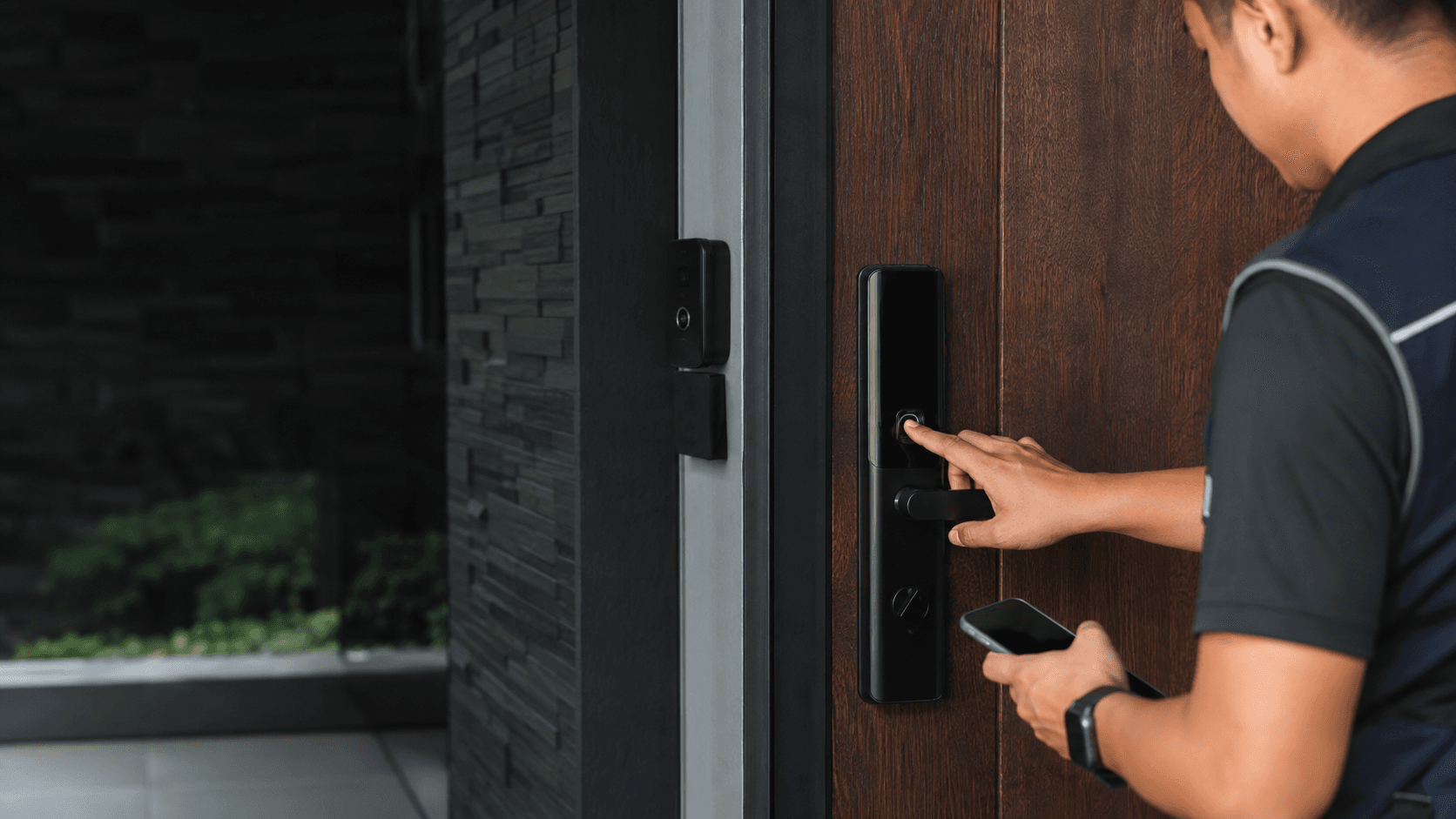
Eyonic Sdn Bhd, a security system supplier in Sarawak, treats smart lock door access as controlled convenience rather than a plug-in upgrade. The company's own review guidance states that smart locks work best when the door condition, user roles and backup method are reviewed before installation, and that for business use it usually checks whether a standalone smart lock or an access-control panel is more appropriate.
That framing matters for short-term rental doors. A rental lock is not judged on features alone. It is judged on whether it still lets the right person in on the night a battery runs flat, a cleaner arrives early, or a guest cannot find the keypad in the dark. The sections below work through the operational questions that decide the best smart lock for airbnb 2026 in practice, using Eyonic's published guidance and project experience rather than unverified model rankings.
Best Smart Lock For Airbnb 2026: What Matters Before You Choose
Hosts manage three things at once: who can enter, for how long, and what happens when the normal entry path fails. Eyonic's product review page describes smart lock door access as good for controlled convenience when user permissions and backup entry are planned properly. Those two conditions are the whole job.
User permissions are the first layer. A short-term rental door serves guests, cleaners, maintenance workers, co-hosts and sometimes the owner. Each group needs a different access window. A guest code that stays live after checkout is a security gap. A cleaner code that expires before the cleaner arrives is a failed turnover. The lock's permission model, not its finish, decides whether those windows can be set and changed remotely.
The second layer is the backup entry method. Every electronic lock has a failure mode. The question is what happens at that moment. A physical key kept off-site, a mechanical override, or a second independent entry path all solve the problem differently, and the right choice depends on how far the host lives from the property and how fast a locksmith can reach it.
The third layer is turnover. Between one guest leaving and the next arriving, someone has to confirm the door is locked, the code has changed, and the unit is ready. Eyonic's Kuching Immigration Office project focused on arrival flow, staff areas, visitor movement and dependable daily operation, which is the same discipline a rental door needs: a predictable path in, and a predictable path to check it.
Guest Access Methods And Backup Entry
Guest access methods fall into a few practical families. A keypad code is the most common because it needs nothing from the guest except a number. A mobile app or digital key removes the keypad but depends on the guest's phone, its battery and its data connection. A physical key still works when everything else does not.
The backup entry method deserves a decision before purchase, not after the first lockout. Eyonic's review guidance places backup entry alongside door condition and user roles as a pre-installation check. A host who lives ten minutes away can treat a flat battery as a minor errand. A host managing a unit from another state or country cannot, and that difference should shape which lock and which backup path gets chosen.
Access codes also need a lifecycle. A code issued for a booking should be tied to that booking's dates, revoked at checkout, and not reused for the next guest. Where a lock supports scheduled or time-limited codes, that removes the manual step of remembering to delete them. Where it does not, the host carries that task on every turnover, and it is the task most likely to be missed during a busy weekend.
Cleaner and maintenance access is a separate case. A permanent code is convenient and risky in equal measure, because it survives every guest change and every staff change. A recurring window that only opens on turnover days limits the exposure without adding a daily task.
Connectivity, Power And Battery Upkeep
Connectivity decides what can be managed remotely. A lock that talks to the network lets a host issue, change or revoke a code without visiting the property. A lock that only communicates locally requires someone on site or within range. For a single unit near the host's home, that difference is small. For a portfolio spread across a city, it is the difference between a two-minute task and a site visit.
Battery upkeep is the recurring cost that hosts underestimate. Every electronic lock consumes power, and the consumption rate depends on how often the door is used, how the lock communicates, and how much of its work happens over the network rather than locally. A rental door with several guest arrivals a day draws down faster than a family home door. The practical control is a low-battery warning that reaches the host before the guest does, plus a scheduled replacement routine rather than a reaction to a lockout.
Power interruptions are a real consideration in Malaysian properties, and the supplied evidence does not include verified data on how specific locks behave during an outage. What can be said without inventing detail is that any lock relying on mains power or on a live network connection has a dependency that a purely battery-powered, locally verified lock does not. That dependency should be identified during planning, and the backup entry method should cover it.
Eyonic's own installation work follows a sequence of site survey, system proposal, installation and handover. The survey stage is where connectivity at the door, power availability and signal conditions get checked rather than assumed. The same logic applies to camera placement, where Eyonic recommends checking actual lighting conditions before confirming placement. Door hardware deserves the same treatment: verify the conditions at the door before committing to a model.
Door Condition And Installation Checks
Door condition is the constraint that eliminates more lock options than any feature comparison. A smart lock has to fit the existing door preparation, or the door has to be modified to accept it. Frame alignment, door thickness, the existing deadbolt bore and the strike plate position all affect whether a lock seats correctly and whether it can throw its bolt without binding.
Eyonic's review guidance lists door condition first among the pre-installation checks, ahead of user roles and backup method. That ordering reflects how installation problems surface: a lock that fits badly will fail intermittently, and intermittent failure on a rental door means a guest standing outside at check-in.
Installation handover is the other half. A lock that is fitted but not explained leaves the host dependent on whoever installed it. Handover should cover how codes are created and revoked, how the backup entry works, what the low-battery indicator looks like, and who to contact when the door will not open. Eyonic's CCTV process ends with handover for the same reason: the system is only useful once the people running it know how to run it.
The pre-installation sequence below keeps those checks in order, so a decision is made against the actual door rather than a product listing.
- Confirm door and frame condition, including thickness, existing bore and strike alignment, before selecting any lock.
- Map who needs access and for how long, separating guests, cleaners, maintenance and co-hosts into distinct permission windows.
- Decide the backup entry method and where the physical override or spare key will be kept.
- Verify power and connectivity at the door, including signal conditions and what happens during an interruption.
- Test codes and complete handover before the next guest arrives, covering code creation, revocation and the low-battery warning.
Matching The Lock To The Property
The best smart lock for airbnb 2026 depends on the property, not on a ranking. A single apartment door in a managed building has different constraints from a standalone house with a gate and a side entrance. A unit where the door cannot be modified needs a different approach from one where the door can be replaced.
Eyonic's review guidance notes that for business use it usually checks whether a standalone smart lock or an access-control panel is more appropriate. That distinction applies to rental operations with several doors. A standalone lock suits one entrance with a small set of users. An access-control panel suits a property where multiple doors, shared areas or a larger user list need to be managed together, because permissions live in one place rather than across separate locks.
Property type also shapes the backup decision. A unit inside a building with a guardhouse and a management office has a different recovery path from a standalone house on an outer road. The further the property sits from the host and from any fallback support, the more the backup entry method has to stand on its own.
Where the evidence runs out is model-level comparison. The supplied material contains no verified specifications, prices, ratings or battery-life figures for any smart lock brand, and no verified compatibility facts between specific models and booking platforms. Any page that ranks named locks on those numbers is working from data this article does not have. What can be stated with confidence is the planning sequence: door condition, user permissions and backup entry first, hardware second.
For hosts and property operators in Malaysia weighing this decision, the practical next step is a site-level assessment of the actual door. Eyonic's installation work begins with a site survey and a system proposal before any hardware is fitted, which is the point at which door condition, connectivity and backup entry get confirmed against the property rather than assumed from a product page. Share the location, property type and required system with Eyonic on WhatsApp at +60 11-5111 7959 to move from comparison to a checked plan.