
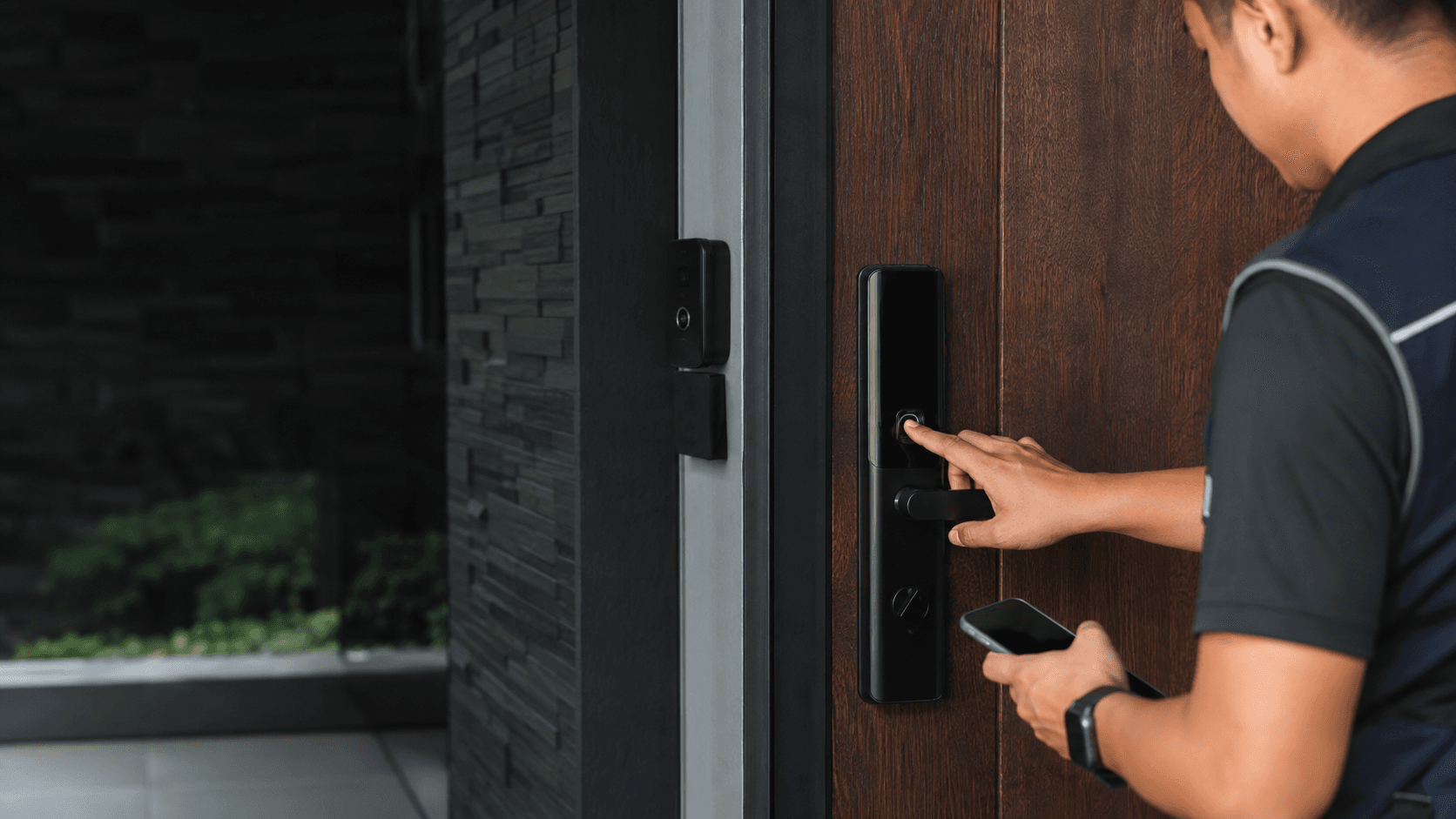
The exact model matters more than the brand name. Godrej sells several digital lock families, and the access methods, door compatibility, and warranty differ between them. A buyer in Malaysia comparing a Godrej smart lock for main door should confirm the specific model against the actual door before paying a deposit.
What A Godrej Smart Lock For Main Door Does
A main door smart lock replaces the existing handle set or deadbolt with a battery-powered unit that unlocks through credentials instead of a key alone. Godrej's own product listings describe access combinations that range from a basic two-in-one setup, using PIN and mechanical key, up to a nine-in-one setup that adds fingerprint, RFID card, Wi-Fi, NFC, smart watch, and BLE remote.
That spread is the single most useful thing to understand. A two-in-one lock and a nine-in-one lock sit at very different price points and suit very different households. More access methods mean more ways in, but also more setup, more user management, and more that can go wrong at the door.
Godrej's digital lock range is documented on its own product pages, and the company's app listing on Google Play describes remote lock control, one-time password access, and scheduled access through a mobile app. Those features are app-dependent, so the phone becomes part of the entry routine rather than an optional extra.
Door Condition And Access Methods
Most main door lock failures in Malaysia trace back to the door, not the lock. Godrej's own listings describe its smart locks as designed for wooden doors, and several models are described as main door digital locks. That wording matters because a metal gate, a glass door, or a hollow-core door may not accept the same unit.
Eyonic's own product review guidance states that smart locks work best when the door condition, user roles, and backup method are reviewed before installation. That is a practical sequence, and it applies to any brand, including Godrej.
What To Check On The Door Itself
Door thickness, existing cutout position, and whether the door closes squarely all affect whether a mortise-style lock body will seat properly. A door that has swollen, dropped, or been rehung may need adjustment before a smart lock will align reliably. Godrej's listings reference three dead bolts on several models, which means the door needs enough internal depth to house the lock body.
Alignment is the quiet problem. A lock that needs a shoulder push to engage will drain batteries faster and wear the motor sooner, regardless of brand.
Choosing Access Methods
Fingerprint access suits a household with a small, stable set of regular users. PIN access suits households that need to give temporary entry to a cleaner, a contractor, or a relative. RFID cards suit older users or anyone who prefers a physical token over a code. A mechanical key override is the fallback that keeps the door usable when everything electronic fails.
Godrej's product listings show that not every model includes every method. A buyer who needs a mechanical key override should confirm it is listed for the specific model, because a PIN-and-fingerprint-only unit leaves no physical fallback.
Installation And Handover In Malaysia
Installation is where a main door lock project either settles or keeps returning. Godrej's own store listings advertise free installation on several models, but that offer is tied to the seller and the market, and no supplied evidence confirms how it applies to a Malaysian purchase.
Eyonic's documented installation process for its security work runs through site survey, system proposal, installation, and handover. That same sequence is the sensible shape for a main door lock: someone looks at the door, confirms the model will fit, installs it, then walks the owner through user setup and backup entry before leaving.
Handover is the step buyers most often skip. It is also the step that decides whether the household can add a user, delete a departed helper's fingerprint, or get in after a flat battery without a phone call.
What Handover Should Cover
A proper handover covers adding and removing users, changing the master code, testing every access method at the door, confirming the mechanical key works, and explaining what the lock does when the battery runs low. If the lock supports app control, handover should also confirm the app is paired and the account is in the owner's name, not the installer's.
Backup Entry And Daily Reliability
Every electronic lock has a failure mode, and the honest question is what happens at the door when it arrives. Three failure paths matter. a flat battery, a lost or unpaired phone, and a network outage if the lock depends on Wi-Fi for remote features.
A mechanical key override covers the first two. It is the reason a physical key cylinder should be treated as a requirement rather than a bonus, and the reason the key should be stored somewhere other than inside the house.
Battery life is the least predictable part of any smart lock purchase. No supplied evidence verifies battery life for any Godrej model, so a buyer should treat any specific figure quoted by a seller as unverified until it appears in the manufacturer's documentation for that exact model. Usage intensity, door alignment, and how often the motor works against a stiff door all shorten the interval.
Wi-Fi and app features add convenience and add dependency. A lock that opens by app still needs a working phone, a charged battery, and in some cases a live network. The mechanical key and the PIN pad remain the parts of the system that work without any of that.
What To Confirm Before Buying
Work through these checks in order. Each one can change the model, the budget, or whether the project should proceed at all.
- Measure the door thickness and confirm the existing cutout, then match those measurements against the specific Godrej model's stated door compatibility.
- Decide which access methods the household actually needs, and confirm the chosen model lists every one of them, including a mechanical key override.
- Plan user roles in advance, including who gets permanent access, who gets temporary access, and who can add or delete users later.
- Confirm the backup entry method and store the physical key outside the home.
- Agree the installation and handover scope in writing, covering who tests each access method and who explains user management at the door.
Two commercial facts are worth confirming directly with the seller rather than assuming. First, whether the specific model is available in Malaysia through an authorised channel, since Godrej's published listings and pricing are largely India-facing. Second, what warranty applies locally, because warranty terms are market-specific and no supplied evidence confirms Malaysian warranty coverage for these locks.
For households in Sarawak, the practical question is often who will attend the door if something goes wrong. Eyonic is a security system supplier based in Sarawak that plans, supplies, and installs monitoring and ELV systems for homes, offices, shops, and industrial sites, and its product review guidance treats smart lock door access as suitable for controlled convenience when user permissions and backup entry are planned properly. Whether a specific Godrej model falls within that scope is a question for the supplier, not an assumption to make from a product listing.
Share your location, property type and required system with Eyonic on WhatsApp at +60 11-5111 7959 for the next practical step.