
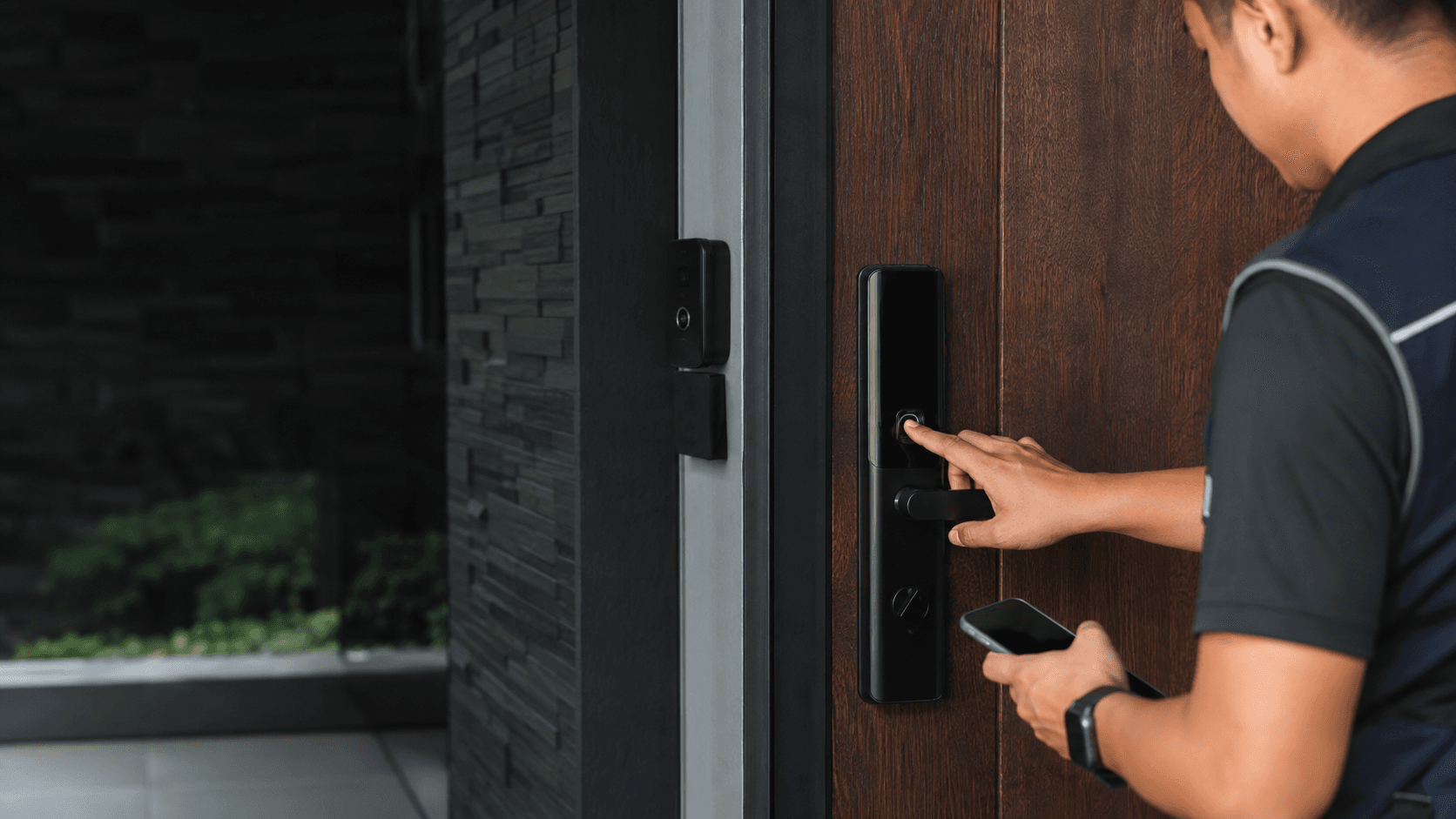
The category covers a wide spread of hardware, from a simple keypad deadbolt to a facial-recognition lock with app control. What separates a good fit from a poor one is rarely the feature list. It is the door itself, the people who need to pass through it, and what happens when the battery dies or the network drops.
Eyonic Sdn Bhd is a security system supplier in Sarawak that plans, supplies and installs CCTV and ELV systems, and its product range includes smart locks alongside Hikvision cameras. The company's own review guidance notes that smart locks work best when door condition, user roles and backup method are reviewed before installation.
High Tech Door Locks. What Matters Before You Choose
Three things decide whether a lock performs well over years of daily use: the door and frame it mounts to, the access methods people actually use, and the fallback when power or connectivity fails.
Door condition comes first. A lock body needs a solid mounting surface and correct alignment between the bolt and the strike plate. A door that already sticks, sags, or has a worn mortise will cause problems for any motorised mechanism, no matter how good the electronics are. This is why a physical check before purchase matters more than a specification comparison.
Access methods come second. Fingerprint readers suit people who want fast entry without carrying anything. Keypad codes suit shared entrances where codes can be changed when someone leaves. App and remote control suit owners who want to grant temporary access or check entry history. Most modern locks combine two or three of these, and the combination matters more than any single method.
Backup comes third. Every electronic lock needs a mechanical or external-power fallback. That may be a physical key, a 9V battery terminal, or a USB-C emergency port. The specific method varies by model, so it is worth confirming before installation rather than after a lockout.
Choosing the Right High Tech Door Locks
A short decision sequence keeps the choice grounded in the property rather than the product page.
- Confirm the door type, thickness and existing hardware, including whether the current deadbolt can be replaced or must be retained.
- List who needs entry and how often, separating permanent users from visitors, contractors and short-stay guests.
- Decide which access methods are required, such as fingerprint, keypad, card, app or remote.
- Check the power source and backup method, including how the lock behaves during a power cut.
- Confirm how the lock integrates with existing systems, such as an alarm panel, intercom or access-control setup.
- Plan installation and handover, including user enrolment, code changes and a test of every access method.
For business premises, the choice often narrows to a standalone smart lock or a wider access-control panel. Eyonic's own product review guidance describes this as a check it usually runs for business use, because a single door with a handful of users behaves very differently from a site with staff, visitors and shift changes.
What is high tech door locks?
High tech door locks are door hardware that replaces or augments a mechanical key with electronic authentication and control. Common forms include fingerprint deadbolts, keypad locks, Bluetooth and Wi-Fi connected locks, and retrofit units that sit over an existing deadbolt. The shared trait is that entry is granted by a credential rather than a cut key, and that credential can usually be added, removed or time-limited without changing the lock.
The term is broader than "smart lock" in everyday use. It covers locks that connect to a phone app, locks that work only as standalone keypads, and commercial-grade units designed for higher traffic. That breadth is why two products with the same label can differ enormously in price, installation effort and suitability.
Best Smart Locks Of 2026: Excellent Door Upgrades - CNET
Review roundups from CNET, The Verge, PCMag, SafeHome and Consumer Reports all follow a similar structure: named picks by category, pros and cons, and a testing methodology. Those pages are useful for understanding what reviewers look at, including access options, battery behaviour, platform compatibility and installation type.
They are less useful for a buyer in Sarawak, because availability, door standards and support arrangements differ by market. A lock that tops a US roundup may not be stocked locally, and installation support may not exist for it. The practical approach is to use those reviews to understand the categories, then confirm what is actually available and serviceable locally.
Practical Considerations for High Tech Door Locks
Several constraints show up repeatedly once a lock is in daily use.
Battery life depends on usage frequency, motorised bolt design and how often the lock maintains a wireless connection. Locks that stay connected to Wi-Fi generally draw more power than those that connect only when needed. A low-battery warning is standard on most models, but the warning window varies, so the backup method remains the real safeguard.
Connectivity is a second constraint. Remote control and entry history require a working network and, in many cases, a bridge or hub. Where the network is unreliable, a lock that also works offline through a keypad or fingerprint remains usable, while one that depends entirely on an app does not.
Door and frame condition is a third. Motorised locks apply force to move the bolt, and a misaligned door increases that load. On older doors, adjusting the strike plate or hinge may be necessary before the lock will operate reliably.
User management is a fourth, and it matters most on shared entrances. Codes and credentials need an owner, a process for removal when someone leaves, and a record of who holds access. Without that, the convenience of keyless entry becomes an administrative gap.
Eyonic's project work shows how these considerations play out in practice. At the Kuching Immigration Office, the focus was arrival flow, staff areas, visitor movement and dependable daily operation. For KTA Sarawak Sdn Bhd, an engineering consultancy, the requirement was a practical office setup supporting staff movement, visitor handling, tidy cabling and clearer daily site control. Both are cases where access design followed the movement of people, not the other way round.
Where high tech door locks fit well
They suit entrances where keys are inconvenient or hard to control: a family home where children arrive at different times, an office with staff and visitors, a shop with a back entrance, or a rental property where codes can be changed between guests. They also suit properties where entry needs to be logged or time-limited.
They fit less well where the door is structurally poor, where power and network are unreliable and no offline method exists, or where a single entrance must handle very high traffic volumes. In those cases, a conventional lock or a dedicated access-control system may be the more durable answer.
Making an Informed Choice About
The most reliable path is to treat the lock as part of a wider entry system rather than a standalone gadget. That means checking the door, deciding the access methods, confirming the backup, and planning who manages credentials over time.
For properties in Sarawak, local supply and installation support matter as much as the product. A lock that cannot be serviced locally becomes a liability the first time it misbehaves. Eyonic's installation process follows a site survey, system proposal, installation and handover sequence, which is the same order that suits a lock installation: confirm the door and requirements first, then supply and fit, then test and hand over every access method.
Budget expectations vary widely by model and door condition. Eyonic's published packages for related systems sit at RM 1,599 for a Hikvision CCTV package, RM 1,599 for a Hikvision alarm system, and RM 1,599 for an autogate package, each covering supply, setup and handover. Larger project work, such as the Kuching Immigration Office engagement, falls in the RM 12,000 to RM 28,000 range, while the KTA Sarawak Sdn Bhd office setup falls between RM 8,000 and RM 18,000. Lock pricing depends on the model and the door, so it is confirmed after a survey rather than quoted in advance.
Share your location, property type and required system with Eyonic on WhatsApp at +60 11-5111 7959 for the next practical step.