
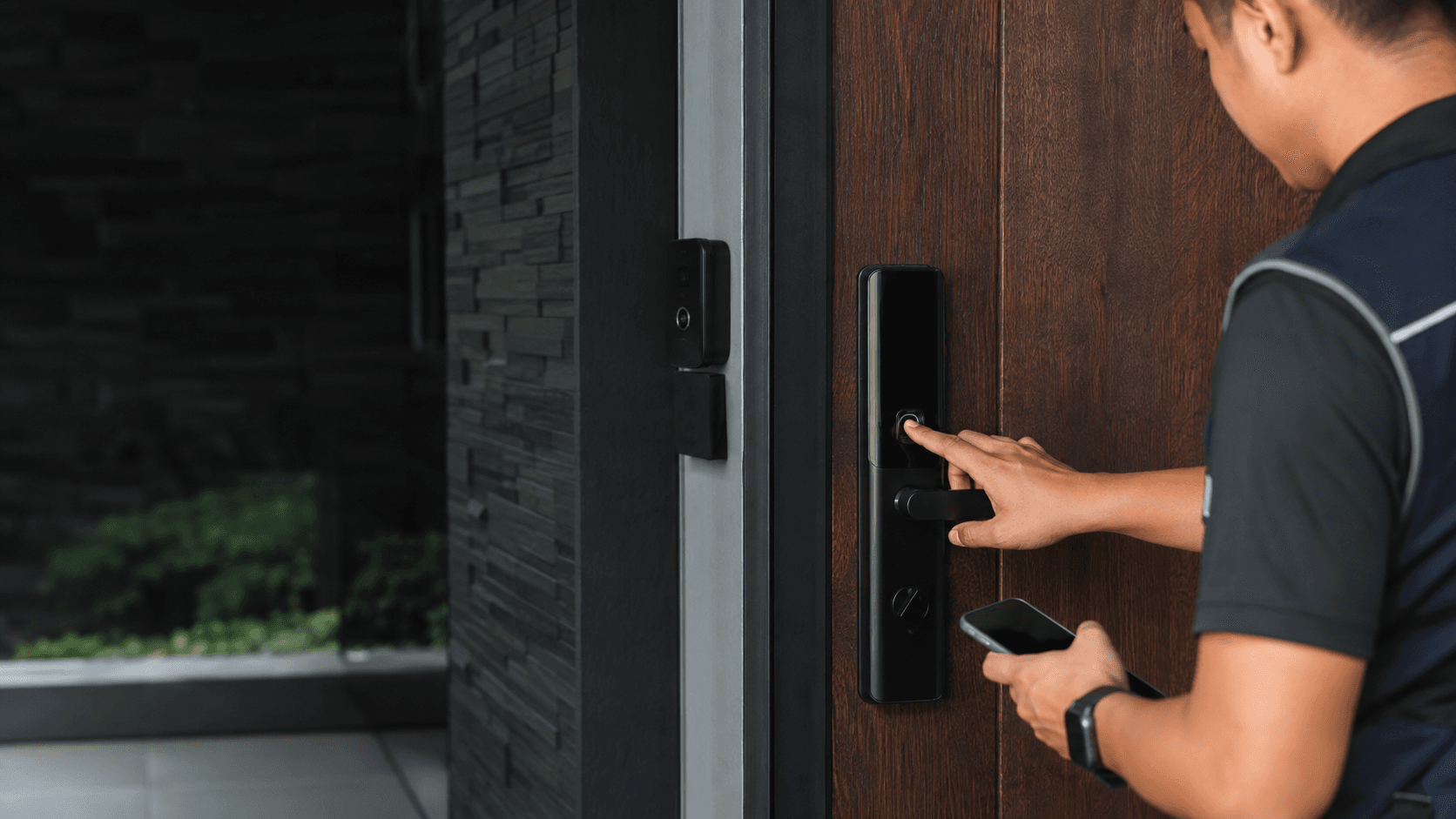
The category matters in Malaysia because most homes and offices still run on keys, and a fingerprint deadbolt changes who can enter, how entry is logged, and what happens when the reader fails. The sections below cover what the lock does, how fingerprint entry compares with keypad and keyed entry, which door and user checks come first, and how installation and handover should run.
Kwikset Fingerprint Lock. Fingerprint Entry Explained
Fingerprint entry replaces the key as the everyday credential. A capacitive or optical sensor captures the ridge pattern of a finger, converts it into a stored template, and compares a new scan against that template before the bolt retracts. The mechanical deadbolt still does the physical work; the reader only decides whether the bolt is allowed to move.
Kwikset's Halo Touch is the model family most often described as a Kwikset fingerprint lock. Public product pages describe it as a Wi-Fi enabled smart deadbolt with fingerprint access, sold in Traditional and Contemporary trim, with finishes including Satin Nickel, Matte Black and Venetian Bronze. Those are the manufacturer's own product descriptions, not local stock confirmation.
Two design points separate fingerprint entry from a keypad. First, there is no shared code to leak or guess, so a lost code is not a risk. Second, a finger cannot be handed to a visitor the way a code or key can, so temporary access has to be issued through the app or a second credential rather than passed along.
What the reader actually stores
A fingerprint lock stores templates, not photographs. The template is a mathematical summary of distinguishing ridge features, and matching happens on the device. That is why a scratched finger, wet hand or very dry skin can produce a failed read even when the enrolled finger is correct.
Where the fingerprint sits in the entry sequence
On a deadbolt, the sequence is scan, match, motor or thumb-turn release, then door open. If the scan fails, the lock falls back to whatever backup method was configured. That fallback is the single most important design decision on the whole installation, and it is covered later in this article.
What a Kwikset Fingerprint Lock Does
The lock performs four jobs. it holds the door closed, it verifies identity at the door, it records or reports entry activity depending on the model and app, and it lets an owner add or remove users without rekeying the cylinder.
Kwikset's own product material describes app-based control, remote lock management, and user access that can be limited by date, weekday and time. Support documentation also describes IFTTT integration for Kwikset smart locks, which allows scheduled actions such as auto-locking at a set time. Those are manufacturer-published capabilities; the exact feature set depends on the specific model and firmware.
For a household, the practical gain is that a domestic helper, a contractor or a short-stay guest can be given access that expires without anyone copying a key. For a small office, the gain is that the last person out can lock without carrying a key, and the owner can see whether the door was locked.
What the lock does not do is replace a full access-control system. A standalone smart lock manages one door and a small user list. It does not manage multiple doors, lift lobbies, turnstiles or staff attendance records. Eyonic's own product review notes that smart locks work best when door condition, user roles and backup method are reviewed before installation, and that for business use it usually checks whether a standalone smart lock or an access-control panel is more appropriate.
Kwikset Fingerprint Lock Compared With Keypad and Keyed Entry
All three methods secure the same door. They differ in what happens when the credential is lost, shared or forgotten.
Keyed entry is the cheapest and the most familiar. It needs no power, no app and no enrolment. Its weakness is key duplication. once a key is copied, the only remedy is rekeying or replacing the cylinder, and there is no record of who entered.
Keypad entry removes the physical key and issues a code instead. Codes can be changed in seconds and can be time-limited on most smart locks. The weakness is that codes are shared verbally, written down, and reused across properties, and a code observed over a shoulder is compromised.
Fingerprint entry removes both the key and the shared secret. Nothing can be copied, told or written down. The trade-offs are real. enrolment takes a few minutes per finger, some users have fingerprints that read poorly, and every user needs to be physically present at the door at least once to enrol.
A practical pattern is to combine methods rather than choose one. Fingerprint for daily users, a keypad code for the occasional visitor, and a physical key kept off-site for the case where the electronics fail. Kwikset's Halo Touch product pages describe keyed entry as part of the hardware, which is what makes that third layer possible.
When fingerprint entry is the wrong choice
Fingerprint entry suits a door used by a small, stable group of people. It suits poorly where dozens of people pass through daily, where users change constantly, where hands are routinely wet, oily or gloved, or where the door is exposed to direct rain and heavy sun. In those cases a keypad or a proper access-control reader with cards or fobs is usually the better fit.
Door and User Checks Before Choosing a
Most smart lock failures in Malaysia are door problems, not lock problems. A deadbolt needs a door that closes squarely, a frame that holds the strike plate firmly, and enough thickness for the bolt body. Work through these checks in order before committing to a model.
- Measure the door thickness and the existing backset, and confirm the door closes without lifting or dragging.
- Confirm the strike plate sits in solid timber or a reinforced frame, not in a hollow section or a loose filler.
- List who needs daily access, and separate daily users from occasional visitors and contractors.
- Decide the backup entry method before installation, and confirm where the physical key will be kept.
- Confirm whether the door needs Wi-Fi or app control, or whether standalone fingerprint entry is enough.
- Check the door's exposure to rain, direct sun and salt air, since the reader and keypad sit on the outside face.
- Confirm who will install the lock and who will handle support if the reader or motor fails.
The door condition check is not cosmetic. A misaligned door forces the motor to work harder on every cycle, which shortens the life of the mechanism and produces the false impression that the lock is unreliable. Fixing alignment before installation is cheaper than replacing a lock that was never the problem.
The user check matters just as much. A fingerprint lock with three enrolled users behaves very differently from one with thirty. If the door serves a shop, a clinic or an office with rotating staff, the enrolment and removal process needs an owner, not an informal arrangement where everyone knows the app password.
Backup entry is not optional
Every fingerprint lock needs a second way in. That may be a keypad code, a physical key, or a temporary app credential. The backup must be tested before the door is relied on, and the person who holds it must be reachable. A lock with no tested backup turns a flat battery into a locksmith call.
Power and connectivity expectations
Battery-powered smart locks trade convenience for maintenance. Battery life depends on how often the motor runs, how often the reader is used, and how strong the Wi-Fi signal is at the door. A weak signal makes the lock work harder to stay connected, which drains cells faster. Wi-Fi at the door should be verified, not assumed, before the lock is installed.
Installation and Handover for a
Installation is a sequence, and the handover is what makes it usable. Eyonic's published installation process for its security work runs through site survey, system proposal, installation, and handover, and the same discipline applies to a door lock: the door is assessed first, the right hardware is proposed, the unit is fitted and tested, and the users are shown how to enrol, remove and recover access.
During the survey, the points that decide the outcome are door thickness, backset, alignment, strike condition, and the position of any existing wiring or peephole. On the user side, the survey should establish how many people need access, whether any of them need time-limited access, and who will administer the app.
During installation, the deadbolt body, the exterior reader and the interior assembly are fitted, the bolt is checked for smooth travel, and the strike plate is adjusted until the door latches without force. Then the lock is paired, users are enrolled, the backup method is configured, and every credential is tested at least twice.
Handover is where most installations are won or lost. It should cover enrolling a new finger, deleting a departed user, replacing batteries, using the backup entry, and what to do when a scan fails repeatedly. If the lock is app-connected, handover should also confirm that the owner, not the installer, holds the administrator account.
For commercial doors, the decision between a standalone smart lock and a managed access-control system should be made before purchase, not after. Eyonic's review of smart lock door access notes that for business use it usually checks whether a standalone smart lock or an access-control panel is more appropriate, because a single-door lock cannot manage a building's worth of movement. Eyonic's project work for the Kuching Immigration Office, which focused on arrival flow, staff areas, visitor movement and dependable daily operation, is the kind of environment where that distinction decides the design.
Questions Buyers Ask
Does a Kwikset fingerprint lock work without Wi-Fi? Fingerprint entry and the deadbolt function are local to the lock. Wi-Fi is what enables remote control, notifications and app-based user management. A lock installed without a reliable signal still opens by fingerprint, keypad or key, but the remote features will not be dependable.
How many fingerprints can be enrolled? Capacity varies by model and is not confirmed by the evidence available here. The practical limit is usually the number of people who genuinely need daily access, not the storage ceiling.
What happens when the battery runs flat? A flat battery stops the motor, not the door. The backup method, whether a key or an external power point, is what gets the door open. This is why the backup must be tested at handover and the key kept somewhere reachable but not under the mat.
Can it be installed on an existing door? Usually yes, if the door is thick enough, the backset matches, and the frame holds the strike plate firmly. Metal doors, glass doors and doors with unusual mortise cutouts need assessment before purchase.
Is it suitable for a shop or office? For a single back door with a small, stable user group, yes. For a main entrance with high traffic, rotating staff or a need for attendance records, a managed access-control system is the better fit.
Where can it be bought and supported in Malaysia? Availability, warranty terms and authorised dealer status are not confirmed by the evidence available here, so those should be verified directly with the supplier before purchase. What can be confirmed is that installation quality and post-installation support matter more than the model name on the box.
For a door that needs to be assessed before hardware is chosen, Eyonic covers security and ELV work across Sarawak, including site survey, proposal, installation and handover. Share your location, property type and required system with Eyonic on WhatsApp at +60 11-5111 7959 for the next practical step.