
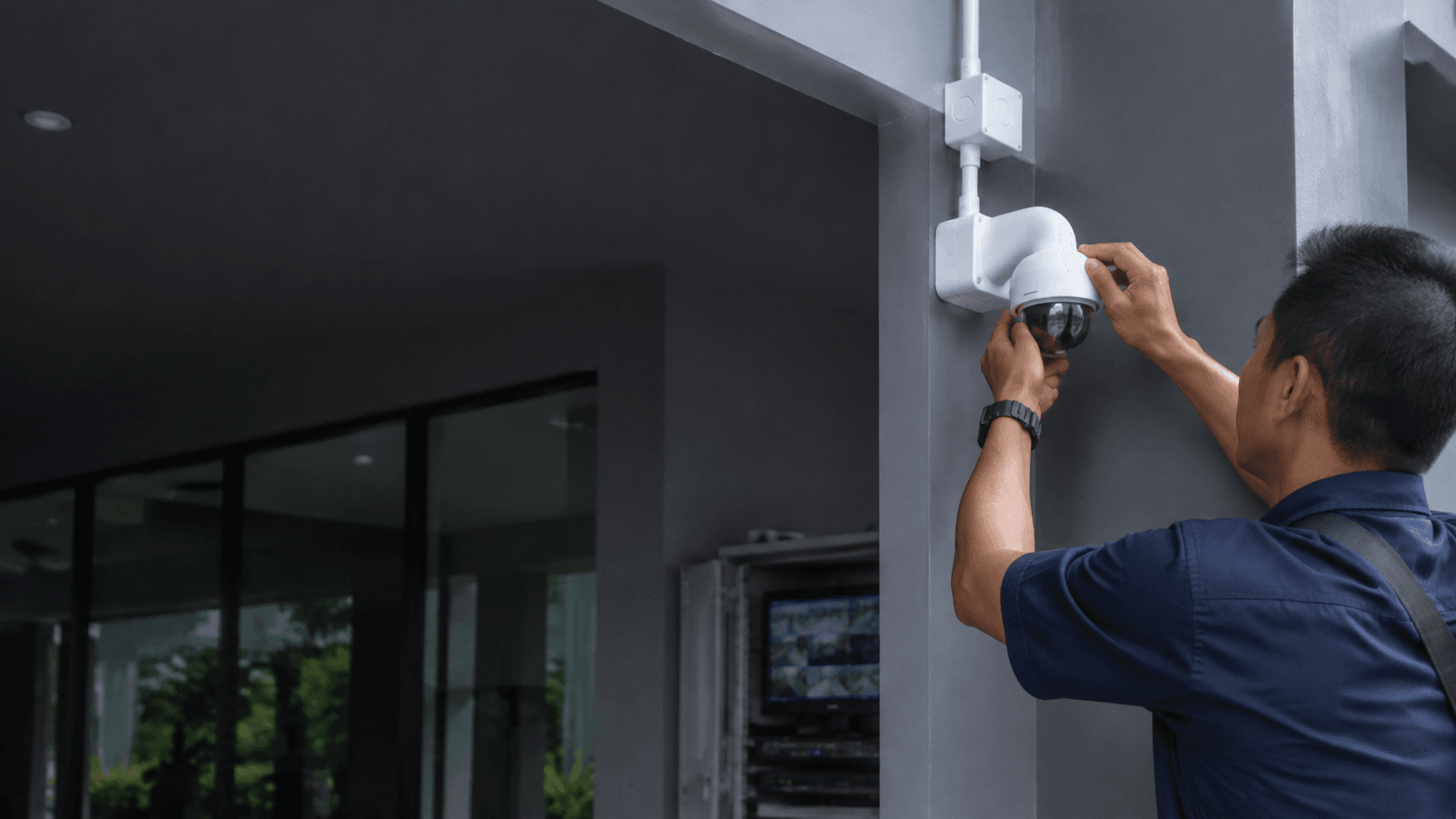
That sequence matters because the cable route, camera positions, and recorder location all have to be settled before anything is drilled or pulled. Eyonic Sdn Bhd is a security system supplier based in Sarawak that plans, supplies, and installs CCTV and ELV systems for homes, offices, shops, and industrial sites.
Wired Home Security Systems in Malaysia: What the Setup Involves
A wired setup is a physical infrastructure decision before it is a product decision. Cameras, alarm sensors, and the devices that record or report them are connected by cable rather than by wireless signal, which means the property itself shapes the plan.
Eyonic's CCTV installation process follows four stages, and the same shape applies to a hardwired security system built around cameras, an alarm panel, or both.
- Site survey. The property is inspected before any equipment is confirmed, so cable routes, mounting points, and power or recorder locations are checked against the actual building.
- System proposal. The survey findings become a proposed layout and equipment list, which is the point where camera count, recorder position, and alarm zones are agreed.
- Installation. Cabling, mounting, and configuration are carried out, including NVR setup and the recording configuration that decides how footage is stored.
- Handover. The system is tested with the user, and remote viewing is set up so the finished installation can be checked from a phone.
The order is not decorative. A proposal written before a survey is a guess about cable runs, and a handover without testing leaves the owner to discover problems alone.
Why a Fixed Cable Run Suits Some Malaysian Homes
A fixed cable run makes most sense where the property has predictable, accessible routes: a terrace house with a car porch, a shoplot with a service corridor, or a home still under renovation where conduits can be planned in advance. In those cases the cabling is a one-time job that does not depend on signal strength through walls.
It suits less well where the building is finished, wall surfaces are hard, or the owner wants to add cameras in stages across different parts of the compound. A wired plan is easier to get right at the start than to extend later, so the survey should account for positions that might be wanted in future, not only the ones needed on day one.
Eyonic's project work shows the same pattern at larger scale. For the Kuching Immigration Office, the requirement was practical support for a public office focused on arrival flow, staff areas, visitor movement, and dependable daily operation. For KTA Sarawak Sdn Bhd, an engineering consultancy site in Kuching, the need was a practical office setup supporting staff movement, visitor handling, tidy cabling, and clearer daily site control. Both are cases where cable routing and coverage were decided around how people actually move through the building.
What a Site Survey Checks Before Any Cabling Is Confirmed
The survey is where a wired plan is either made workable or made expensive. It is also the stage that decides whether the final bill matches the original expectation.
Four things get checked in practice. First, the cable path: where cable can run, whether existing conduit can be reused, and which surfaces will need to be opened. Second, camera placement: which angles cover entrances, parking, and movement routes without pointing at a neighbour's property or a public walkway. Third, lighting: Eyonic recommends checking actual lighting conditions before confirming placement for ColorVu-style cameras, because a position that looks adequate in daylight can behave differently at night. Fourth, the recorder and panel location: where the NVR or alarm panel can sit with reasonable access, ventilation, and a route back to the cameras.
Alarm zones are surveyed on the same visit when an alarm system is part of the scope. Eyonic's alarm installation service covers control panel and sensor placement, siren and zone setup, and user testing at handover, so zone boundaries are agreed before sensors are fixed to doors and windows.
Wired Home Security Systems. Cameras, Recording and Remote Viewing
The camera and recorder side of a wired system is where most of the day-to-day value sits. Cameras feed a recorder, the recorder stores footage, and remote viewing lets the owner check the property from a phone.
Eyonic's CCTV service covers camera placement, recording, and remote viewing for homes, offices, shops, and industrial sites, with NVR setup as a named part of the work. The practical decisions are how many cameras the property needs, where the recorder lives, and how much footage is kept before older recordings are overwritten.
Remote viewing is configured at handover rather than left to the owner. That matters because a system that records correctly but cannot be checked remotely is only half useful, particularly for owners who are away from the property during the day.
Where an alarm system is included, the panel, sensors, siren, and zones are set up and tested with the user before handover. Eyonic's Hikvision Alarm System package is priced at RM 1,599 and covers control panel and sensors, siren and zone setup, and user testing and handover. The Hikvision CCTV Package is also RM 1,599 and covers camera supply and setup, basic recording configuration, and mobile viewing handover. An Autogate Package at RM 1,599 covers motor recommendation, remote-control setup, and safety testing and handover.
Those figures are package prices for CCTV, alarm, and autogate work. They are not a quoted price for a specific wired home security system, because the cost of a wired installation depends on camera count, cable distance, and how much building work the route requires.
Planning Lighting and Camera Placement Around Real Conditions
Placement is the decision most likely to be regretted later, because moving a camera after cabling usually means new cable. Two constraints drive it. what the camera needs to see, and what the light is actually doing at that spot after dark.
Eyonic's guidance on ColorVu-style cameras is to check real lighting conditions before confirming placement. A position chosen from a daytime walkthrough can turn out to be lit by a porch lamp that washes out the frame, or dark enough that the camera's own illumination is doing all the work. Checking the position at night, or at least checking what lighting exists there, is a cheaper step than re-running cable.
Coverage angles matter for the same reason. A camera aimed to catch faces at an entrance is doing a different job from one covering a parking area, and a single position rarely does both well. Where the property has a gate, the autogate and camera positions interact, which is why Eyonic's autogate work includes safety testing alongside remote-control setup.
For properties that also need intercom or internet infrastructure, Eyonic supplies keyphone intercom and Starlink internet installation services in Sarawak, which can be planned alongside the security cabling rather than added afterwards.
Wired Home Security Systems. Costs, Handover and Next Steps
Cost in a wired installation is driven by scope rather than by a single list price. Camera count, cable distance, whether conduit already exists, and whether alarm zones are included all move the figure. Eyonic's published package prices start at RM 1,599 for the Hikvision CCTV Package, the Hikvision Alarm System, and the Autogate Package, each covering supply, setup, and handover for its own scope.
For larger or more complex sites, Eyonic's completed project budgets give a sense of scale. The Kuching Immigration Office project carried an approximate budget of RM 12,000 to RM 28,000, and the KTA Sarawak Sdn Bhd project an approximate budget of RM 8,000 to RM 18,000. Both were commercial premises rather than homes, so they indicate how scope affects cost rather than what a house would pay.
Handover is the stage that decides whether the system is usable. It includes testing with the user, confirming recording behaviour, and setting up remote viewing so the owner can check footage without calling anyone. Eyonic's founder, Eric Yong, has worked in the industry for more than ten years, with experience in technical installation of digital security solutions for commercial businesses in Sarawak.
One limit worth stating plainly. no monitoring, subscription, or contract terms for Malaysia are confirmed here, and no warranty or credential details are supplied. Those should be settled in writing before installation begins rather than assumed from a package description.
For a property in Sarawak, the practical next step is to share the location, property type, and required system with Eyonic on WhatsApp at +60 11-5111 7959, so the survey can be arranged before any cabling is confirmed.